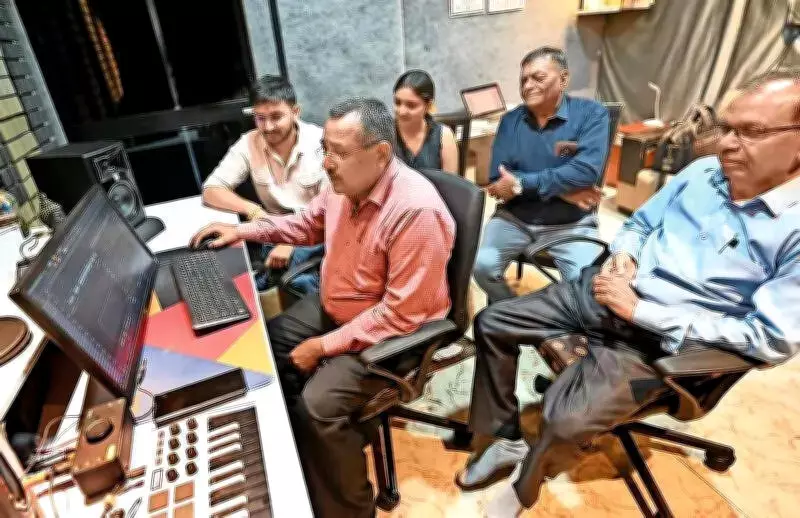
Ahmedabad: The monumental task of restoring songs from the era of India's first talkie, 'Alam Ara' (1931), demands more than just passion—it requires a finely tuned ear and deep technical knowledge of vintage recordings. Yet, Shekhar Iyer, an Ahmedabad-based management professor, admits he possessed none of these qualities initially. His 36 years of painstaking restoration work stemmed from a quiet sense of remorse. As youngsters, he and his brother often engaged in tugs-of-war over their father's massive LP record collection, each bent on claiming ownership. In the heat of those sibling fights, several LPs cracked or broke. When their father inquired, they feigned ignorance. Years later, that lingering guilt transformed into a mission: to recover, restore, and preserve the songs of a golden bygone era, weathered by time, hissing and crackling with volume variations that dull the richness of words and melody.
A Personal Mission
'Talat Mehmood was our family singer, just like one has a family doctor,' said Iyer, who has been teaching at LJ College since 1995 and working to increase the popularity of ghazals among youngsters. He said, 'It dawned upon me that the broken LPs were a huge loss not just to my family but also to lakhs of music lovers.' Iyer emphasized, 'Restoring and repairing old Hindi film songs, particularly from 1930 to 1965, is crucial for safeguarding our musical legacy. These compositions are far more than entertainment as they capture the spirit of our history and emotions through lyrical excellence. By using modern restoration technologies and encouraging collaboration among experts, we can ensure that these timeless melodies are preserved and not lost to the passage of time.'
Expert Perspectives
'During our times, recording was extremely challenging as there was a limited number of microphones even when the orchestra was large. Every instrument had its own importance even if the piece was for just 5 seconds. For example, Tum Bin Jaaun kahan from 'Pyar Ka Mausam', in which I played the mandolin, sounds sweeter after restoration. I applaud Shekhar's hard work in preserving these timeless pieces,' said Kishore Desai, 90, Bollywood mandolin player. Ravindra Kharat, guitarist and music director from Mumbai, added, 'Digital restoration methods, modern audio-editing software, and high-quality sound formats have made it easier to improve damaged recordings. These techniques help protect restored songs from further deterioration and ensure they remain accessible for years to come. With continuous advancements in technology, there are greater possibilities to preserve and revive the rich musical heritage of early Hindi cinema.'

Magic Box of Melodies
- Originally known as the phonograph, the gramophone earned its official name in the 1920s.
- Entry-level disc players start from about Rs 1 lakh and can go up to Rs 3-3.5 lakh depending on brand and features, said experts.
- The discs start below Rs 1,000 and can go above Rs 5,000 based on availability and demand.
Conserving Vintage Echoes
Decades of neglect and poor storage have damaged many old records. Restoration helps safeguard priceless songs from early Hindi cinema. It helps remove noise and enhance clarity. Missing or deteriorated parts can be reconstructed or improved.

Some Restored Classics
- Aayega aane waala, 1951, Mahal
- Ye zindagi usi ki hai, 1953, Anarkali
- Jayen to jayen kahan, 1954, Taxi Driver
- Mera joota hai japani, 1955, Shri 420
- Ae dil hai mushkil jeena yahan, 1956, CID
- Hai apna dil toh aawara, 1957, Solvah Saal
- Haal kaisa hai janab ka, 1958, Chalti Ka Naam Gaadi
- Zindagi bhar nahi bhulegi, 1960, Barsaat Ki Ek Raat
- Chaudhvin ka chaand ho, 1961, Chaudhvin Ka Chand
- Jab pyaar kiya to darna kya, Mughal-E-Azam