Waheeda Rehman Offers Thoughtful Perspective on AR Rahman's Bollywood Remarks
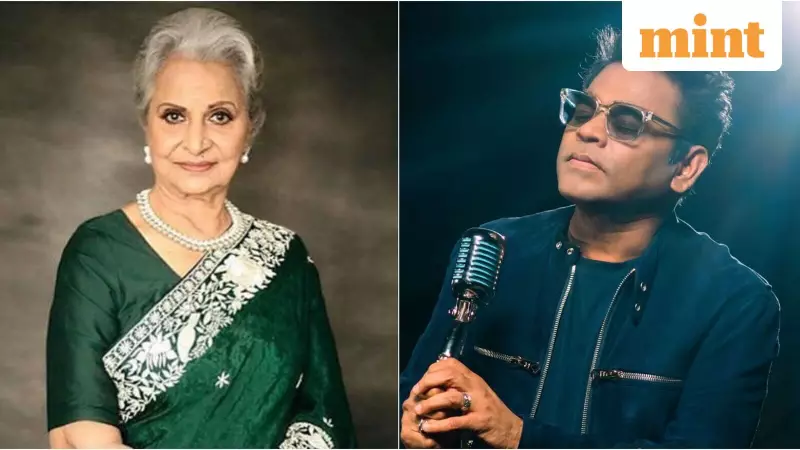
Veteran actress Waheeda Rehman has provided a measured and insightful response to recent comments made by acclaimed composer AR Rahman regarding his career experiences in the Hindi film industry. In an exclusive interview with The Indian Express, the legendary actress addressed Rahman's observations about perceived power shifts and potential communal undercurrents in Bollywood, bringing her decades of experience to bear on this sensitive topic.
A Voice of Experience and Wisdom
When asked about Rahman's remarks, the 87-year-old actress demonstrated her characteristic wisdom and perspective. "Yes, I read about it, but I try to dig less into it," she stated thoughtfully. "I prefer not to pay attention to it, when everything is going fine. These small things happen in every country."
Rehman emphasized that she believes the film industry, like many other professional fields, naturally undergoes various phases and transformations over time. She suggested that personal peace and contentment become increasingly important priorities at her stage of life. "So, what to believe and how much to believe? If it's even true or not. Why should we get involved?" she questioned rhetorically.

The veteran actress elaborated further with her characteristic philosophical approach: "At least at my age, I don't want to get involved with anything or anybody. Apni shaanti se raho, yeh mulk hai humaara, bas khush raho, that's what I can say (this is our country, live in peace and stay happy)."
Industry Evolution and Natural Fluctuations
Waheeda Rehman offered an alternative perspective on Rahman's reduced workload in recent years, suggesting it might be connected to the natural ebb and flow of opportunities within creative industries rather than any specific bias. "Kaam toh upar neeche hota hi rehta hai (work opportunities keep fluctuating)," she observed pragmatically.
The actress pointed out that age often becomes a factor in casting and hiring decisions across entertainment industries worldwide. "Ek umar ke baad, log kehte hain that bring somebody new or different (your ability to get work changes after a certain age). All this can lead to a few people staying behind," she explained with her characteristic honesty.
Rehman further elaborated on the cyclical nature of success in creative fields: "Agar vo bahut oonchaai par pahuche hain aur vo vahin rahenge, unhi ko lenge, aisa bhi toh nahi hota na. Upar neeche hota hi rehta hai, aisi koi nayi baat nahi hai (It is nothing new, this fluctuation keeps happening)."
The Context: AR Rahman's Controversial Interview
Rehman's comments come in response to a controversial interview given by AR Rahman to BBC Asian Network in mid-January. During that conversation, the Oscar-winning composer suggested that a significant shift in the Bollywood industry over the past eight years may have affected his opportunities for work. He hinted that there might be communal undercurrents involved in these changes, though he clarified that such bias was never overt or explicitly stated.
Rahman specifically mentioned that "people who are not creative" now hold decision-making power in the industry and suggested this development might represent "a communal thing also." These remarks generated substantial discussion and debate across social media platforms and within artistic circles throughout India.
Industry Reactions and Broader Implications
The music maestro's comments prompted strong reactions from numerous prominent figures within the Indian entertainment industry. Several respected artists, including lyricist Javed Akhtar, singer Shaan, and composer Shankar Mahadevan, publicly disagreed with the suggestion that religion plays a significant role in determining artistic opportunities within Bollywood.

Many industry veterans argued instead that changing audience tastes, increased competition, and commercial considerations drive hiring decisions more than any identity-based bias. Director-producer Ram Gopal Varma specifically rejected the communal bias claim, emphasizing that commercial success remains the principal factor in film industry decisions. Varma pointed to historical examples where non-Hindi artists thrived precisely because they delivered box office hits.
In response to the widespread discussion and some criticism, Rahman himself released a clarification statement last week. He emphasized that music has always represented a way for him to connect with people, celebrate diversity, and honor India's rich cultural heritage. The composer reaffirmed his love for the country and reiterated that his intention has always been to uplift, honor, and serve through his artistic work.
A Broader Conversation About Creative Industries
This exchange has sparked broader conversations about how film industries balance tradition, creativity, and commercial imperatives in an evolving landscape. Artists like singers Hariharan and Leslie Lewis have highlighted how decision-making structures within Bollywood have transformed significantly over time, with corporate influence growing at what some perceive as the expense of purely creative judgment.
These industry observers suggest that this structural shift may be affecting opportunities for both established artists and newcomers alike, creating new challenges for creative professionals across generations. Waheeda Rehman's measured response adds an important voice of experience to this complex conversation, reminding everyone that industries naturally evolve while emphasizing the importance of maintaining personal peace and perspective throughout one's career journey.