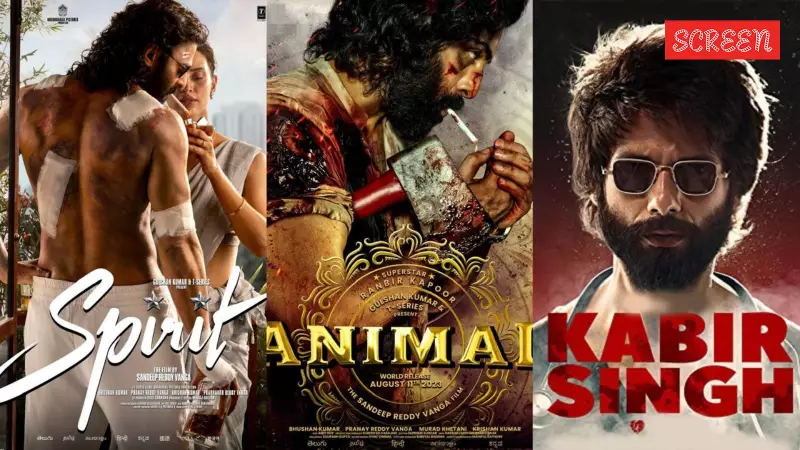
As the clock struck midnight on January 1, 2026, filmmaker Sandeep Reddy Vanga chose to ring in the new year by unveiling the first-look poster for his highly anticipated film, Spirit. Starring Prabhas and Triptii Dimri, the poster instantly reignited a long-standing and contentious conversation about the director's persistent cinematic ideology and its portrayal of gender dynamics.
The Poster: A Familiar Vanga Blueprint
The poster, true to Vanga's established visual language, places Prabhas at its centre. The actor is depicted as a wounded alpha male, with long hair, a cigarette dangling from his lips, an alcohol bottle in hand, and glasses on. His back, turned to the viewer, shows visible bruises. He faces Triptii Dimri's character, who looks at him with a shy, nurturing, and deferential gaze. The imagery drew immediate comparisons to Vanga's previous hits, Kabir Singh and Animal, leading many on social media to critique its repetitive and provocative nature.
For critics and observers, this was not merely a promotional tool but a deliberate piece of baiting rhetoric. The poster reinforces Vanga's trademark focus on the 'tortured, worship-worthy male lead,' around whom his entire cinematic universe orbits. The female lead, once again, appears relegated to the role of an emotional caretaker, present primarily to absorb the male protagonist's pain and turmoil.

Context and Controversy
The film Spirit has been trailing controversy for months. Earlier reports suggested that actor Deepika Padukone walked out of the project after her demand for an eight-hour shift schedule was allegedly not met. The film, currently in production, is said to be a cop drama with Prabhas playing a man in uniform.
The release of the poster led to a wave of sarcastic reactions online. Many netizens expressed relief that Deepika Padukone was spared from what they perceived as another Vanga-shaped sermon on hyper-masculinity. The discourse quickly shifted from mere film promotion to a critical examination of the director's recurring themes.
Branding Misogyny: A Calculated Trademark?
Following the polarising reception of Animal—a film many argued was more about retaliation than storytelling—the benefit of the doubt for Vanga has worn thin for a significant section of the audience. Analysts and journalists, like The Indian Express's Anas Arif, point out that what might have been a nuanced exploration of complex themes is often sacrificed at the altar of provocation.
At this juncture, the portrayal of submissive women and glorified, violent masculinity feels less like an accidental by-product and more like a deliberate branding exercise. Vanga has cultivated a creative identity that seems to actively antagonize criticism while championing a brittle and aggressive version of manhood. The concern raised is that in Vanga's cinema, misogyny is no longer a subtle undertone but has become a central, and perhaps marketable, selling point.
While it is often considered unfair to judge a film solely by its poster, Vanga's established track record and fondness for incendiary imagery make it difficult for the conversation to drift elsewhere. The first look of Spirit has successfully set the stage for yet another fiery debate on the responsibilities of mainstream cinema and the narratives it chooses to normalize, even before a single frame has been shot for public viewing.