
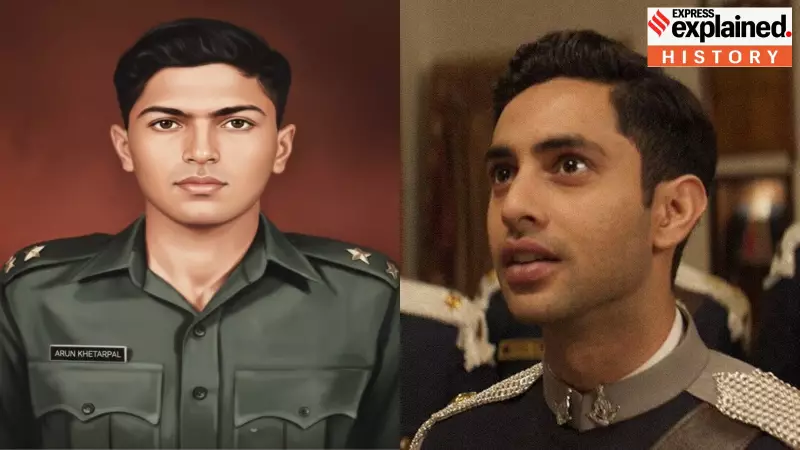
The legendary bravery of Second Lieutenant Arun Khetarpal, who became the youngest recipient of India's highest military honour, the Param Vir Chakra, is set to be immortalised on the silver screen. The upcoming film 'Ikkis', a reference to his age of martyrdom at 21, will star actor Agastya Nanda in the pivotal role. The film, scheduled for release on January 1, 2026, will focus on Khetarpal's defining moment during the fierce Battle of Basantar in the 1971 India-Pakistan War.
The Final Stand of a Hero
The Battle of Basantar, fought between December 6 and 16, 1971, on the Western Front, was a critical defensive-offensive operation for India. On the morning of December 16, with his tank, Famagusta, engulfed in flames and himself seriously injured, the young officer was ordered to abandon his post. His defiant and now-iconic reply sealed his place in history: "No, Sir, I will not abandon my tank. My main gun is still working and I will get these bas****s."
True to his word, the 21-year-old, who had been in service for only six months, engaged the enemy one last time. He destroyed another Pakistani Patton tank before his own tank suffered a second, fatal hit. 2nd Lt Arun Khetarpal died on the battlefield, but his actions prevented a Pakistani breakthrough, a valour for which he was posthumously awarded the Param Vir Chakra.
Strategic Importance of the Battle of Basantar
While the 1971 war is celebrated for the liberation of Bangladesh, the Western Front was equally crucial. Pakistani strategy hinged on making territorial gains in the west to offset losses in the east. The Shakargarh Bulge, a slice of Pakistani territory jutting into India between the Ravi and Chenab rivers, was a key vulnerability. Its capture could threaten the vital NH 44 connecting Jammu and Kashmir to the rest of India.
In a masterstroke, Indian forces under Maj Gen W A G Pinto launched a surprise offensive into the Bulge on December 6. Over twelve days of intense combat, Indian troops crossed the heavily mined Basantar river under fire, repelled fierce armoured counter-attacks, and captured nearly 500 square kilometres of Pakistani territory. The battle ended with Indian forces at the doorstep of Sialkot, marking a humiliating defeat for Pakistan, as later noted by the Hamoodur Rahman Commission.
The Poona Horse and Khetarpal's Defining Action
The storied Poona Horse (17th Horse) regiment was tasked with establishing a bridgehead across the Basantar river on December 15. After a daring advance through minefields and enemy fire, they secured their position by dawn on December 16. It was here that the regiment faced a massive Pakistani counterattack.
2nd Lt Khetarpal, commanding a Centurion tank, was at the forefront of the defence. Displaying exceptional courage and skill, he first chased down and destroyed retreating enemy tanks. Later, when a squadron of a dozen Pakistani tanks attacked a sector held by just three Indian tanks, Khetarpal personally accounted for four enemy tanks. It was during this frenzied engagement that his tank was hit and set ablaze, leading to his final, fateful decision.
His PVC citation credits him with saving the day, noting that "not one enemy tank got through" due to his actions. The bridgehead held, allowing Indian forces to press their advantage deep into Pakistani territory.
A Legacy Cast in Bronze and Celluloid
The legacy of 2nd Lt Arun Khetarpal is permanently etched into India's military institutions. The parade ground at the National Defence Academy is named Khetarpal Ground, and the Indian Military Academy has an auditorium and a main gate bearing his name. His restored tank, Famagusta Jx 202, is preserved at the Armoured Corps Centre and School in Ahmednagar.
Now, through Maddock Films' 'Ikkis', a new generation will witness the story of this unparalleled hero. The film promises to bring to life not just the ferocity of the Battle of Basantar, but also the indomitable spirit of a young officer whose last act defined the highest ideals of courage and sacrifice for the nation.