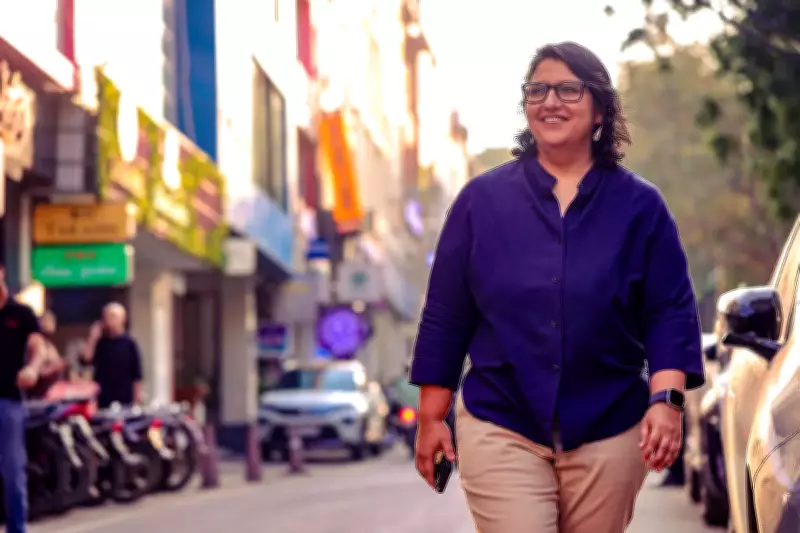
Aditi Anand: The Producer Fighting for Cinema's Soul in a Changing Industry
When Bison: Kaalamaadan finally premiered in Delhi several months ago, producer Aditi Anand found herself navigating the familiar turbulence of modern filmmaking: unpredictable schedules, exhibition hurdles, and the perpetual uncertainty of audience reception. The screening arrived later than anticipated, but Anand viewed this delay as strangely appropriate. "I actually don't mind that it happened this way," she reflected with a half-smile in the theater lobby. "It reflects the reality we're in. Everything is over-dated, over-scheduled, over-stretched. That's kind of the industry right now."
From Army Dreams to Film Realities
Born and raised in Delhi, Anand's childhood aspirations were far from the silver screen. She initially dreamed of joining the Indian Army, but when she discovered women were only admitted through technical corps—a path incompatible with her disinterest in science—that door closed. Next came a fascination with war journalism, though the relatively peaceful 1990s offered limited opportunities in that field.
What truly shaped her perspective were college professors who introduced her to historical and political narratives absent from mainstream culture. This exposure to "the stories missing from the record" planted early seeds for her future career. Before film school, Anand gained crucial experience working with her father in agricultural exports, particularly in Myanmar, where she mastered trade negotiations and global business dynamics.

An Accidental Journey into Filmmaking
"I stumbled into fiction almost by accident," Anand admits about her entry into cinema. Her professional path began at the Times Group before moving to Walkwater Media (then part of Adlabs), where she earned her first producer credit on Tere Bin Laden. Later at UTV Motion Pictures, she contributed to critically acclaimed films like No One Killed Jessica, Paan Singh Tomar, and Chillar Party—projects blending popular appeal with substantial political and emotional depth.
She founded Little Red Car Films (LRCF), a production company with dual focus: service production for international nonfiction projects (including Netflix and YouTube series like Unreported World and Cooked) alongside independent features. Her most ambitious venture was The Extraordinary Journey of the Fakir, starring Dhanush alongside international actors Erin Moriarty, Bérénice Bejo, and Barkhad Abdi. While successful internationally, the film struggled domestically. "I was the real Fakir of that journey," Anand often remarks about the experience that both "broke her heart" and "hardened her spine."
Political Awakening and Tamil Cinema
As creative spaces narrowed amid increasing censorship, Anand gravitated toward cultural activism through projects like India, My Valentine. Her perspective transformed after watching Pa. Ranjith's film Kaala. "Kaala restored my faith in cinema as a political force," she shares. Deeply moved by the film's pre-climax Rajinikanth mask sequence—which she describes as "a five-minute distillation of Indian political history"—she reached out to Ranjith, who responded within twenty minutes.
Their collaboration led to co-founding Neelam Studios, a sister company to Ranjith's Neelam Productions and Anand's LRCF. Their Tamil film slate—including Writer, J Baby, and Akuva—emphasizes narrative sovereignty and community storytelling. December 7, 2020, marked a pivotal moment: production began on Writer (delayed by the pandemic) and Anand adopted her son with partner Susan. "Tamil cinema became my real film school," she says, acknowledging how it tested her politics, patience, and resilience as both an outsider and a woman in a male-dominated industry.

The Crisis in Theatrical Exhibition
The Delhi screening of Bison: Kaalamaadan occurred against a troubling industry backdrop. "We've dropped below 8,000 screens nationally," Anand reveals, "and a huge chunk are in Andhra Pradesh and Telangana. That's why Telugu cinema is having a renaissance. They still have density." She contrasts this with North India, where Hindi films might release on 1,000–1,500 screens across vast geography without "buzz density" for effective word-of-mouth.
Revenue streams have dramatically contracted. Music rights have nearly vanished, satellite television has shrunk, leaving only theatrical releases and OTT platforms. "You can't price fans out of theatres," Anand insists. "A blue-collar worker can't take a family of four to a multiplex. That's killing the culture." She champions single-screen theaters for preserving cinema's "festival feel"—the energy of front stalls that multiplexes cannot replicate.
Redefining Entertainment and Global Vision
Anand argues that Hindi cinema has misunderstood entertainment itself. "Entertaining doesn't mean dumbing down the audience," she asserts. "People want to feel something." She worries the industry has stripped cinema of its magic while emphasizing its enduring power: "There is nothing more powerful in this country than cinema. Nothing. It can change how people think. How they feel."
Her vision extends globally. "Indian films are already global. Indians are everywhere. Europe isn't the whole world anymore. Africa, Southeast Asia, the Middle East—these are massive untapped markets." She points to Korean cinema's success, achieved through state and studio support for auteurs, as a model India should emulate by backing independent voices with "real money and marketing muscle."
Beyond the Edit Room: Advocacy and Family
Anand's work transcends film production. She has co-founded or led initiatives including To Dharavi With Love and Rabies Mukt Bharat, contributed to Mission Oxygen, and—with partner Susan—was among petitioners in India's Equal Marriage case before the Supreme Court. Personally, she raises her son in a large, chaotic joint family, with dogs (especially her beloved Bombil) ever-present. Her bond with animals informs advocacy for humane stray animal policies nationwide.
The Producer's Burden and Unwavering Faith
Anand describes producing as stewardship rather than status. "When a film works, it's the director and actor. When it fails, it's the producer," she notes, admitting that losing investor money is devastating. Yet she persists, driven by conviction in cinema's cultural significance. "That's why we must fight for theatres. If we don't respect our fans, they'll leave. And when they leave, cinema becomes just content. Not culture."
Her latest project, Bison: Kaalamaadan—a Tamil-language sports drama directed by Mari Selvaraj—has been recognized among Letterboxd's top 10 action films of 2025. The film's success as a socio-political blockbuster demonstrates audience hunger for stories interrogating power while remaining emotionally accessible. For Anand, this achievement feels "like touching the sky"—a testament to cinema's enduring power to entertain, challenge, and transform.