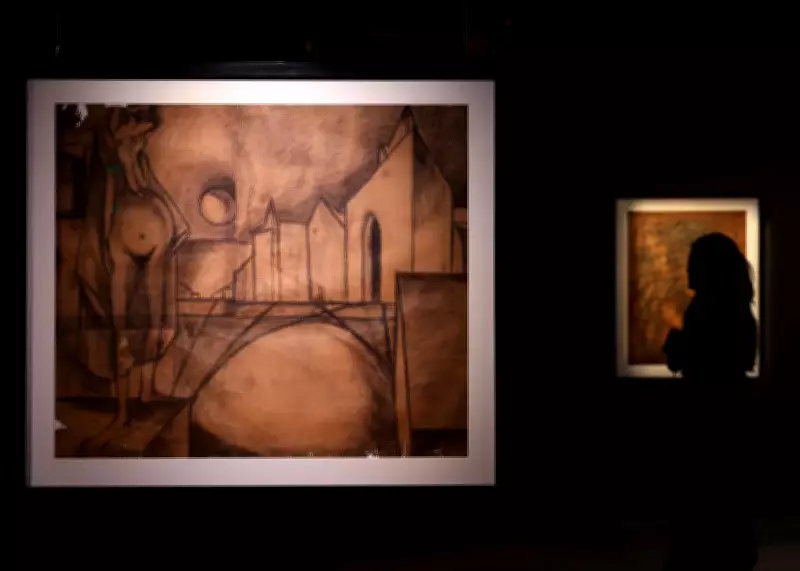
Bringing into focus a compelling body of work by Abdul Aziz Raiba from the 1950s and 1960s, Thapar Gallery presents a significant exhibition celebrating the artistic legacy of this master artist. The exhibition offers a rare glimpse into a pivotal phase of Indian modernism.
Exhibition Details
Titled Master Artist A. A. Raiba: A Unilateral Eclectic, the exhibition presents a nuanced exploration of Raiba's practice, underscoring his distinctive visual language shaped by a confluence of artistic traditions. As noted by historian Shivaji K Panikkar, “The art of Master Raiba emblematically reveals this historical context of the multistranded synthesis within the Indian modernism where the unique fusion of Indo-Islamic traditions, European academic naturalism, the Bengal School and European modernity lent an amazing richness and depth.”
The exhibition, which is on view till June 21, foregrounds Raiba's remarkable versatility across mediums. Over a prolific career spanning six decades, he worked across murals, paintings on jute, elaborate drawings, reverse glass paintings, serigraphs, and calligraphy in both Urdu and English, alongside an extensive body of sketches. This diverse practice reflects both technical mastery and a sustained engagement with form. As Panikkar observes, “Raiba quickly denied any group association, and asserted his independence while opting to remain a solitary loner.”

Artistic Style and Techniques
A defining feature of Raiba's work is his command of line. His drawings and paintings are marked by strong, deliberate outlines that structure his imagery with clarity and precision. Particularly in his narrative compositions, these contours become central to his visual language, giving his works a distinct identity. The stylized and simplified forms recall the linear elegance of miniature traditions, while his angular treatment of line situates the work within a modernist framework.
The exhibition also includes a series of landscape sketches from Raiba's Kashmir sojourn between 1957 and 1959. These works capture fleeting impressions of the natural world with immediacy and sensitivity, offering a quieter counterpoint to his more structured compositions.
Use of Grids
Another important aspect of his practice is the use of grids as an underlying framework. As noted by Pannikar, “Raiba's use of grids in the drawings are exemplary since he used the gridded layouts to meticulously plan compositions on paper and then transferred them on to the surface prepared for painting to ensure precise proportions from small sketches to large surfaces of the murals/paintings.”
Curator's Statement
Speaking about the exhibition, Ashish Thapar, Director, Thapar Gallery said, “AA Raiba's work holds a quiet yet powerful place within Indian modernism. What makes his practice compelling is the seamless synthesis of diverse traditions alongside a deeply individual approach to line and form. This exhibition brings that legacy into focus while allowing contemporary audiences to engage with its enduring relevance.”
The exhibition is a must-see for art enthusiasts and offers a deep dive into the works of a master artist who remained independent and unique in his approach.