Einstein's Nobel Prize: The Surprising Omission of Relativity
When students learn about Albert Einstein's Nobel Prize, they often assume it was awarded for his groundbreaking theory of relativity. This assumption seems natural, given how relativity redefined our understanding of space, time, and gravity, cementing Einstein's reputation as a genius. However, this common belief is incorrect.
The Official Citation: A Deliberate Choice
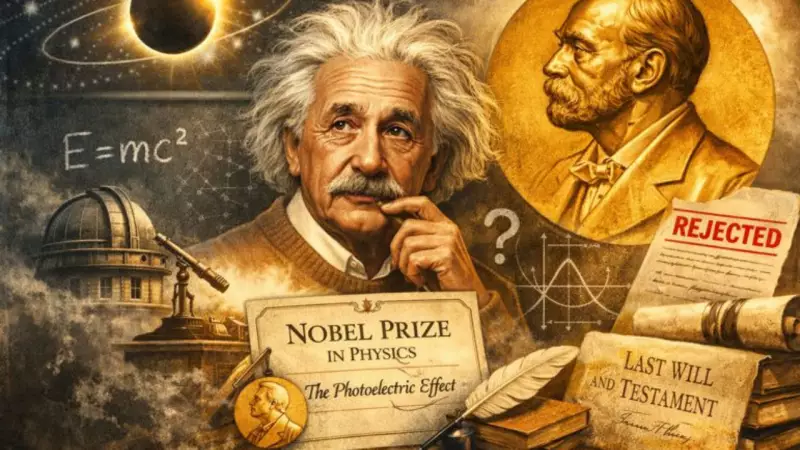
Einstein received the Nobel Prize in Physics for 1921, though it was announced in 1922. The Nobel citation carefully avoided any mention of relativity. Instead, it credited Einstein especially for his discovery of the law of the photoelectric effect. This omission was not accidental; it reflected deep institutional hesitation about how to judge scientific revolutions.
Nobel's Rules and the Burden of Proof
The foundation of this decision lies in Alfred Nobel's will, which instructed that prizes be awarded for discoveries conferring the greatest benefit to humankind. Over time, Nobel committees interpreted this cautiously, preferring work that was:

- Experimentally verified
- Demonstrable in practical terms
- Defensible before skeptical peers
Einstein's theories of special relativity (1905) and general relativity (1915) were radical reconceptions that relied heavily on mathematics and thought experiments, rather than traditional laboratory apparatus. To many committee members, steeped in experimental traditions, this made relativity conceptually dazzling but institutionally uncomfortable.
The 1919 Eclipse and Lingering Doubts
In 1919, expeditions led by Arthur Eddington measured the bending of starlight during a solar eclipse, confirming a key prediction of general relativity. This made headlines worldwide and turned Einstein into an international celebrity overnight. However, within the Nobel system, enthusiasm did not translate into consensus. Some physicists questioned the precision of the measurements, while others argued that the confirmation depended too much on interpretation rather than repeatable experimental control. Eclipse observations were rare events, not routine laboratory tests, leaving relativity in a gray area for institutional acceptance.
The Compromise of 1921
By 1921, Einstein had been nominated multiple times, but the Nobel Committee and the Royal Swedish Academy of Sciences made an unusual decision: no Physics Prize was awarded that year, with it formally reserved due to unresolved disagreements. This was not a rebuke of Einstein but a sign of caution. Awarding the prize for relativity would have required endorsing a theoretical revolution that some influential evaluators still doubted.
A solution emerged to honor Einstein without risk. His work on the photoelectric effect, published in 1905, was experimentally confirmed and foundational to emerging technologies like light sensors and early electronics. It was measurable, repeatable, and aligned with Nobel's mandate, making it a defensible choice for the committee.
Einstein's Quiet Rebuttal
The final irony came in 1923 when Einstein delivered his Nobel lecture. Instead of speaking about the photoelectric effect, he focused on relativity. Without protest or confrontation, he reclaimed the intellectual center of his work, subtly redrawing the boundaries set by the committee on paper.
Broader Lessons from This Episode
This story is not one of neglect or injustice but about how institutions respond to ideas that move faster than consensus. The Nobel Committee did not deny Einstein's importance; it hesitated to canonize a theory before it felt settled. History, however, was less cautious. Relativity became foundational to modern physics, influencing everything from satellite technology to cosmology.
The deeper lesson for students is that scientific truth does not always receive instant institutional endorsement. It negotiates its way into acceptance through evidence, debate, resistance, and time. Sometimes, delays in recognition say more about institutional processes than about the ideas themselves. Einstein received his Nobel Prize, but relativity achieved something else entirely: permanence, which may be the more enduring award in the long run.