Harvard University Extends Historic Invitation to Bengali Poet Subodh Sarkar
In a significant cultural milestone, Harvard University has invited eminent contemporary Bengali poet Subodh Sarkar to deliver a special lecture. The event, organized to commemorate the centennial birth anniversary of legendary American poet Allen Ginsberg, focuses on exploring India's profound influence within Ginsberg's poetic works.
A Legacy Connecting Harvard and Bengali Literary Giants
This invitation continues Harvard's longstanding tradition of engaging with Bengal's literary luminaries, a connection famously established when Nobel laureate Rabindranath Tagore delivered lectures at the prestigious institution in 1913 and 1921. Sarkar, currently residing at Harvard for this occasion, described the invitation as "a landmark moment for contemporary Bengali poetry."
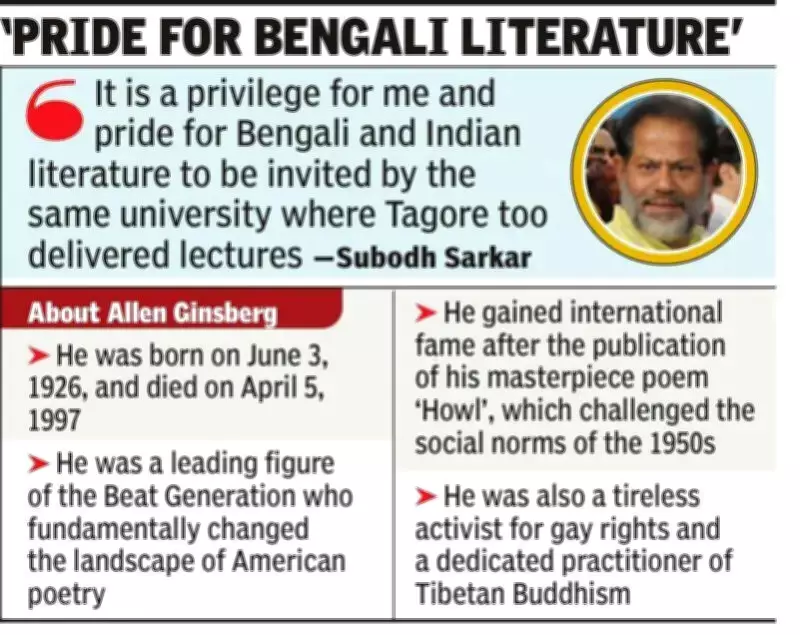
The event was collaboratively hosted by Harvard professor Sugata Bose, professor Spencer Lee-Lenfield, and the Harvard University Asia Centre. "It is both a privilege for me personally and a source of immense pride for Bengali and Indian literature to receive an invitation from the same university where Tagore once lectured," Sarkar emphasized during his address.

Recollecting a Transformative Meeting with Ginsberg
Sarkar shared poignant memories of his initial encounter with Allen Ginsberg approximately thirty-five years ago in New York City. "In 1992, I traveled to New York specifically to meet Allen and conduct an interview for my research book," Sarkar recalled. "During our conversation, he expressed genuine admiration for Bengali poetry, describing it as 'deep and good.' He particularly mentioned being deeply moved by the Shakti-Sunil generation of poets."
Sarkar characterized Ginsberg as "a revolutionary American poet and the chief exponent of the Beat Generation movement in American poetry who essentially dropped a bomb on the White House through his seminal collection 'Howl'." This groundbreaking work faced significant controversy when police and customs officials seized copies in 1956, leading to a highly publicized obscenity trial the following year that challenged societal norms regarding literary expression and sexuality.
Ginsberg's Deep Spiritual and Poetic Connection with India
"I remember Ginsberg explaining how that obscenity trial ultimately contributed to changing American laws regarding what constitutes obscenity," Sarkar noted. The poet further elaborated on Ginsberg's subsequent spiritual journey to India, where he sought deeper meaning and enlightenment.
"After being told in Benaras that the true guru resides within one's own heart, Ginsberg traveled to Birbhum with Bengali poets Shakti Chattopadhyay and Sunil Gangopadhyay," Sarkar explained. "This experience proved transformative, inspiring Ginsberg to embrace elements of baul poetry after studying Lalan Fakir's works and meeting Purna Das Baul. He later brought Purna Das Baul to New York to perform alongside Bob Dylan, demonstrating how deeply Indian culture permeated his artistic vision."
A Centennial Celebration of Cross-Cultural Literary Exchange
For Ginsberg's centenary year, Harvard specifically sought an Indian poet to illuminate these rich cultural connections. "I have been asked to read my original Bengali poetry for one hour alongside English translations," Sarkar revealed. The translations have been meticulously prepared by David Lee Morgan and Birbhum-based scholar Matralina Pati, a PhD candidate from Bankura.
"This endorsement from Harvard University holds tremendous significance," Sarkar concluded. "It recognizes and validates Bengal's enduring connection with and contribution to American literature and culture, creating a meaningful dialogue between two rich poetic traditions that continues to resonate across continents and generations."