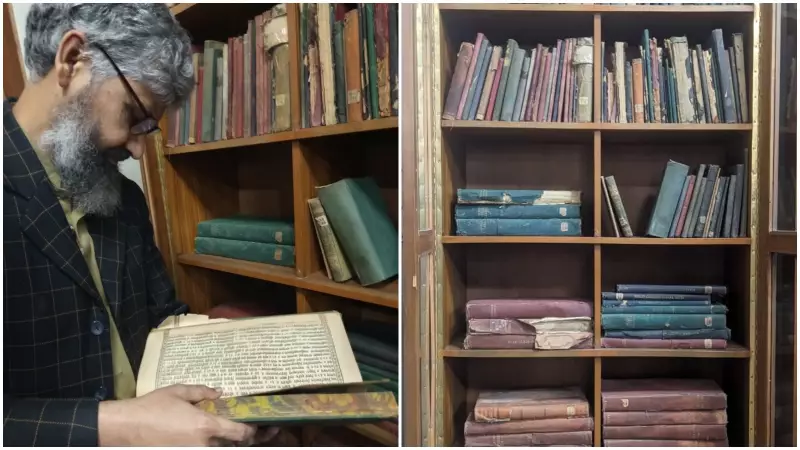
In a quiet but significant academic revival, the classical language of Sanskrit is making a return to Pakistani classrooms after a gap of more than seven decades. This historic development, spearheaded by the passion of a single professor, marks the first known instance of Sanskrit being formally taught in the country since the Partition of 1947.
A Discovery in the Dust
The journey began with a simple discovery in a Lahore library. Shahid Rasheed, an associate professor of Sociology at Forman Christian College, recently stumbled upon two full shelves of Sanskrit books at the library of MAO College in Lahore. The only thing he disturbed was the dust. This find was not his first; he has previously uncovered Sanskrit manuscripts in the Hindi Department library at Punjab University's old campus and a rich Hindi-Sanskrit collection at the Dayal Singh Library.
Rasheed's personal passion for Sanskrit blossomed through dedicated self-study, guided remotely by international scholars like Professor McMus Taylor of the Australian National University and Antonia Rupel, author of the Cambridge Introduction to Sanskrit. He maintained his connection to the language through online courses and textbooks such as 'Joy of Sanskrit'.

From Workshop to University Course
Rasheed's efforts, conducted without stirring language debates, bore fruit at one of Pakistan's most prestigious institutions. Following a Devanagari script workshop he conducted with scholar Ali Usman Qasmi at the Gurmani Center of Languages and Literature, the Lahore University of Management Sciences (LUMS) introduced a formal four-credit course in Sanskrit.
The course, open to any LUMS student regardless of their major—from computer science to biology—has already attracted eight students in its debut semester. This initiative represents a bridge to a pre-Partition academic tradition, as MAO College itself was originally located in Amritsar before moving to Lahore after 1947, occupying the building that once housed the Sanatana Dharma College.
Catalyzing a Broader Revival
Encouraged by the success at LUMS, efforts are now underway to revive Sanskrit learning at other institutions. At Punjab University's Hindi Department, Professor Ramesh Kumar, who was introduced to the language by Rasheed, is hoping to restart short courses. Punjab University, established in 1882, once offered courses in Arabic, Persian, Sanskrit, and Gurmukhi Punjabi, though only Arabic and Persian continued after Partition.
Professor Kumar recently conducted a three-to-four-month introductory course focusing on the Devanagari script, basic pronouns, grammar, and singular/plural forms. The pilot course, which taught basics like "how to read Ram as Ramam or Ramaha," attracted three students, signaling a nascent interest.
For Shahid Rasheed, this is just the beginning of a long journey. He aims to eventually catalog and preserve the Sanskrit manuscripts he has found. "I still consider myself a beginner in Sanskrit because the language is a complete ocean," he says, already looking ahead to tackling the complexities of Vedic Sanskrit. His quiet dedication is ensuring that a shared cultural and linguistic heritage, long confined to dusty shelves, finds a new voice in Pakistan's educational landscape.