Rajasthan High Court Upholds Denial of NEET-PG Quota Benefits to Out-of-State Candidates
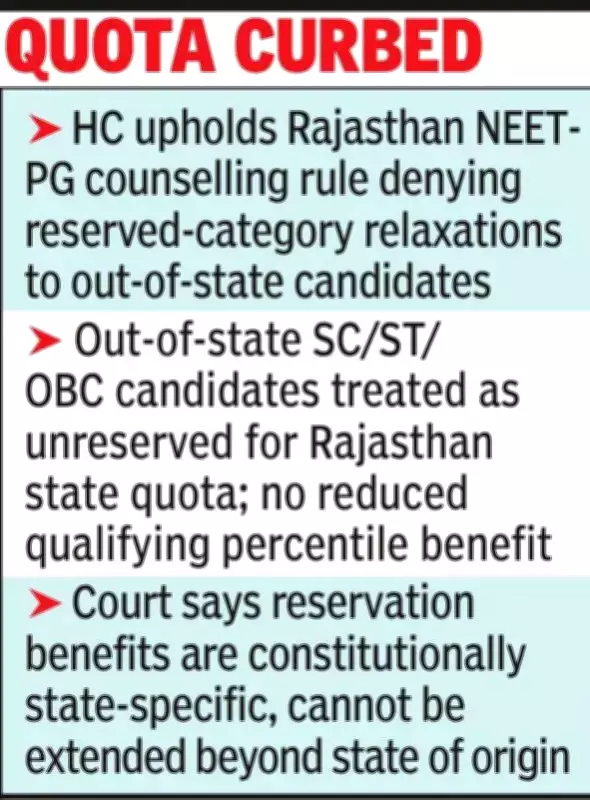
The Jodhpur High Court has delivered a significant ruling that upholds the denial of quota benefits to candidates from reserved categories who hail from other states during the NEET-PG counselling process for Rajasthan. This decision reinforces the constitutional principle that such reservation benefits are strictly confined to state-specific categories, setting a clear precedent for medical admissions in the region.
Court's Ruling on Constitutional Limitations
On Monday, the single bench of Justice Sanjeet Purohit dismissed a writ petition filed by the Federation of Private Medical and Dental College of Rajasthan. The petition sought to quash the counselling board's decision from February 18, which treated reserved category candidates from other states as unreserved candidates. This classification effectively excluded them from the benefits of a reduced qualifying percentile required for admission to postgraduate medical courses in Rajasthan.
The court emphasized that the constitutional framework for reservations is designed to address historical and social disadvantages within specific state boundaries. By upholding the counselling board's decision, the judiciary has clarified that quota benefits cannot be extended arbitrarily across state lines, ensuring that the intent of affirmative action is preserved for local beneficiaries.

Implications for Medical Admissions
This ruling has profound implications for the NEET-PG counselling process in Rajasthan. Candidates from reserved categories in other states will now be considered under the unreserved category, meaning they must meet the standard qualifying percentile without any concessions. This decision aims to maintain fairness and prevent the dilution of reservation benefits intended for Rajasthan's own disadvantaged groups.
The Federation of Private Medical and Dental College of Rajasthan argued that the exclusion was discriminatory, but the court found that the counselling board's approach aligns with constitutional mandates. By treating out-of-state reserved candidates as unreserved, the board ensures that state-specific quotas are not overridden by external applicants, thereby protecting the rights of local candidates.
Broader Context and Future Considerations
This case highlights the ongoing complexities in India's reservation system, particularly in competitive exams like NEET-PG. As medical education remains a highly sought-after field, such rulings help define the boundaries of quota benefits, preventing misuse and ensuring that reservations serve their intended purpose. The decision may influence similar cases in other states, prompting a reevaluation of how reserved categories are applied in national-level admissions.
Moving forward, candidates and institutions must navigate these legal frameworks carefully. The Rajasthan High Court's stance underscores the importance of adhering to state-specific guidelines in counselling processes, reinforcing the need for clarity and consistency in implementing reservation policies across India's diverse educational landscape.