UPSC Essentials Daily Quiz: Environment and Geography MCQs for Week 147
Are you actively preparing for the UPSC Civil Services Examination Prelims 2026? This comprehensive subject-wise quiz on Environment and Geography is designed to help you assess your current preparation level and revise crucial static topics from the syllabus. Written by Nitendra Pal Singh, this 9-minute read offers valuable practice through multiple-choice questions that test factual knowledge and conceptual understanding.
Enhance Your UPSC Preparation with Targeted Revision
The UPSC Essentials initiative brings you structured quizzes that focus on important static portions of the syllabus. Today's quiz specifically covers Environment and Geography, featuring questions on diverse topics including volcanic activity, animal adaptations, historical trade routes, atmospheric phenomena, and mountain geography. Regular practice with such quizzes can significantly improve your ability to handle elimination-based MCQs and tricky factual statements commonly encountered in the examination.
Question 1: Understanding Bactrian Camels
With reference to Bactrian camels, consider the following statements:
- These are double-humped camels.
- These are native to the high-altitude cold desert of Ladakh.
- They can swim over long distances and feed on mangroves.
- They are employed for logistics and patrol duties in the Siachen region.
How many of the statements given above are correct?
- (a) Only one
- (b) Only two
- (c) Only three
- (d) All four
Relevance: This question evaluates knowledge of unique animal adaptations and regional breeds found in India. It helps distinguish between species inhabiting desert, cold-desert, and coastal ecosystems—a common UPSC strategy for framing tricky factual statements in elimination-based MCQs.
Explanation: The Indian Army's Remount and Veterinary Corps (RVC) traditionally features dog squads in Republic Day parades. However, recent parades have included other animals. Bactrian camels now lead contingents, having been inducted for animal transport in Ladakh's cold deserts. Adapted to extreme cold and altitudes exceeding 15,000 feet, these camels can carry loads up to 250 kilograms and navigate steep gradients and sandy terrain, supporting logistics and mounted patrolling along the Line of Actual Control (LAC).
Statement 1 is correct: Bactrian camels are indeed double-humped and found exclusively in Ladakh's high-altitude cold desert. Statement 2 is incorrect: Their native habitat is Central Asia, including Mongolia, China, and Kazakhstan. Statement 3 is incorrect: While Bactrian camels can swim, they do not naturally swim long distances nor feed on mangroves—these traits characterize Kharai camels. Statement 4 is correct: They are employed for logistics and patrol duties in high Himalayan regions like Siachen. Therefore, only two statements are correct, making option (b) the right answer.
Question 2: Global Volcanic Geography
With reference to volcanoes, consider the following pairs:
- Mount Vesuvius – Italy
- Mount Merapi – Philippines
- Kilauea – Indonesia
How many of the pairs given above are correctly marked?
- (a) Only one pair
- (b) Only two pairs
- (c) All three pairs
- (d) None of the above pairs
Relevance: This question tests world physical geography and map-based location awareness, assessing understanding of global volcanic belts like the Pacific Ring of Fire and hotspot volcanism.
Explanation: Millions worldwide live near active volcanoes despite risks, drawn by fertile soil, tourism, cultural connections, and limited space. Mount Vesuvius in Italy last erupted in 1944 and remains one of the world's most dangerous volcanoes due to nearby dense populations. Approximately three million people reside in the greater Naples area, benefiting from economic opportunities, scenic beauty, and volcanic soil that supports agriculture like grapes and tomatoes. Thus, pair 1 is correctly marked.
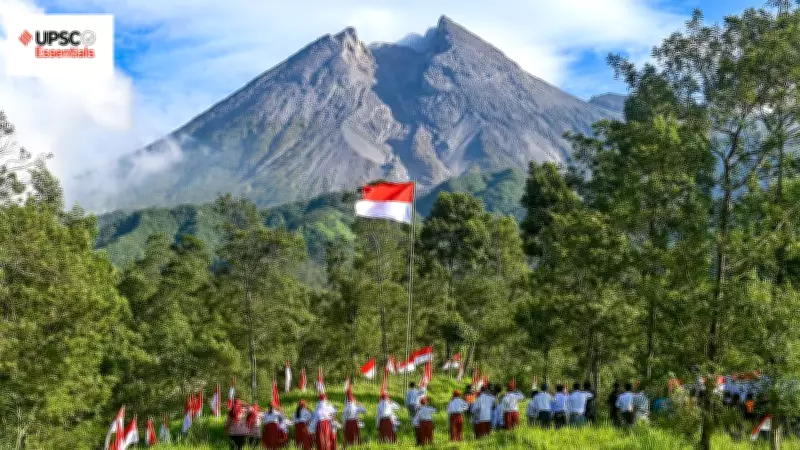
Mount Merapi is actually located in Central Java, Indonesia, not the Philippines. It is among Indonesia's most active volcanoes, erupting frequently every few years. Despite dangers, villages persist on its slopes due to spiritual significance and nutrient-rich volcanic ash that rejuvenates agricultural fields. Evacuation drills and community awareness help minimize casualties. Hence, pair 2 is incorrectly marked.
Kilauea is situated in Hawaii, USA, not Indonesia. It is one of the world's most active volcanoes, erupting intermittently for decades, with residential areas on Hawaii's Big Island within volcanic zones. Therefore, pair 3 is also incorrectly marked. Only one pair is correct, making option (a) the accurate choice.
Question 3: Historical Silk Route Passes
The Indian stretch of the legendary Silk Route once connected Ladakh and Himachal Pradesh to Tibet, China, and Central Asia, passes through:
- Zoji La
- Baralacha La
- Karakoram Pass
- Jelep La
- Pir Panjal Pass
Select the correct answer using the codes given below:
- (a) 2, 3 and 5
- (b) 1, 2 and 3
- (c) 3, 4 and 5
- (d) 1, 3, 4 and 5
Relevance: This question evaluates map-based knowledge of Himalayan passes and ancient trade routes, testing understanding of India's historical connectivity with Central Asia, Tibet, and China.
Explanation: Ancient trade routes like the Silk Route were vital for moving goods such as silk, wool, spices, horses, and turquoise across continents, shaping kingdoms, languages, religions, and cuisine. The Indian stretch connected Ladakh and Himachal Pradesh to Tibet, China, and Central Asia via high-altitude passes including Zoji La and Baralacha La.
The Silk Route traverses passes like Karakoram Pass, Zoji La, Baralacha La, Chang La, Khardung La, Imis La, Lanakh La, Shipki La, Lipu Lekh, Niti Pass, and Mana Pass. Pir Panjal Pass is an internal pass connecting Jammu and Kashmir, while Jelep La links Sikkim and Tibet. Thus, the correct passes are Zoji La, Baralacha La, and Karakoram Pass, corresponding to option (b).
Question 4: Polar Vortex Dynamics
With reference to the polar vortex, consider the following statements:
- The stratospheric vortex is associated with the polar jet stream.
- The tropospheric polar vortex disappears during the summer and is the strongest during the autumn.
Which of the statements given above is/are correct?
- (a) 1 only
- (b) 2 only
- (c) Both 1 and 2
- (d) Neither 1 nor 2
Relevance: This question tests conceptual clarity in dynamic climatology, particularly vertical atmospheric structure (troposphere vs stratosphere), assessing understanding of polar vortex–jet stream interactions and extreme weather mechanisms.
Explanation: The polar vortex is a large area of low-pressure cold air swirling around Earth's polar regions, existing in two types: tropospheric and stratospheric. The tropospheric polar vortex occurs in the atmosphere's lowest layer (surface to about 10-15 km), where most weather phenomena happen. Conversely, the stratospheric polar vortex occurs at higher altitudes (15-50 km).
Statement 1 is incorrect: The tropospheric polar vortex is associated with the Polar jet stream, while the stratospheric polar vortex links to the Polar night jet. Statement 2 is incorrect: The stratospheric polar vortex disappears during summer and peaks in autumn, not the tropospheric version. Therefore, neither statement is correct, making option (d) the right answer.
Question 5: South American Mountain Peaks
Consider the following statements:
- It is the highest peak in South America and the tallest mountain outside of Asia.
- It is situated in Argentina’s Andes range.
- The mountain is believed to have its origins in volcanic activity, but it is not an active volcano.
The above-mentioned statements refer to:
- (a) Mt Aconcagua
- (b) Mt Chimborazo
- (c) Mt Huascarán
- (d) Mt Ojos del Salado
Relevance: This question tests world physical geography, focusing on highest peaks and mountain ranges, helping distinguish between volcanic and non-volcanic mountains and regional locations in South America.
Explanation: Mount Aconcagua, standing at 22,841 feet in Argentina's Andes range, is South America's highest peak and the tallest mountain outside Asia. Despite being lower than Everest, it has a success rate of only about 30% due to harsh conditions: temperatures below zero, wind speeds exceeding 100 kmph, and high-altitude challenges.
Although formed from volcanic activity, Aconcagua is not currently active. It is one of the Seven Summits—the highest points on each continent—second only to Mount Everest in height. The first known summit attempt in 1883 failed, but Swiss mountaineer Matthias Zurbriggen succeeded in 1897. Thus, all statements describe Mount Aconcagua, making option (a) correct.
Conclusion: Regular Practice for UPSC Success
Consistent engagement with subject-wise quizzes like this Environment and Geography MCQs set is essential for UPSC aspirants. It not only reinforces static knowledge but also hones analytical skills needed for the Prelims. Incorporate such quizzes into your study routine to track progress, identify weak areas, and build confidence. Remember to cross-reference answers with reliable sources and maintain a disciplined revision schedule for optimal results in the UPSC CSE 2026 examination.