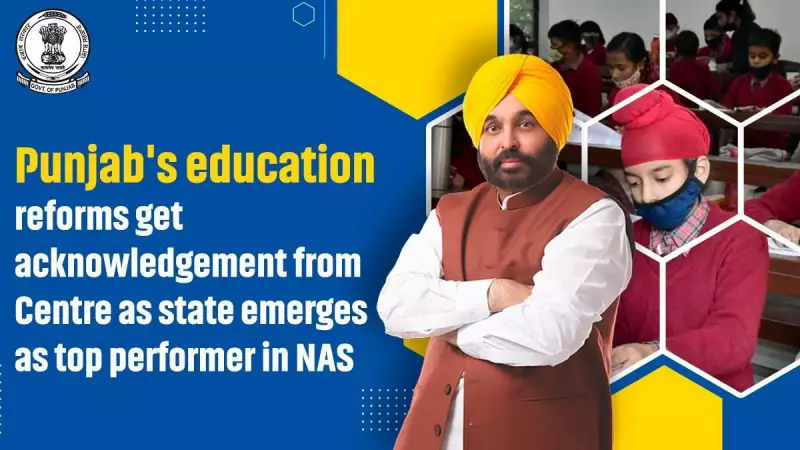
Punjab's Education Reforms Receive Central Acknowledgement as State Tops NAS 2026 Rankings
In a significant development for India's education sector, Punjab has been formally acknowledged by the central government for its comprehensive education reforms, culminating in the state emerging as the top performer in the National Achievement Survey (NAS) 2026. This recognition marks a pivotal achievement for Punjab, highlighting the effectiveness of its strategic initiatives aimed at enhancing learning outcomes across schools.
Central Government's Formal Praise for State-Led Initiatives
The central government has extended formal acknowledgement to Punjab for its dedicated efforts in revamping the education system. This praise underscores the collaborative spirit between state and central authorities in driving educational excellence. The acknowledgement is not merely symbolic; it reflects a validation of Punjab's data-driven approach and targeted interventions that have yielded measurable improvements in student performance.
The state's reforms have focused on multiple fronts, including teacher training, curriculum enhancement, and infrastructure development. By prioritizing these areas, Punjab has created a more conducive learning environment, which has directly contributed to its top ranking in the NAS 2026. This achievement is particularly noteworthy given the competitive landscape of educational assessments across Indian states.

National Achievement Survey 2026: Punjab's Standout Performance
The National Achievement Survey 2026, a comprehensive assessment conducted to evaluate learning levels among students, has positioned Punjab at the forefront. The state's performance in NAS 2026 demonstrates substantial progress in key subjects such as mathematics, science, and languages. This success is attributed to the state's relentless focus on quality education and its ability to implement reforms effectively at the grassroots level.
Punjab's emergence as the top performer is a testament to the hard work of educators, administrators, and policymakers who have championed these reforms. The survey results provide concrete evidence of the positive impact of Punjab's initiatives, offering a model for other states to emulate in their pursuit of educational advancement.
Key Elements of Punjab's Successful Education Reforms
The reforms that propelled Punjab to the top of the NAS 2026 rankings encompass a holistic strategy designed to address various challenges in the education sector. Key elements include:
- Enhanced Teacher Training Programs: Punjab invested in continuous professional development for teachers, ensuring they are equipped with modern pedagogical skills and subject knowledge.
- Curriculum Modernization: The state updated its curriculum to align with national standards and incorporate interactive learning methods, making education more engaging for students.
- Infrastructure Upgrades: Significant improvements were made in school infrastructure, including better classrooms, libraries, and digital facilities, to support effective teaching and learning.
- Student Assessment Mechanisms: Punjab implemented robust assessment tools to regularly monitor student progress and identify areas needing intervention, allowing for timely corrective measures.
These reforms, backed by adequate funding and political will, have collectively driven Punjab's success in the NAS 2026, earning it accolades from the central government.
Implications for India's Education Landscape
Punjab's achievement in the NAS 2026 and the subsequent acknowledgement from the centre have broader implications for India's education landscape. It highlights the importance of state-led initiatives in achieving national educational goals and sets a benchmark for excellence. Other states can draw inspiration from Punjab's model, adapting its strategies to their unique contexts to improve learning outcomes.

This development also reinforces the role of collaborative governance in education, where central support and state innovation work in tandem. As India continues to strive for educational equity and quality, Punjab's success story offers valuable insights into the potential of targeted reforms to transform the sector.
Looking ahead, sustaining this momentum will be crucial for Punjab. The state must continue to innovate and adapt to emerging challenges, ensuring that its education system remains responsive to the needs of students and the demands of a rapidly changing world.