NCERT Textbook Wars: A Recurring Feature of India's Curriculum Politics
The National Council of Educational Research and Training (NCERT) textbook controversies have become a recurring feature of India's curriculum politics. In recent years, controversies have consistently followed various curriculum decisions, including the rationalization of Mughal-era historical material, the deletion of references to the 2002 Gujarat riots, and later modifications that incorporated the abrogation of Article 370 into updated school textbooks.
The Latest Flashpoint: Supreme Court Takes Exception
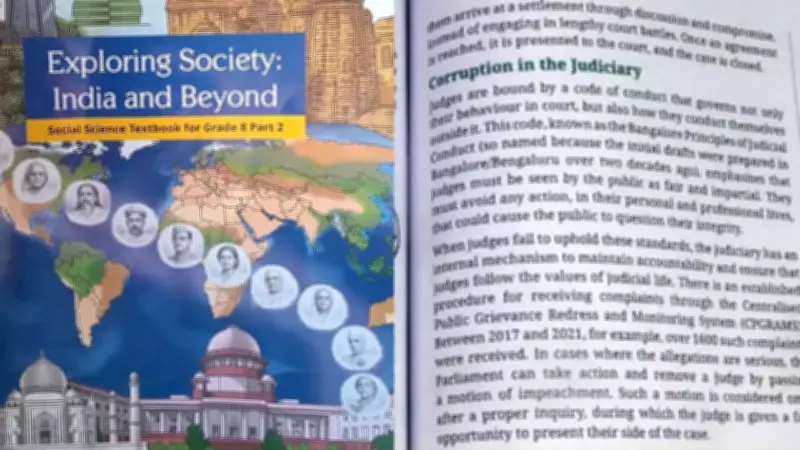
However, the latest flashpoint has escalated beyond the usual curriculum skirmishes. The Supreme Court of India took strong exception to specific passages in Chapter 4, titled The Role of Judiciary in our Society (pages 125–142) of NCERT's Class 8 Social Science textbook, Exploring Society: India and Beyond, Volume II. The controversial passages referred to corruption at various levels of the judiciary and highlighted the massive case backlog as significant challenges within the judicial system.
NCERT, which officially released this textbook on 24 February 2026, initially acknowledged that inappropriate textual material and an error of judgement had inadvertently entered the chapter, promising a complete rewrite. By 10th March 2026, NCERT issued an unconditional and unqualified apology and withdrew the entire Class 8 Social Science textbook from circulation nationwide.

The Core Issue: Perfect Ideals vs. Living Systems
The real issue extends far beyond the apology, the Supreme Court's anger, and the textbook withdrawal. This controversy fundamentally questions whether school textbooks should present public institutions as perfect ideals or as living systems that sometimes operate under stress, fall behind schedule, and remain prone to human error.
What the disputed chapter explicitly described was corruption at all levels of the judiciary, illustrating the enormous backlog and linking it to structural issues such as insufficient judges, unwieldy legal procedures, and poor infrastructure. These are not hidden truths whispered in hostile corners but established parts of public discourse. However, when these hard facts appeared in a Class 8 textbook, the situation transformed dramatically.
The Supreme Court objected sharply, NCERT apologized, and the book was withdrawn. This sequence of events gives the episode its particular sting and significance.
The Classroom Problem: Truth vs. Framing
No serious civics textbook can realistically pretend that the judiciary exists beyond criticism. Adults understand that the judicial system contains inherent contradictions: it stands for justice and constitutional protection while simultaneously being slow, expensive, and often difficult to access. At times it inspires confidence, while at other moments it leaves citizens frustrated. This represents a complicated truth that cannot be absorbed by children in a single encounter.
Case backlogs, high legal costs, and unequal access are not fabricated complaints but genuine realities that cannot be entirely excluded from educational materials. If omitted, students receive an overly sanitized version of public life. However, the opposite approach also proves problematic: introducing a 13-year-old to a constitutional institution primarily through the lens of decay and failure creates its own educational challenges.
The Critical Importance of Framing in Textbook Writing
This is precisely why framing matters so critically in textbook composition. There exists a substantial difference between acknowledging that an institution operates under strain and presenting that strain as its defining characteristic. A textbook can introduce the judiciary as a constitutional safeguard that simultaneously faces delays and structural problems. Alternatively, it can make the institution appear, from the outset, as a lofty establishment weighed down by dysfunction. These approaches deliver fundamentally different lessons that shape young readers' opinions in distinct ways.

A well-designed textbook should first explain what the judiciary exists to accomplish, why judicial independence matters, what rights require protection, how disputes are settled, and why constitutional remedies exist. Only after establishing this foundational understanding can a textbook carefully suggest that institutions designed to uphold justice do not always operate with the expected smoothness.
The Challenge of Writing Civics Textbooks
Writing civics textbooks presents greater difficulty than initially apparent. History possesses one advantage that civics lacks: most historical protagonists are deceased, departed, or out of office. Civics deals with institutions that remain active, powerful, capable of commanding respect while simultaneously provoking anger. This reality changes everything. A civics chapter does not merely explain the state; it shapes a child's initial instincts about authority and governance.
Therefore, writing civics material for middle-school children represents one of the most demanding tasks in public pedagogy. The challenge extends beyond stating facts to deciding which truths enter first, which wait their turn, what receives emphasis, and what kind of moral atmosphere the chapter creates around an institution.
If sanitized excessively, students inherit a shiny yet fragile concept of the republic that cracks when reality inevitably confronts them. If the approach goes too far in the opposite direction, an institution may appear compromised before students even understand its fundamental purpose. The essential problem becomes one of composition: how to write about imperfect institutions without making imperfection their sole identity.
Why Textbook Controversies Become So Charged in India
Textbooks in India never function merely as educational materials. They serve as proxies in larger contests over collective memory, authority, and national self-description. Every alteration gets interpreted as a signal, every deletion as motivated, every insertion as ideological intent. This explains why NCERT controversies rarely remain administrative matters for long, instead spiraling into television debates, courtrooms, ministerial statements, and social media trench warfare.
Viewed through this lens, the current NCERT Social Science textbook controversy for Class 8 extends beyond a chapter that crossed an invisible line. It reflects the country's broader uncertainty about how much realism its educational pedagogy can tolerate.
The Fundamental Question for Schoolbooks
The safest conclusion may also prove the most difficult to implement. Schoolbooks should not offer children a polished, grandiose version of institutions. Simultaneously, they should not introduce adult disillusionment into early civic education and present it as truth-telling. Both approaches represent forms of distortion.
What a nation owes its children is a language through which institutions are neither worshipped nor misunderstood. This requires textbook writers possessing unusual steadiness and editorial judgement, undaunted by complexity. This fundamental requirement makes this NCERT episode worth contemplating beyond the immediate controversy. It serves as a reminder that education, in its purest form, lives or dies by tone as much as by factual authenticity.
Children in classrooms should not be deliberately misled. However, they should also not receive fragmented truths without proper context. Between these two obligations lies the difficult craft of civics writing. If this controversy prompts society to pause and think more carefully about how schoolbooks introduce children to public institutions, it may ultimately leave behind something more valuable than just another burst of public outrage.