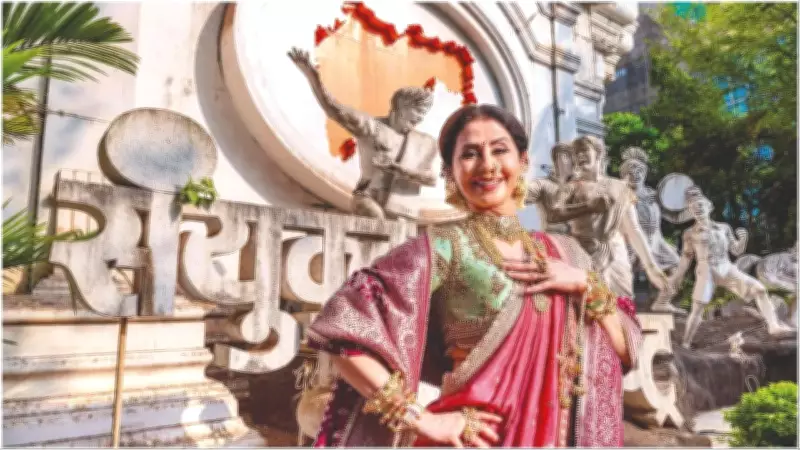
There was a sense of occasion and belonging as Urmila Matondkar arrived at Shivaji Park in a pink nauvari sari on Maharashtra Day yesterday. Walking through Dadar’s familiar lanes and into a space steeped in history, she carried with her not just the aesthetics of tradition, but its spirit.
During the exclusive shoot with Bombay Times, the actress reflected on her journey, her Marathi roots, and the pride, resilience and self-respect that shape her idea of being Maharashtrian.
'I received my education in Marathi'
With her roots in Sindhudurg, Urmila spoke of identity and belonging, reflecting on what being Maharashtrian means to her. She said, “It means dignity and a great sense of self-respect. I take immense pride in my roots, culture, Marathi literature and language. I could conduct an opera on Maharashtra. I received my education in Marathi — something very few people can say today. I was introduced to Marathi literature very early in life. I come from the coastal side, Konkan, and then there are the Sahyadris on the other side, along with beautiful rivers — that’s the diversity of Maharashtra, rich with flora and fauna.”

'Maharashtra stands firm in its values while welcoming every community'
Delving deeper into the state’s legacy, Urmila adds, “What’s truly remarkable about Maharashtra is how it stands tall on the strength of its social and educational reforms. We must not forget Rajarshi Shahu Maharaj, Dr Babasaheb Ambedkar and Mahatma Phule — the foundational architects of social justice and equality in the state. Likewise, many progressive milestones like the first school for girls in India began here, thanks to Savitribai Phule. And above all, Chhatrapati Shivaji Maharaj, for all the battles he fought. Beyond this, there’s our rich legacy of art, theatre and literature — even the film industry. Dadasaheb Phalke could never have imagined that the seeds he sowed would grow so magnificently. The greatness of Maharashtra lies in how it stands firm in its values while continuing to welcome every community with open arms.”
'My all-time favourite Marathi film is Shyamchi Aai'
Addressing the challenges that the Marathi film industry is facing today, the actress says, “It’s all about supporting your culture and staying rooted. Marathi cinema goes through its own ups and downs, but it consistently delivers some exceptional films. I recently watched Krantijyoti Vidyalay Marathi Madhyam and really liked it. I make it a point to watch Marathi films in theatres, and I urge my fellow Maharashtrians to do the same and support the industry. My all-time favourite Marathi film is Shyamchi Aai. And of course, all of V. Shantaram’s films have been remarkable — his vision, especially in the way he shot songs, has had a profound influence on many Hindi filmmakers.”
'I was told that my Hindi has Marathi intonations'
Turning the lens to her own journey in cinema, she speaks candidly about finding her footing in the film industry. “The best thing about the Hindi film industry is that it is cosmopolitan, just like Mumbai. However, being a Maharashtrian wasn’t easy for me in the industry because I was told that my Hindi has Marathi intonations. I really had to work hard towards it, but who am I to complain because even Lata Mangeshkar was told that! I believe it’s a part of our journey.”
As a Maharashtrian, what comes to your mind when we say: Food: Puran Poli Place: Sindhudurg Song: Vedat Marathe Veer Daudale Saat Vada Pav or Misal Pav: Misal Pav Favourite Marathi word: Thamba, thamba, thamba! Whenever I get flustered listening to someone, I say that.