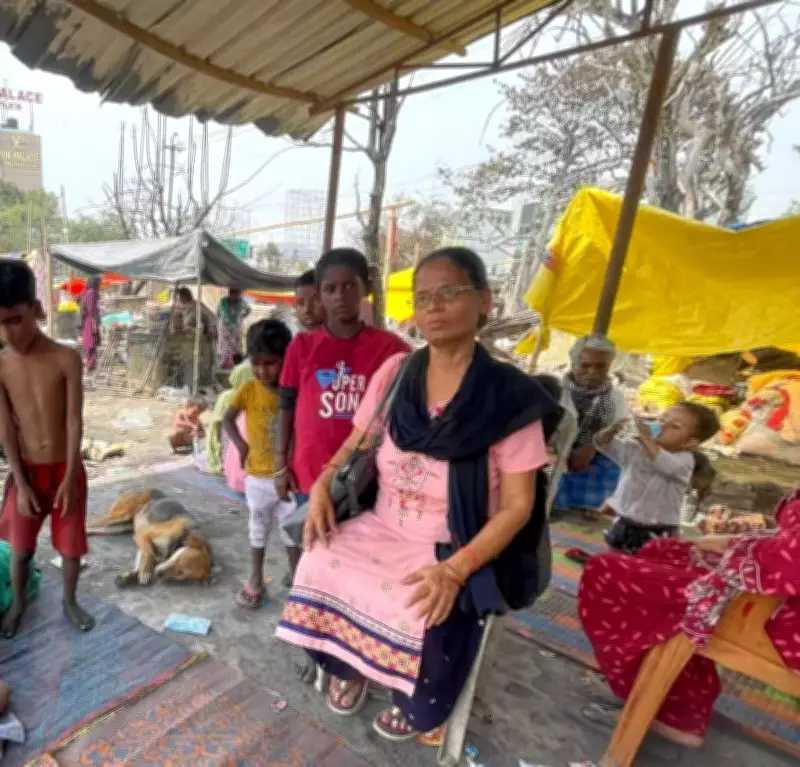
Lucknow Slum Fire Destroys Classroom, But Teacher Manju Devi Continues Lessons in Ashes
In the aftermath of a devastating fire that gutted homes in Lucknow's Vikas Nagar slum, a remarkable scene unfolds on a patch of blackened earth. Four-year-old Jugnoo stands barefoot, his face still smudged with soot, pointing to his features and reciting in careful English: "eyes, nose, ears." When prompted further, he softly continues, "Monday, Tuesday, Wednesday..." pausing only to remember what comes next.
Open-Air Classroom Amid the Ruins
Just one day after the fire destroyed their makeshift homes, nearly a dozen children have gathered again—not for play, but for learning. Under the open sky where their huts once stood, they sit in a circle on the scorched ground. Some trace letters in the dust with their fingers, while others repeat the alphabet aloud. There are no books, no blackboards, no walls—only memory and determination.
At the heart of this improvised classroom is 50-year-old Manju Devi, who has been teaching children from this slum for free for nearly two decades. Her open-air school had become a refuge for approximately 50 children, offering basic reading, writing, and counting skills. Now, everything she built has been reduced to ashes.

"Everything burned—blackboards, charts, notebooks, even the small fan we used in summer," Manju said, her voice filled with emotion. "But how can I stop? These children will forget what they learned."
Children's Resilience Shines Through
Among the students is eight-year-old Pooja, who proudly writes her name in English on the dusty ground. She learned this skill just a few weeks ago. "Didi taught me," she said, looking up at Manju with admiration.
Nearby, seven-year-old Arif carefully spells out "A-R-I-F" before quickly adding, "Sunday comes after Saturday," as if afraid he might forget this newly acquired knowledge.
Another boy, Sonu, who had just begun recognizing numbers, counts slowly on his fingers—"one, two, three..."—before stopping midway, distracted by the sight of his burnt home behind him.
"These children had just started to change," Manju explained. "They learned to speak politely, to write their names, to dream a little. Now everything is uncertain again."
Parents Watch with Mixed Emotions
Parents observe silently from a distance, their faces reflecting both loss and hope. Rekha, a domestic worker, wipes her eyes as she watches her daughter try to revise the alphabet. "We lost everything—clothes, utensils—but when I see her studying again, I feel maybe something is still left," she says.
For many of these families, education represents the only fragile ladder out of poverty. Manju remembers how some of her former students went on to enroll in government schools, while others learned enough to help their families with basic literacy and numeracy.
Starting from Zero with Unwavering Purpose
Manju began her teaching mission in 2006, following the breakdown of her marriage. A Class XII graduate with nothing at the time, she found purpose in educating slum children. "Teaching gave me a purpose. Now again, we are starting from zero," she said, her resolve evident despite the circumstances.
With no classroom, no materials, and no certainty about tomorrow, Manju has already begun rebuilding—word by word, lesson by lesson. The children repeat after her, their voices rising above the silence of the burnt settlement: "A… B… C…"
Each letter represents a small act of defiance against despair, a testament to human resilience in the face of adversity. As the community grapples with loss, this open-air classroom on blackened earth continues to offer hope and education against all odds.