When toxic air blankets Delhi and schools shift to online classes, a stark inequality surfaces. For children from affluent backgrounds, learning continues seamlessly from home. But for thousands of students from the city's poorest families, the shift to digital platforms becomes an insurmountable barrier, brutally exposing a deep and persistent digital divide.
A Daily Dash for a Digital Window
Every morning in west Delhi's Shivaji Park, 12-year-old Sumit begins a frantic race against time. He lives with his parents and two siblings in a cramped tarpaulin shelter. While his more privileged peers log into classes from comfortable homes, Sumit's education depends on the generosity of a neighbor.
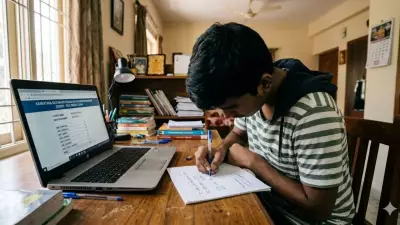
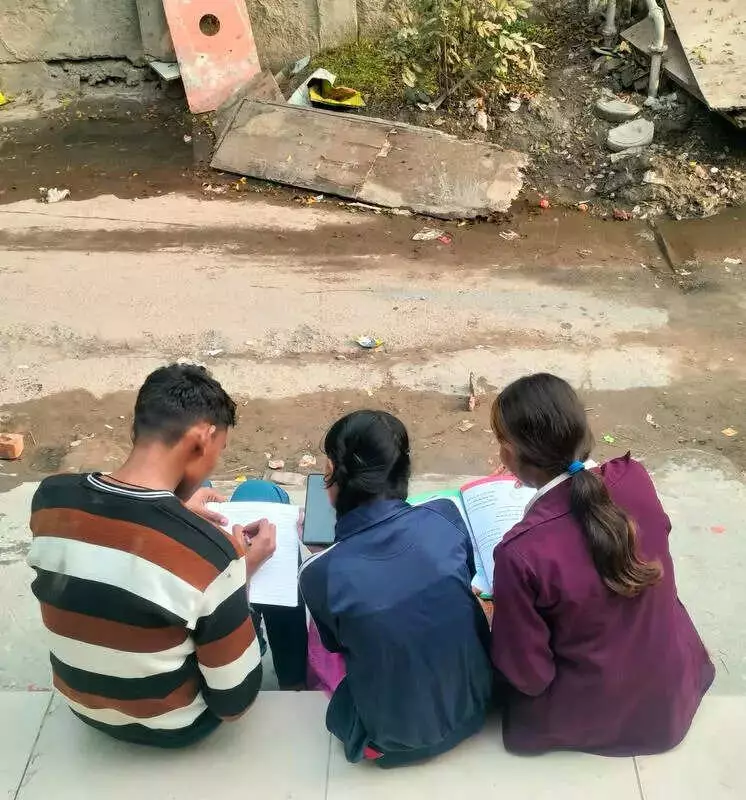
With notebooks tucked under his arm, he rushes to a neighbor's house, one of the few in the area with a spare mobile phone. Squeezed into a corner of a room or verandah, he clutches the borrowed device, attending his Class VI online classes from the Govt Co-ed Senior Secondary School in Shakurpur.

The connection is patchy, voices break, and screens freeze. Time is always limited, and access is never guaranteed. "Often, she sounds upset and tells me, ‘Did I get this mobile phone for you?'" Sumit says about his neighbor. On days when the phone is not available, he simply misses his lessons.
When a Smartphone is a Distant Dream
Sumit's struggle is not unique. Julie, a Class VII student from Nehru Camp, faces a similar ordeal. Her family does not own a phone. Her father, a rickshaw puller, earns a meager Rs 100 to Rs 150 a day, making the purchase of a smartphone for education an impossible dream.
For Julie, salvation comes from an NGO called Chetna. She visits their ‘education contact club’ to use a team member's phone to attend classes. Without this critical support, she would risk falling irretrievably behind academically.
After his online classes, Sumit helps his mother sift through garbage; his father is also a ragpicker. The family's daily struggle to make ends meet forms a bleak backdrop to his fight for an education. "At times like this, it is hard to study. The internet in our area is patchy, so the online classes are frequently interrupted," he explains.
A Systemic Failure Amplified
Educators and activists point out that the problem is systemic and worsened by environmental crises. "Throughout the year, Delhi faces extreme weather, which hampers the education of kids from the vulnerable section," said Sanjay Gupta, director of Chetna.
He notes that the discontinuation of offline classes proves disproportionately challenging for these children. Furthermore, increased and unsupervised online exposure puts them at risk on social media. Gupta suggests that training both teachers and students to better adapt to online learning could help address some issues.
A government school principal, Sunita, lays bare the reality in many households: "There are homes with just a phone, which one of the parents carries to work. In many cases, a single device is shared among several siblings." She adds that younger children are often the worst affected, sometimes being left out of online classes altogether.
While toxic air remains a primary public health concern, for Sumit, Julie, and countless others in Delhi's fragile settlements, the immediate crisis is more basic: finding a mobile phone and a steady internet signal. Their relentless pursuit of learning underscores a urgent need to bridge the digital chasm that threatens to leave an entire generation behind.