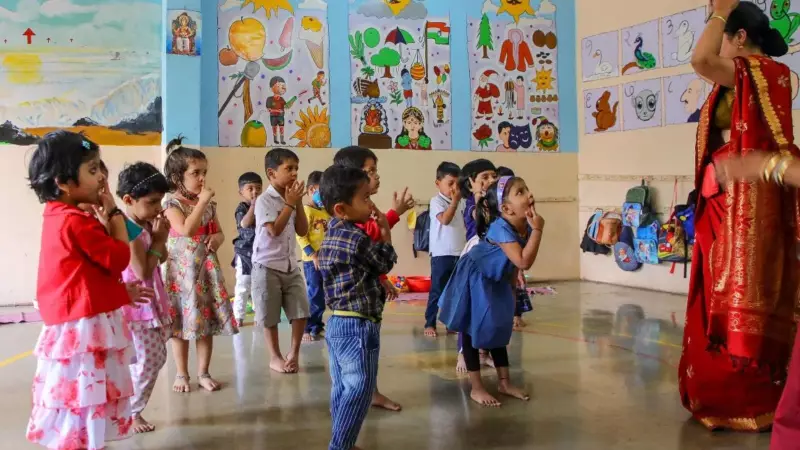
For thousands of families in India's capital, the annual nursery admissions process has transformed into a fiercely competitive race, marked by anxiety, strategic calculations, and difficult choices. The admission cycle for the 2026 academic session, which began with schools uploading criteria on November 28, 2024, and saw applications close on December 27, is now at a critical juncture. The first merit lists are set to be published on January 23, 2025, deciding the educational starting point for countless three-year-olds.
The Parental Dilemma: Proximity, Price, and Prestige
The scramble for a limited number of seats—with an average of nearly 2,000 families vying for 60 general-category seats per school—forces parents to balance multiple, often conflicting, priorities. For Aparna Kuliyal, a 32-year-old MCD school teacher from Malviya Nagar, the conversation was sobering. Discussing top schools with annual fees exceeding Rs 5.5 lakh, a friend's practical warning resonated: sending a child to a 'posh' school could lead to unaffordable demands. "I want him to be around children from similar backgrounds," Aparna explained, ultimately prioritizing Gyan Bharti School in Saket, just 1.5 km from home, for its proximity, while still hoping for admission to Birla Vidya Niketan for its 'brand value'.
This tension between aspiration and reality is widespread. Asha Awana, a 31-year-old government teacher from Aya Nagar, selected a nearby private school with robotics and sports over a more elite, distant option. Her concern extended beyond fees. "If the environment is very elite, our child may feel inferior... If the other children are too rich, our child may lose confidence," she stated, highlighting the social considerations in school choice.

For cab driver Amardeep Singh in Shalimar Bagh, the primary filter is affordability, with nursery fees around Rs 9,000 per month. For his wife, Samneet Kaur, cultural alignment is non-negotiable. "We are Sikh. Our children must learn Punjabi. That is important," she said, making Jaspal Kaur Public School, within walking distance and where their older daughters study, the ideal choice.
The Points System and Intensifying Competition
The current admission framework is governed by a 100-point system, established by a committee after a 2004 PIL challenged opaque practices. This system aims for fairness by allocating points objectively. Distance from the school carries the highest weight, typically between 55 and 70 points within a 5-8 km radius. Sibling status adds 10 points, and having alumni parents contributes 20 points. The remaining seats are often allocated via lottery.
However, the enforcement of the Right to Education (RTE) Act's 25% Economically Weaker Sections (EWS) quota has reshaped the landscape. While providing crucial access, it has reduced the number of seats available for non-EWS applicants. Dr. Latika Gupta of Delhi University notes this has made competition among middle- and upper-middle-class families sharper. At Amity International School in Saket, for instance, of 144 nursery seats, 36 are reserved for EWS, and about 40-50 go to siblings, alumni, and staff wards, leaving roughly 60 seats for thousands of applicants.
Principals observe a new breed of hyper-prepared parents. "Parents make Excel sheets with school name, distance, results, facilities," said Divya Bhatia, Principal of Amity. Tania Joshi, Principal of The Indian School, noted a shift from purely academic inquiries to questions about sports, activities, and holistic growth. This has bred an environment of aggression and suspicion, with parents forming WhatsApp groups and fearing unfair advantages.
Systemic Gaps and the Road Ahead
Experts argue that the admission frenzy is a symptom of deeper systemic issues. Veteran educationist and former NCERT director Krishna Kumar points to the scarcity of quality early childhood education centers. "Nursery teachers are underpaid and undertrained. Even famous nurseries pay teachers a pittance," he stated, adding that the training is often disconnected from child psychology.

This reality stands in stark contrast to the vision of the National Education Policy (NEP) 2020, which recognizes ages 3-8 as a foundational stage for play-based learning and recommends formal schooling only from age 6. The gap between this policy vision and ground-level infrastructure pushes parents towards private schools, which, as Dr. Gupta notes, often merely offer "a miniature Class 1" experience in their nursery sections.
The way forward, according to experts, requires substantial public investment in government nursery schools, proper training and pay scales for early childhood educators, and developmental curricula. Until then, the winter anxiety in Delhi's households is likely to persist, as parents navigate a high-stakes system where a seat in nursery is perceived as securing a child's future for the next 15 years.