The Central Board of Secondary Education (CBSE) has introduced significant changes to its affiliation rules. These changes aim to make career guidance and counseling services available to every student in CBSE schools.
New Mandatory Requirements for Schools
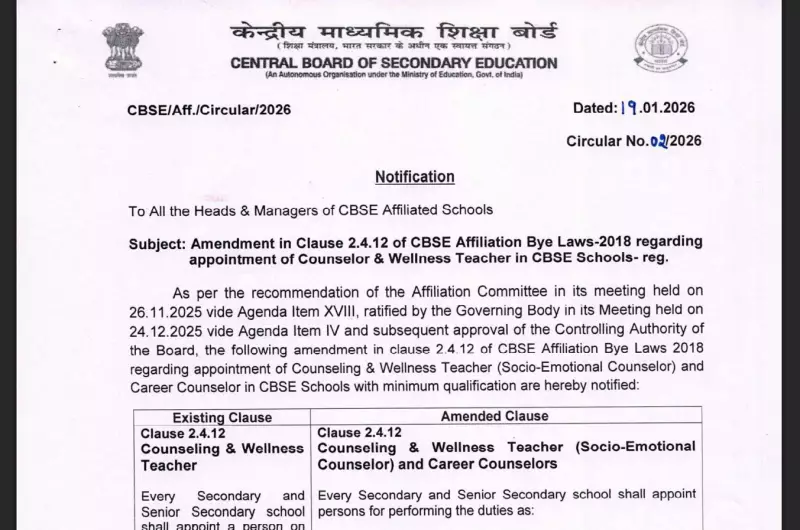
The CBSE Governing Body approved these revisions during a meeting on November 26, 2025. The updated Clause 2.4.12 now makes it compulsory for all affiliated schools to have a Counseling & Wellness Teacher. This teacher will act as a socio-emotional counselor.
Staffing Ratios and Accessibility
Schools must maintain a ratio of one counselor for every 500 students. Even smaller schools with fewer than 300 students are not exempt. They must ensure access to a qualified counselor. This can be achieved by hiring a full-time professional or sharing a counselor with neighboring schools through collaboration.

This approach guarantees that all students receive professional support. It does not matter how large or small their school is.
Qualifications for Counseling Roles
Counseling & Wellness Teachers need specific educational backgrounds. They must hold a bachelor's or master's degree in psychology, counseling, or social work. Additional qualifications like a diploma in career development or emotional counseling are considered advantageous.
These counselors primarily focus on students' mental health. They also support social and emotional development and general welfare.
Career Counselors' Credentials
Career counselors have a different focus. They provide academic and career guidance. They should be graduates with a bachelor's or master's degree in humanities, science, or social sciences.
Additionally, career counselors must complete a 50-hour professional development training. CBSE must sanction this training. The training covers essential areas such as counseling techniques, career assessment, effective communication with students and parents, and adherence to ethical standards.
Training and Implementation Strategies
All counselors must undergo a structured training program. They need to complete this training within two academic years.
Schools have the option to implement the CBSE Counseling Hub & Spoke Model. This model allows a central counseling service to support a cluster of schools. It ensures students receive consistent counseling on mental health, career planning, and social-emotional learning.
Shifting Towards Holistic Education
These new norms represent a shift in CBSE's educational approach. The focus moves beyond traditional academics to a more comprehensive school experience.
Integrating counseling and career guidance into the school framework aims to nurture students emotionally, socially, and professionally. This holistic development prepares them better for future challenges.