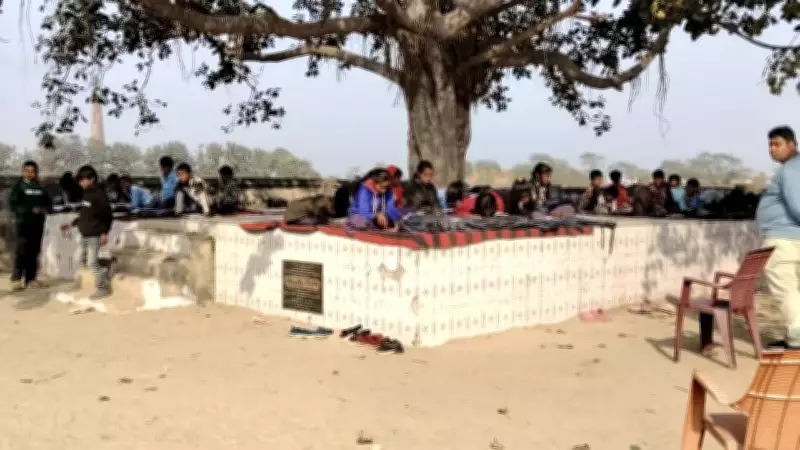
Thousands of Students in West Champaran Forced to Study Under Trees as 84 Schools Lack Buildings
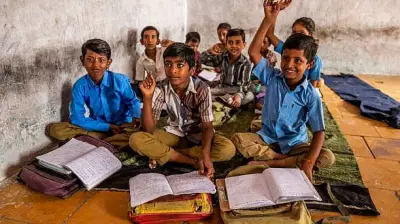
In the rural expanses of West Champaran, Bihar, education unfolds not within the confines of classrooms but under the open sky, where rustling leaves serve as the only roof for thousands of children. Across dozens of government schools in the district, students continue their studies without permanent buildings, enduring harsh weather conditions from scorching heatwaves to monsoon downpours and biting winter cold.
Stark Reality of Infrastructure Deficits
The situation remains dire, with official data revealing that at least 84 schools lack proper structures, compelling students to attend classes in the open, deprived of even basic facilities. West Champaran boasts 1,551 primary schools, 900 middle schools, and 336 high schools, including minority and project institutions, yet persistent infrastructure gaps undermine educational outcomes.
At the Government Upgraded Middle School in Gurchurwa Vriti Tola under the Majhauliya block near Bettiah, approximately 230 students from classes I to VIII sit in clusters under separate trees, with blackboards leaning precariously against trunks. Classes are frequently suspended during the monsoon, while summer brings unbearable heat and winter ushers in cold waves.

"Two or three classes run side by side under trees, which severely affects teaching quality. When it rains, we are simply sent home," said Divya Kumari, a student at the school.
Headmaster Aditya Narayan noted that the school, established in 1987, has never received a proper building. "Earlier, enrolment was around 500. As families became financially better off, they shifted children to private schools. If a building is constructed, enrolment will rise again," he explained.
Official Responses and Temporary Measures
District programme officer Gargi Kumari stated that the school has two rooms and 11 decimals of allotted land. "A proposal has been submitted for constructing six rooms under the current budget. The Majhauliya block education officer has been instructed to make temporary arrangements for senior classes at a nearby primary school within one kilometre of Vriti Tola," she said.
A similar scenario unfolds at the Government Primary School in Sabeya Musai Musahar Tola, about 10 kilometers from Bagaha subdivision headquarters. Established in 2000, its two-room structure features a partially collapsed roof, making it unsafe for use.
Following a land dispute in 2018, another primary school was merged with it, intensifying the space crunch. Around 130 students, predominantly from Mahadalit communities, now study in open fields or on raised platforms.
"We are scared to sit inside because the roof is broken. So we study outside," said Anjali, a Class IV student.
Headmaster Vinod Prasad Pal lamented that repeated representations to authorities have yielded no action. Parent Bittu Ram highlighted the safety concerns, stating, "Our village has no school land. Hence children were tagged to a school 2km away. It is difficult for five-to ten-year-olds to walk that far. We leave early for work and constantly worry about their safety."
Phased Upgrades Promised by Authorities
District education officer Ravindra Kumar acknowledged that approximately 84 schools remain building-less or landless. He assured that land identification and construction processes are underway, with detailed project reports (DPRs) already prepared.
"The schools will be upgraded in phases under Bihar State Educational Infrastructure Development Corporation Limited (BSEIDC) with modern and sustainable standards," he said, offering a glimmer of hope for the future.
This persistent issue underscores the broader challenges in rural education infrastructure, where children's right to a safe learning environment is compromised by administrative delays and resource constraints. As authorities pledge phased improvements, the immediate reality for these students remains one of resilience amidst adversity, studying under trees while awaiting the promise of proper classrooms.