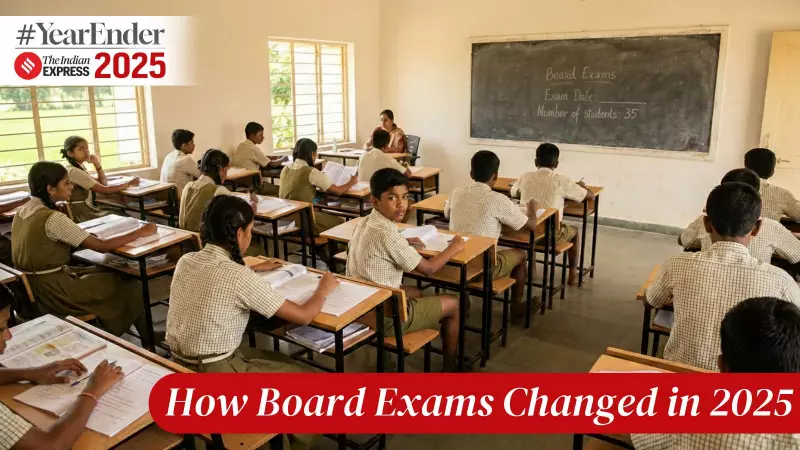
As 2025 concludes, India's school examination landscape is witnessing its most profound overhaul in decades. Moving beyond the pandemic-era disruptions, the change this year is structural and deliberate: the systematic dismantling of the traditional, once-a-year, high-stakes board examination model for Classes 10 and 12. Driven by the vision of the National Education Policy (NEP) 2020, central and state education boards are rolling out a more flexible, competency-based, and less stressful assessment framework, fundamentally resetting how final school exams will function from the 2026 academic session onwards.
The End of the Single-Attempt System
For generations, board exams in India have been a synonym for immense pressure, defined by a single timetable, one question paper, and just one chance to perform. An illness, a family emergency, or simply having a bad day could disproportionately impact a student's academic record, college admissions, and future career paths. This rigid model is now being decisively challenged.
Under the directives of NEP 2020 and the National Curriculum Framework (NCF), the Union government has pushed all school boards to redesign examinations. The core idea is to make assessments more flexible, focused on core competencies, and significantly reduce student stress. A central recommendation was to conduct Class 10 and 12 board exams at least twice a year, allowing learners to retain their best score. By the end of 2025, this policy intent has solidified into concrete implementation roadmaps across the country.

CBSE Leads the Transformation as States Follow
As the largest national board, the Central Board of Secondary Education (CBSE) has set the template for this nationwide shift. From the 2025-26 academic year, CBSE will conduct Class 10 board examinations twice annually. The first exam, scheduled around February, will be mandatory for all students. A second, optional phase in May will allow students to improve their scores or recover from an unsatisfactory first attempt.
Results for the first phase will be declared in April, with second-phase results coming in June. Crucially, the final marksheet will reflect the best score from the two attempts, effectively ending the concept of a single, final exam. Officials have clarified that the second exam is not compulsory and should be viewed purely as an opportunity for improvement, with identical syllabus and evaluation standards across both phases. While initially for Class 10, this framework is expected to extend to Class 12 in subsequent cycles.
The CBSE move has triggered a wave of similar announcements from state boards in 2025:
- Madhya Pradesh has adopted a twice-a-year model for both Class 10 and 12, retaining the better of the two performances.
- Gujarat's GSEB has approved two annual board exams for secondary and higher secondary students, positioning the second as an improvement option.
- Haryana has introduced a comparable system, framing the second exam as a pressure-relief mechanism.
- Rajasthan has announced plans to follow CBSE's model from the 2026-27 academic year.
- Chhattisgarh implemented the two-exam pattern for 2025, with the first in March and a second chance in June-July.
Karnataka's Pioneering Three-Exam Model and Tamil Nadu's Divergent Path
While most states are moving to two exams, Karnataka has been a pioneer, introducing up to three exam opportunities annually for its state board students since the 2023-24 academic year. Students can appear in one, two, or all three windows, with the best score counted. This model erases the distinction between "regular" and "supplementary" exams, creating a continuous improvement system.
In a contrasting decision, Tamil Nadu has chosen to reduce external assessments. In October 2025, the state government abolished the Class 11 (Plus One) public examination from the 2025-26 academic year, reverting to internal school-based assessment. This decision, responding to long-standing demands from teachers and schools, phases out the exam over a five-year transition period until March 2030 for repeaters only.

Rationale and the Road Ahead
The shift to multiple exam opportunities is framed by policymakers as a combined mental health intervention, equity measure, and academic reform. It aims to reduce anxiety, provide a buffer against unforeseen disruptions, and acknowledge that a single day's performance is an imperfect measure of a student's learning or capabilities.
For higher education, this system could widen the pool of eligible candidates, especially in competitive streams where even a marginal improvement in board marks can be crucial. The year 2025 was marked by the institutionalisation of these changes, with boards locking in timelines, issuing circulars, and schools recalibrating their guidance to students—treating the first attempt as primary and the second as a safety net.
This collective move signals a fundamental reimagining of India's board exams: from a solitary, do-or-die event to a more humane process that offers choice, recovery, and genuine opportunity for every student to perform at their best.