Nearly Half of VTU Engineering Students Pay for Internships, Sparking System Debate
Bengaluru faces a growing controversy in its engineering education sector. A recent report reveals that 46% of Visvesvaraya Technological University students must pay companies to secure mandatory internships. These payments range from Rs 500 to a staggering Rs 1.2 lakh, raising serious questions about equity and the fundamental purpose of internships.
University Leadership Points to Broader Responsibility
VTU Vice-Chancellor S Vidyashankar addressed the issue directly. He stated that universities cannot shoulder the entire burden alone. "How many internships can a university arrange for free?" Vidyashankar asked. He noted that even government training centers do not provide internships without charge.
The vice-chancellor emphasized shared responsibility. He argued that companies and government institutions must participate in creating solutions. Public institutions, he suggested, should at minimum offer internships without financial barriers to students.

Industry Experts Explain Why Companies Charge Students
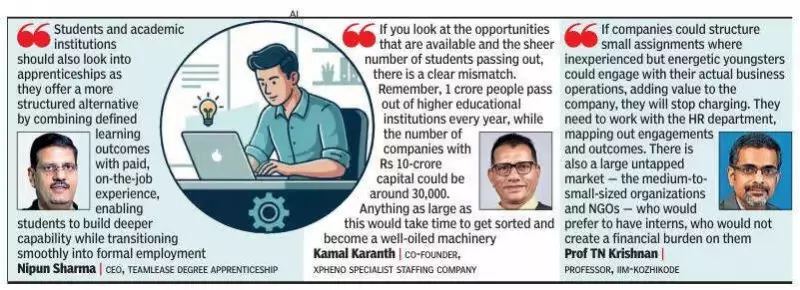
Kamal Karanth, co-founder of staffing firm Xpheno, provided insight into corporate practices. He explained that payment requirements often serve as filtering mechanisms. Companies use fees to identify serious candidates from less committed applicants.
Karanth clarified that this practice typically occurs among smaller, less established firms. Large, reputable companies generally do not charge students for internship opportunities. The staffing expert highlighted capacity constraints as another significant factor.
"Many companies lack sufficient resources, time, or opportunities to host large numbers of interns," Karanth said. Managing interns presents logistical challenges, especially for firms with limited existing internship programs. Any additional interns require extra effort and investment.
Supply-Demand Imbalance Drives Payment Trend
Nipun Sharma, CEO of TeamLease Degree Apprenticeship, identified structural issues. He explained that charging students often emerges when internship demand spikes without corresponding supply frameworks. Some organizations begin functioning more like training providers than traditional employers.
These companies recover costs related to supervision, infrastructure, mentoring, and administration through student payments. Sharma warned that this model creates sustainability concerns. "Charging students creates access barriers and can harm employer branding," he stated.
The executive advocated for treating internships as workforce development investments rather than transactional services. He emphasized that internships work best when companies view them as strategic opportunities rather than financial burdens.
Academic Perspective Highlights Value Proposition
Professor TN Krishnan from IIM-Kozhikode offered academic analysis. He observed that many firms perceive internships as costly obligations rather than social and strategic investments. This perspective, he suggested, limits potential benefits for both companies and students.
Krishnan highlighted the value students bring to organizations. "They provide energy and ideas at a fraction of full-time employee costs," he noted. The professor argued that this value proposition needs clearer communication to both companies and students.
He also addressed student responsibilities. Clearer expectations around work ethic and professional engagement could build trust between interns and employers. Improved outcomes would benefit both parties in the internship relationship.
Systemic Solutions Required for Sustainable Change
The current situation reveals multiple interconnected challenges. Universities face practical limitations in arranging sufficient free internships. Companies struggle with capacity constraints and resource allocation. Students encounter financial barriers that limit access to essential learning experiences.
Experts agree that sustainable solutions require coordinated efforts. Government institutions could lead by offering free internship opportunities. Companies might reconsider how they value young talent and internship programs. Universities could strengthen partnerships with industry to create more accessible pathways.

The debate continues as stakeholders seek balanced approaches. The goal remains creating internship systems that serve educational purposes without imposing financial burdens on engineering students pursuing their mandatory requirements.