Ranchi University Campus Becomes Battleground Over UGC's Anti-Discrimination Directive
The main gate of Dr Shyama Prasad Mukherjee University (DSPMU) in Ranchi became the epicenter of contrasting student demonstrations on Tuesday, as campus groups clashed over the newly introduced University Grants Commission (Promotion of Equity in Higher Education Institutions) Regulation 2026. This comprehensive framework aims to systematically eliminate various forms of discrimination, including those based on caste, within higher education institutions across India.
Opposing Camps: Burning Protests Versus Constitutional Support
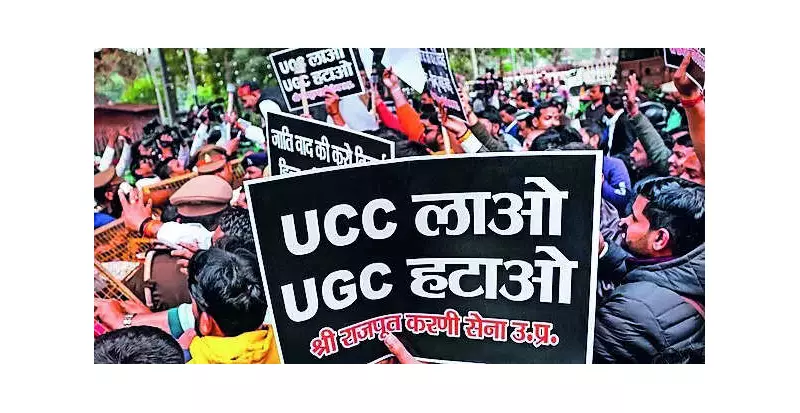
Two distinct student factions emerged with dramatically opposing viewpoints. The Hindu Chhatra Sangh (HCS) led one contingent, vociferously demanding the withdrawal of what they termed a 'black law'. Their protest turned symbolic as they set papers ablaze, representing their rejection of the regulations. This act nearly escalated into physical confrontation when members of the opposing Yuva OBC Morcha attempted to intervene and prevent the burning.
Abhishek Prasad, an HCS member, articulated the group's primary concern: 'These regulations have created an unfortunate division among the student community. We fear they might inadvertently lead to reverse discrimination against students from forward castes. The mechanism could be misused through false complaints, putting general-category students at risk of unjust disciplinary action.'

Voices in Favor: A Long-Awaited Protective Measure
Contrasting sharply with this perspective, Amanjit Mehta of the Yuva OBC Morcha presented a different narrative. 'Rules should instill fear only in those who contemplate wrongdoing. For decades, students from Scheduled Castes, Scheduled Tribes, and Other Backward Classes have endured systemic discrimination on this very campus. These regulations are not about creating divisions; they are about enforcing the constitutional rights that have long been promised but seldom protected. It's crucial to understand that despite our differing stands on this issue, we remain friends and fellow students.'
Organizational Backing and Historical Context
The All India Students' Association (AISA) further solidified the support for the UGC directive by conducting a formal media briefing. The organization explicitly welcomed the regulation, highlighting its objectives to eradicate discrimination rooted in religion, race, gender, place of birth, caste, and physical disability, thereby ensuring genuine equity in higher education institutions.
Triloki Nath, the AISA state secretary, provided crucial context: 'It is essential to recognize that this regulation is not merely a government handout. It is the hard-earned fruit of persistent, long-term struggles waged by student organizations and various social groups, reinforced by judicial directives. It represents a milestone in the ongoing fight for a just academic environment.'
Structural Framework of the 2026 Regulation
The UGC regulation introduces a robust institutional mechanism to translate its principles into action:
- Establishment of an Equal Opportunity Centre within each Higher Education Institution (HEI) to oversee the implementation of policies designed for disadvantaged sections.
- Formation of a 10-member Equity Committee, with a mandated representation of five members from reserved category backgrounds, to formally address and resolve complaints of discrimination.
- Creation of an Equity Squad, tasked with maintaining constant vigilance on campus to proactively prevent discriminatory practices and ensure a safe, inclusive atmosphere for all students.
The demonstrations at DSPMU have thus laid bare the deep-seated tensions and divergent interpretations surrounding equity policies in Indian higher education, setting the stage for continued debate on the balance between protection, prevention, and perceived fairness.