Presidency University to Resume Departmental Entrance Exams After 10-Year Hiatus
In a significant shift in its admission policy, Presidency University in Kolkata has announced that seven of its undergraduate departments will conduct their own entrance examinations starting from the upcoming academic session. This marks the first time in a decade that the prestigious institution will hold such tests, moving away from its reliance on the West Bengal Joint Entrance Examination (WBJEE) Board.
Departments Embracing the New Testing Approach
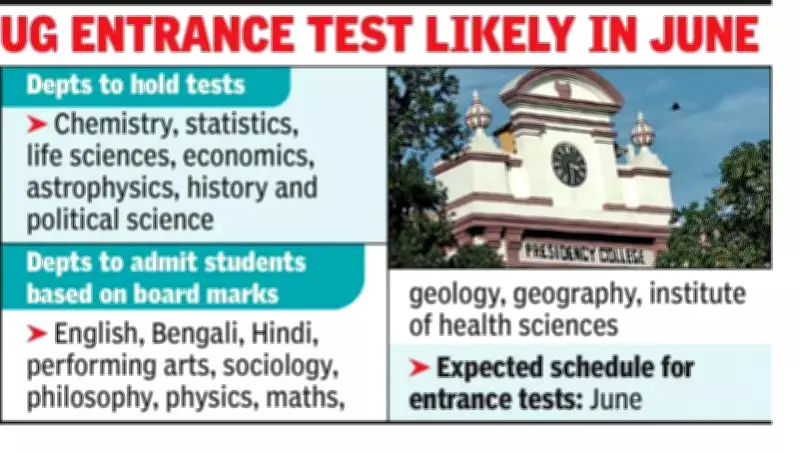
The seven departments that have opted to conduct entrance tests are chemistry, statistics, life sciences, economics, astrophysics, history, and political science. These departments have formed a dedicated committee comprising their respective heads to oversee the entire admission testing process.
"To ensure a smooth process for admission tests, a committee has been formed with heads of the seven departments," confirmed a university official. "The committee will decide on the timeline, the centers, the number of sets of question papers, and how to ensure proper moderation."

The official emphasized that since entrance tests will be held after 10 years, the university needs thorough preparation beforehand. The admission tests are expected to be conducted in June, with the committee working diligently to establish all necessary protocols and procedures.
Background and Rationale for the Change
This decision follows the university's admission committee's January resolution to part ways with the WBJEE Board and conduct undergraduate admissions independently. The seven departments advocating for entrance exams argued that department-led testing represents the most effective method for identifying and screening bright students who possess the specific academic qualities needed for their programs.
The entrance examinations will be Multiple Choice Question (MCQ) based, according to department representatives. This format was selected to provide a standardized, objective assessment method while allowing for efficient evaluation of a potentially large applicant pool.
Alternative Admission Pathways for Other Departments
While these seven departments pursue entrance testing, other departments at Presidency University have chosen different admission criteria. Departments including English, Bengali, Hindi, physics, mathematics, geology, geography, performing arts, sociology, and philosophy will admit students based on a formula that incorporates candidates' class 10 and class 12 board examination scores.
"Departments were given autonomy to decide whether they wanted to conduct tests or admit students based on marks," explained a teacher familiar with the admission process. This decentralized approach allows each academic unit to select the admission method best suited to its specific disciplinary requirements and educational objectives.
Faculty Concerns Prompting the Policy Shift
The move away from WBJEE Board oversight follows growing concerns among Presidency University faculty members about the board's handling of the admission process. In July of last year, teachers wrote to Vice-Chancellor Nirmalya Narayan Chakraborty expressing their reservations.
The faculty letter highlighted that in the initial years of collaboration, Presidency University professors were actively involved in setting question papers, ensuring both academic rigor and contextual appropriateness for their programs. However, when the WBJEE Board opted to take over the entire question-setting process, faculty involvement diminished significantly.
"Recent developments, marked by inefficiencies and opacity, force us to reconsider our arrangement with the board," stated the letter signed by Presidency University teachers. This dissatisfaction with the external board's processes ultimately led to the decision to resume internal entrance examinations.
Historical Context of Admission Practices
The WBJEE Board has been conducting both undergraduate and postgraduate admissions for Presidency University since 2015. Prior to that arrangement, the university consistently held its own admission tests, maintaining direct control over the evaluation and selection of prospective students.

The return to department-specific entrance examinations after nearly a decade represents both a restoration of historical practice and a response to contemporary concerns about admission quality and institutional autonomy in student selection processes.