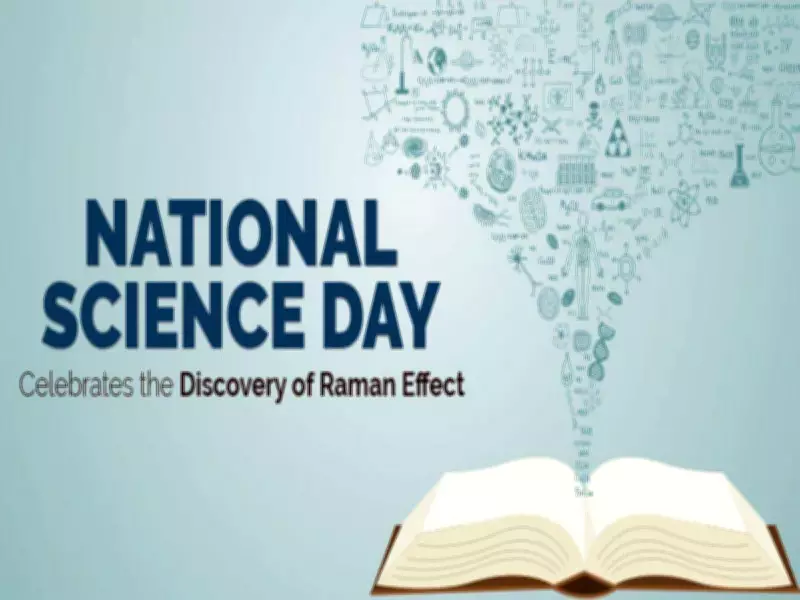
National Science Day 2026: A Celebration of Scientific Heritage and Future Innovation
Every year on February 28, educational institutions, research laboratories, and science centers throughout India collectively pause to honor a pivotal moment in the annals of modern physics. National Science Day is observed to commemorate the announcement of the Raman Effect by the illustrious Sir C.V. Raman in 1928. This groundbreaking discovery subsequently earned him the Nobel Prize in Physics in 1930, marking the first time this prestigious award was bestowed upon an Indian scientist within the scientific disciplines.
The Historical Significance of February 28
February 28 holds profound importance not as the birthday of C.V. Raman, but as the date when he made a revolutionary observation. Raman discovered that when a beam of light traverses a transparent medium, a portion of that light undergoes a change in its wavelength. This phenomenon, christened the Raman Effect, conclusively demonstrated that light interacts with molecules in a measurable manner. This breakthrough enabled scientists to analyze the molecular composition of matter without causing destruction to the sample.
The Government of India officially instituted the celebration of National Science Day in 1987, following a recommendation from the National Council for Science and Technology Communication in the preceding year. The primary objective was to foster widespread scientific awareness among the populace and encourage the practical application of scientific principles in everyday life.

The Raman Effect: A Discovery That Transformed Science
The Raman Effect describes the scattering of light upon interaction with molecules, resulting in alterations to its energy and frequency. This fundamental discovery gave rise to the sophisticated analytical technique known as Raman spectroscopy. This non-destructive technology allows for the precise identification of substances, revolutionizing numerous scientific fields.
Today, Raman Spectroscopy finds extensive application across diverse sectors. In medicine and healthcare, it is utilized for analyzing complex biological samples. Forensic science employs it for meticulous evidence examination. Chemists and material scientists rely on it to determine molecular composition, while environmental scientists use it to detect and study pollutants. Remarkably, C.V. Raman conducted his pioneering experiments with relatively simple laboratory apparatus, proving that profound global scientific achievements can stem from keen observation and rigorous experimentation.
National Science Day 2026: A Focus on Youth and Global Leadership
The theme for National Science Day 2026 is "Empowering Indian Youth for Global Leadership in Science and Innovation for Viksit Bharat." This theme is strategically aligned with India's broader vision of evolving into a developed nation through scientific advancement. It underscores the critical need to prepare students and young researchers to contribute meaningfully to global scientific progress and to address pressing national challenges through innovative scientific solutions.
How India Commemorates National Science Day
Celebrations permeate schools, colleges, universities, and scientific institutions nationwide. A vibrant array of events is organized, including:
- Interactive science exhibitions and fairs
- Educational quizzes, debates, and poster competitions designed to engage young minds
- Public lectures delivered by eminent scientists
- Live demonstrations of Raman spectroscopy experiments
- Special programs at planetariums and science museums
- Events hosted by premier institutions like CSIR laboratories and major universities
- Outreach initiatives through mobile science units such as the Vigyan Rail
Thus, National Science Day on February 28th serves as a powerful annual reminder of India's rich scientific legacy. It simultaneously highlights the nation's ongoing, vigorous efforts to promote cutting-edge research, foster evidence-based critical thinking, and actively involve its youth in the exciting journey of scientific discovery and technological innovation.