MR Round Table 2026 Champions Progressive People Practices in Higher Education
The landscape of higher education is undergoing a profound transformation, driven by shifting societal expectations, technological disruption, and the critical need for stronger, more adaptive institutional cultures. Academic institutions today face unprecedented demands. They are tasked with producing highly employable graduates, generating research with tangible impact, seamlessly integrating Artificial Intelligence into teaching methodologies, and simultaneously nurturing ethical, socially responsible citizens. This expanded mandate places faculty members and academic leadership squarely at the epicenter of institutional transformation.
The Inadequacy of Traditional Systems
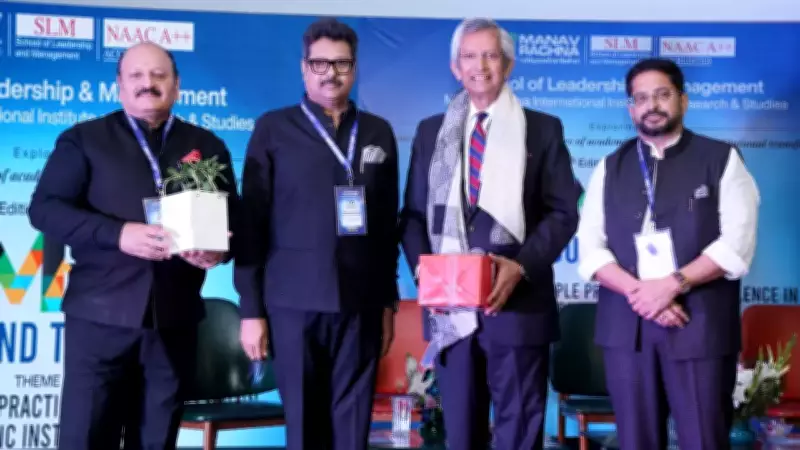
However, traditional people management practices within academia—often narrowly focused on seniority, publication volume, or rigid appraisal systems—are proving increasingly inadequate. As higher education navigates technological upheaval, intense global competition, and rapid societal shifts, a new paradigm is essential. Addressing this imperative, the School of Leadership and Management at Manav Rachna International Institute of Research and Studies (MRIIRS) recently hosted the fifth edition of the MR Round Table. The forum convened under the theme “Progressive People Practices for Excellence in Academic Institutions.”
The event assembled a distinguished gathering of policymakers, vice-chancellors, academic leaders, and industry experts to deliberate on the human dimension of institutional excellence. The central premise was unequivocal: the future of academia will not be determined by infrastructure or technology alone, but fundamentally by people—their motivation, leadership, evaluation systems, and the overarching institutional culture. This focus aligns directly with two core values of Manav Rachna Educational Institutions (MREI): Inclusivity and Integrity.

Leadership Insights on Systemic Alignment
In the inaugural address, Rajeev Dubey, Honorary Director General of MRIIRS, emphasized the systemic nature of achieving institutional performance. “Institutional excellence is the outcome of alignment between purpose, systems, and people,” he stated. “The real question is: are we creating processes that engage people meaningfully and produce value for all stakeholders?” Dubey further highlighted India's position at a critical juncture, possessing immense demographic and intellectual potential. He stressed that realizing this promise requires institutions to significantly strengthen execution capability, talent management, and cultural alignment.
The keynote address by Prof. Prajapati Trivedi offered a profound historical and systemic perspective on performance management. Drawing from extensive experience in government and academic leadership, he underscored the centrality of measurement and accountability. “What gets measured gets done. But performance depends not merely on people, but on systems,” he observed. “If expectations are unclear and accountability is diffused, institutional capacity suffers.” His reflections reinforced a critical sub-theme of the Round Table: the urgent need to reform faculty performance management to recognize quality, contribution, and holistic impact over mere quantitative metrics.
AI and the Future of Teaching
A highly anticipated fireside chat featured Prof. M Jagadesh Kumar, Former Chairman of the University Grants Commission (UGC), in conversation with Narayanan Ramaswamy of KPMG India. Prof. Kumar addressed the profound implications of Artificial Intelligence for the academic profession, articulating a powerful vision for the future of teaching. “Teachers must move from being providers of information to creators of learning ecosystems,” he asserted. “Technology can automate routine tasks, but empathy, mentorship, and the ability to inspire cannot be replaced.”
He emphasized the necessity for institutions to focus on competency-based education and holistic student development, moving beyond traditional degree-centric models. Prof. Kumar also called for comprehensive reforms to assessment systems to actively encourage critical thinking, collaboration, and real-world problem-solving skills among students.

Emerging Themes and Institutional Action
Across various panel discussions and breakout sessions, several interconnected sub-themes emerged prominently:
- Faculty Motivation and Well-being: Participants highlighted widespread concerns regarding faculty burnout and the need to create supportive environments where educators feel genuinely valued, supported, and recognized. It was noted that crucial but often invisible contributions—such as mentoring, institutional development work, and interdisciplinary collaboration—frequently remain undervalued.
- Talent Attraction and Retention: Leaders discussed the challenges of attracting and retaining world-class academic talent amid intense global competition and attractive industry alternatives. The importance of fair evaluation systems, professional autonomy, and clear growth opportunities was strongly emphasized.
- Technology and Collaboration: The Roundtable also explored the practical integration of AI in academic work, the promotion of interdisciplinary teaching, and the strengthening of industry-academia partnerships to enhance student employability—a fundamental requirement of modern degree programs.
The discussions, enriched by inputs from over thirty institutional leaders, culminated in a shared recognition that academic excellence is, at its core, a human endeavor. While systems, policies, and technologies serve as essential enablers, it is the alignment of purpose, visionary leadership, and empowered people that ultimately determines institutional success.
In his closing reflections, Mr. Dubey captured the essence of the deliberations: “The success of this Round Table will not be measured by today’s discussions alone, but by the questions it inspires and the actions it enables when participants return to their institutions.”
A Catalyst for Continued Reform
As the organizing body, the School of Leadership and Management demonstrated its pivotal role in advancing thought leadership within higher education. Dean Dr. Deepti Dabas shared a key takeaway, noting that academics represent a vital blend of virtues and professional competencies. Director Dr. Arnab Chakraborty added that by creating a meaningful dialogue platform for leaders and policymakers, the School reinforces its position as a catalyst for institutional innovation and excellence.
The 5th MR Round Table served as a timely and powerful reminder that the future of education hinges on progressive people practices deeply rooted in purpose, accountability, and enduring human values. As institutions navigate the complexities of an AI-driven era, strategic investment in people—their continuous development, sustained motivation, and empowered leadership—will remain the single most decisive factor in achieving sustainable academic excellence. The conversations initiated at this forum have laid a robust foundation for continued reflection and substantive reform, contributing significantly to the ongoing evolution of India’s higher education ecosystem.