

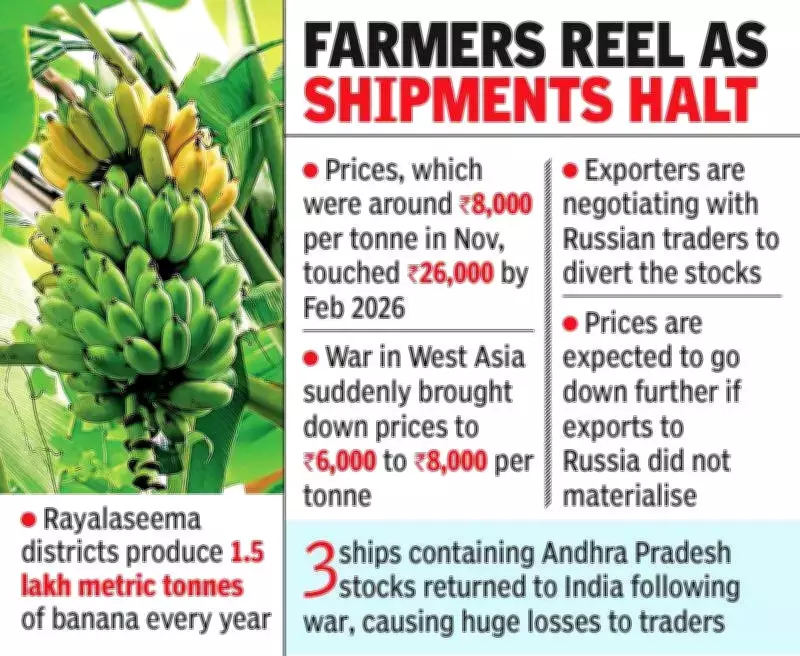
West Asia Conflict Cripples Rayalaseema Banana Exports, Farmers Face Ruin
The escalating tensions and military actions in West Asia, particularly involving Israel, Iran, and allied groups, have delivered a devastating blow to the agricultural economy of Rayalaseema in Andhra Pradesh. Banana farmers across this region, who had built a thriving export business supplying fruit to Gulf nations, are now confronting severe financial distress as international trade routes have been severely disrupted and domestic prices have collapsed.
Export Hubs Paralyzed as Shipments Grind to a Halt
Districts such as Nandyal, Kadapa, Anantapur, and Kurnool had emerged as major centers for banana cultivation, specializing in the popular G-9 variety. These areas were successfully exporting substantial quantities to key markets including Iran, Iraq, Saudi Arabia, the United Arab Emirates, Bahrain, Kuwait, Oman, Qatar, and Jordan. However, the ongoing conflict has crippled these vital trade channels, leading to a dramatic slowdown in export orders.
Syed Shajahan, a leading exporter, highlighted the scale of the disruption: "During peak seasons, nearly 30,000 to 40,000 tonnes of bananas would be shipped monthly from Kurnool and Nandyal. Now, with shipments disrupted, the entire supply chain is thrown off balance, leaving tonnes of produce stranded in cold storages and warehouses." Traders, wary of the uncertainty and security risks in West Asia, have become extremely reluctant to procure large volumes, exacerbating the backlog.

Price Collapse and Mounting Losses for Farmers
With exports stalled, bananas originally destined for overseas markets are now flooding local mandis (markets). This oversupply has caused prices to plummet from a robust ₹14,000–₹26,000 per tonne to a meager ₹6,000–₹8,000 per tonne. For farmers, these rates are insufficient to cover the high costs of cultivation, which include significant investments in planting material, fertilizers, irrigation, and labor.
A farmer named Nayak from Nandyal expressed the widespread despair: "We invested heavily expecting good returns from exports. The sudden and severe slowdown has left us in deep financial trouble, with no way to recover our costs." The perishable nature of bananas compounds the crisis, as without adequate cold-chain infrastructure, farmers are forced to sell quickly at distress prices to avoid total loss.
Broader Economic Impact and Urgent Calls for Intervention
The crisis extends beyond farmers to affect the entire ecosystem dependent on the banana trade. Laborers, packers, and transport operators who rely on this industry for their livelihoods are also facing severe hardship. Traders warn that unless export routes stabilize soon, losses will deepen further, potentially pushing many into long-term financial distress.
In response, stakeholders are urgently calling for government intervention. Key demands include:
- Exploring and securing alternative export markets to diversify trade dependencies.
- Implementing stronger price support mechanisms in domestic markets to cushion farmers.
- Providing immediate financial aid or relief measures to affected growers and workers.
Some exporters are reportedly negotiating with Russian traders to divert stocks, but success is uncertain. The situation remains precarious, with fears that prolonged disruption could devastate the regional economy, given that Rayalaseema produces approximately 1.5 lakh metric tonnes of bananas annually and thousands of acres are under cultivation.






