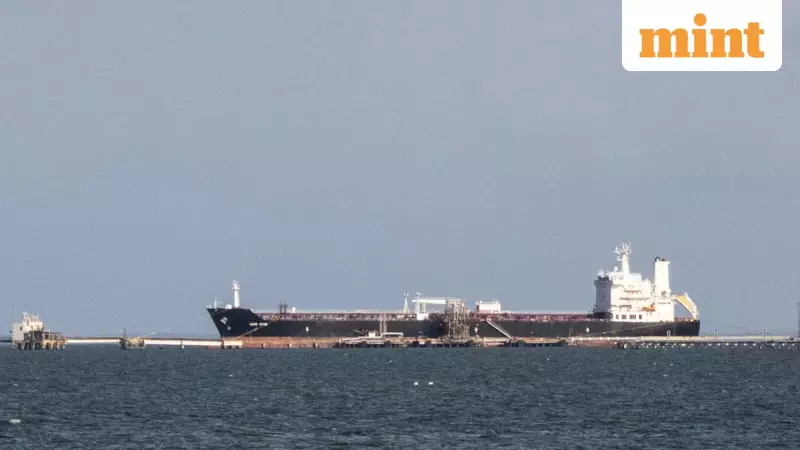
In a bold move that crystallises a worldview he has held for nearly four decades, US President Donald Trump is leveraging military action in Venezuela to seize control of the nation's vast oil reserves. This audacious strategy, aimed at combating inflation and weakening geopolitical rivals, marks a dramatic shift in American foreign policy and carries significant risks for the global energy market.
From Oprah's Couch to Caracas: The Genesis of an Idea
The roots of President Trump's current Venezuela policy can be traced back to a 1988 appearance on The Oprah Winfrey Show. A 41-year-old Trump, in his signature red tie, argued that America deserved a cut of Kuwaiti oil for protecting its tankers during the Iran-Iraq War. "Kuwait is not paying us for all the oil they're sending out," he told Oprah, complaining that Kuwaitis "live like kings" under US protection. This belief—that American military intervention should be repaid in energy resources—has been a consistent thread through his public commentary for over 40 years.
Now, in his second term, Trump is acting on this long-held conviction. Following the US operation that ousted Venezuelan leader Nicolás Maduro, Trump announced the US would take possession of up to 50 million barrels of sanctioned Venezuelan oil, to be sold on the open market with profits shared between the US and Venezuela. A senior administration official stated the President believes lowering oil prices is key to reducing Americans' cost of living ahead of the crucial midterm elections.

Geopolitical Calculus and Domestic Economic Risks
Trump's Venezuela venture is a multi-pronged gambit. It aims to use oil as a tool against adversaries like Russia and Iran, while simultaneously flooding the market to bring down prices and tame inflation. "Low energy prices are like a massive tax cut for everybody in the U.S.," said Jeff Nichols, a partner at Dallas law firm Haynes and Boone.
However, the strategy is fraught with peril. The global market is already oversupplied, unlike the era of scarcity that shaped Trump's early views. A deliberate price crash could injure the very US oil industry that strongly supported his campaign. US oil prices have already fallen 26% since he took office, squeezing domestic producers. Furthermore, reviving Venezuela's dilapidated oil sector requires tens of billions in investment from US companies and would take years, even under ideal conditions.
The move also threatens to upend decades of US foreign policy, where Washington built goodwill by guaranteeing safe oil passage for all nations. "This puts our credibility at risk," said Ramanan Krishnamoorti, an energy expert at the University of Houston, noting the US has removed a leader but now controls the country's resources.
Clash with OPEC and the Long Road Ahead for Venezuela
The plan sets the stage for a potential clash with OPEC, of which Venezuela is a founding member. Energy specialist Jim Krane of Rice University's Baker Institute warned that a US-controlled Venezuelan oil industry could become a market adversary to OPEC, similar to US shale producers in the 2010s. "They finally seemed to figure shale out, and here comes another curveball," Krane said.
On the ground, the challenges are immense. Chevron, the only major US driller operating in Venezuela, could potentially increase production by 50,000 to 300,000 barrels per day by repairing infrastructure, but significant boosts will take years. Oil majors like Chevron, Exxon Mobil, and ConocoPhillips are expected to seek financial guarantees and security assurances from the Trump administration before committing major investments to a country still plagued by instability.
As President Trump prepares to meet with oil executives to discuss reviving Venezuela's oil sector, the world watches a real-time experiment. It is an experiment born from a 1980s interview, driven by a desire to fight inflation, and one that risks reshaping America's role in the global energy order for decades to come.