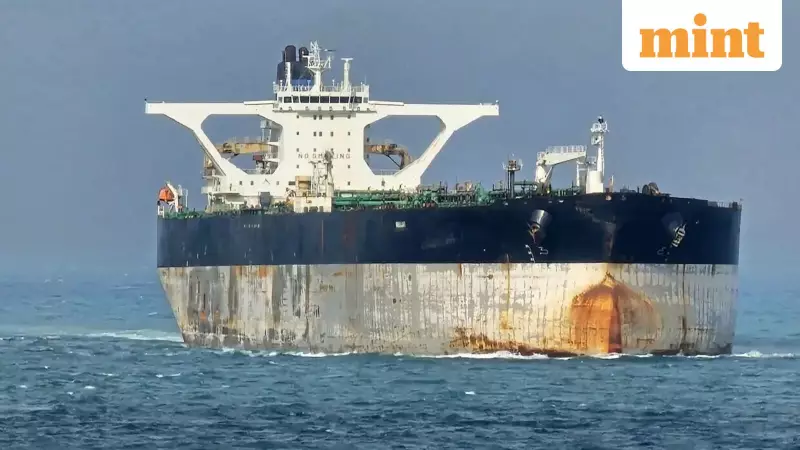
The high seas are witnessing a clandestine maritime war, fought not with warships but with a vast, ghostly armada of aging oil tankers. Known as the shadow fleet, this network of over 1,470 vessels is the lifeblood for sanctioned nations like Russia, Iran, and Venezuela, enabling them to move billions of barrels of oil while evading Western sanctions. A recent dramatic seizure by U.S. forces has thrown this secretive operation into sharp relief, revealing the extreme lengths taken to keep the illicit crude flowing.
The Clandestine Operation at Sea
Earlier this month, a textbook shadow fleet maneuver unfolded in the Sea of Japan. Two sanctioned tankers, the Kapitan Kostichev and the Jun Tong, switched off their identifying transponders and rendezvoused. Using satellite and shipping data, analysts at Kpler watched as the Kapitan Kostichev transferred a staggering 700,000 barrels of Russian crude to the Jun Tong in a covert ship-to-ship transfer. This risky operation at sea is a standard tactic to disguise the origin and destination of sanctioned cargo.
The global crackdown on this network turned kinetic recently. In a bold move, U.S. Special Forces descended from helicopters onto the deck of the Russia-flagged tanker Marinera in the Atlantic Ocean south of Iceland. The vessel, which days earlier was sailing under a false flag as the Bella 1, was fleeing U.S. action against carriers of Venezuelan oil. It was captured with a Russian naval escort but was empty at the time. This action, alongside the boarding of another tanker near the Caribbean broadcasting a false Nigerian location, signals a decisive shift from pure sanctions to military enforcement.

Disguise and Deception: The Shadow Fleet's Toolkit
Operating in the shadows requires a sophisticated playbook of deception. The core strategy involves constantly changing a vessel's identity. The tanker seized in the Atlantic, for instance, was renamed to Marinera just days after being pursued by the U.S. Coast Guard in December; its past aliases include Neofit and Yannis. Crews frequently falsify GPS coordinates and transmit duplicate signals to create 'ghost ships' on tracking radars.
A critical tool is the use of 'flags of convenience'. International law requires ships to be registered to a flag state, which governs its regulations. Shadow tankers often register with smaller, non-Western nations like Cameroon, Gabon, or Comoros, which offer cheaper fees, lower taxes, and minimal oversight. The Jun Tong, for example, currently sails under the Cameroon flag but has previously used registries from Malta, the Marshall Islands, and Panama. This lax oversight allows these vessels to sidestep global standards for insurance and crew welfare.
The Scale, Risks, and Fight to Stop the Fleet
The scale of this operation is monumental. According to TankerTrackers.com, the shadow fleet has swollen since 2022 as Russia sought routes around sanctions for its war on Ukraine. S&P Global estimates these vessels represent 17% of all tankers transporting oil and chemicals globally. In 2025 alone, Kpler data shows the shadow fleet moved about 3.7 billion barrels of oil, accounting for 6-7% of global crude flows.
This fleet poses significant environmental and safety risks. About one-third of these tankers are over 20 years old, making them prone to major accidents. Cut off from Western insurance markets due to sanctions, many sail with unreliable coverage or none at all. Ownership is deliberately obscured through a web of shell companies in Dubai, Hong Kong, and the Marshall Islands.
Western powers are escalating their response. Beyond sanctions, Ukraine's navy used drones to attack sanctioned Russian oil tankers in the Black Sea last year. As Nathanael Kurcab of law firm Morrison Foerster notes, the situation has reached a point where military assets are now being used to enforce economic blockades, a significant evolution in sanctions policy. The cat-and-mouse game on the world's oceans is entering a new, more confrontational phase.