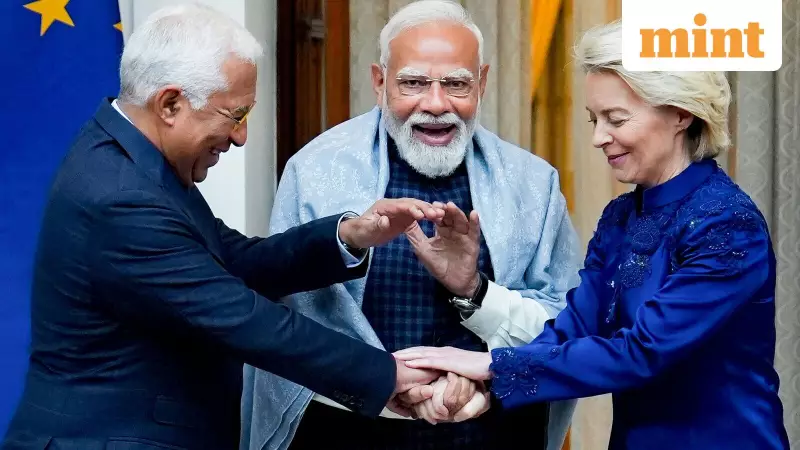
India and European Union Seal Historic Free Trade Agreement
In a significant development for global trade, India and the European Union (EU) announced the successful conclusion of negotiations for a comprehensive Free Trade Agreement (FTA) on Tuesday, 27 January, during the 16th India–EU Summit. This landmark pact, often referred to as "the mother of all deals," is poised to reshape economic relations between two of the world's largest economies.
The official statement emphasized that the FTA seeks to strengthen economic and political ties between India and the EU, which rank as the world's second and fourth largest economies, respectively. This move comes at a critical juncture marked by rising geopolitical tensions and global economic challenges, underscoring their joint commitment to economic openness and rules-based trade.
What the EU Offers India Under the FTA
Under the terms of the agreement, India will gain preferential access to European markets for an impressive 97% of tariff lines, which account for 99.5% of its trade value with the EU. According to a statement from the Ministry of Commerce, this includes substantial benefits for key sectors:

- Around 90.7% of India's exports will benefit from immediate duty elimination in labor-intensive sectors such as textiles, leather and footwear, tea, coffee, spices, sports goods, toys, gems and jewellery, and certain marine products.
- Nearly 2.9% of Indian exports will achieve zero-duty access within 3 to 5 years for specific items like marine products, processed foods, arms, and ammunition.
- An additional 6% of goods will receive preferential access through tariff reductions, covering products such as certain poultry, preserved vegetables, bakery items, and others.
This translates to a major boost for Indian exporters, with approximately $33 billion in exports currently facing import duties of 4% to 26% in the EU set to enter duty-free upon the FTA's implementation, thereby enhancing their competitiveness in the European market.
What India Offers the EU Under the FTA
In return, India is providing the EU with access to 92.1% of its tariff lines, representing 97.5% of EU exports to India. The phased approach to tariff elimination includes:
- 49.6% of these lines will have duties eliminated immediately.
- 39.5% will undergo phased eliminations over periods of 5, 7, and 10 years.
- An additional 3% of products are slated for phased tariff reductions, with certain items like apples, pears, peaches, and kiwi fruit subject to trade rate quotas (TRQs).
Tariff Differences for Major EU Exports to India
The FTA brings significant tariff reductions for key EU exports, making the Indian market more accessible:
- Machinery and electrical equipment: Tariffs will drop from 44% to 0% for almost all products over a 10-year period.
- Aircraft and spacecraft: Most products will see tariffs cut from 11% to 0% within 10 years.
- Optical, medical and surgical equipment: Duties will be reduced from 27.5% to 0% for 90% of goods.
- Plastics: Tariffs will decrease from 16.5% to 0% for nearly all goods over 10 years.
- Pearls, precious stones and metals: Duties will fall from 22.5% to 0% for 20% of products, with reductions for another 36% within 10 years.
- Chemicals: Tariffs will be cut from 22% to 0% on almost all goods.
- Motor vehicles: Tariffs will reduce from 110% to 10%, with a quota of 250,000 units.
- Iron and steel: From 22% to 0% for almost all products in 10 years.
- Pharmaceuticals: Duties will be reduced from 11% to 0% over a 10-year period.
This comprehensive agreement marks a pivotal step in fostering deeper economic integration between India and the EU, promising mutual benefits and enhanced trade flows in the years to come.