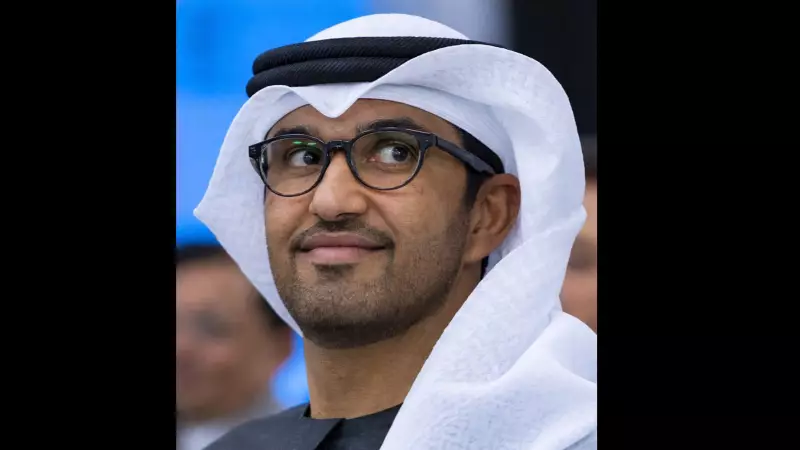
India Positioned as Central Player in Global Energy Megatrends, UAE Minister Declares
India stands at the heart of the megatrends that are currently shaping global energy demand, according to Sultan Ahmed Al Jaber, the UAE's Minister of Industry and Advanced Technology. Speaking at the India Energy Week, Al Jaber emphasized that India has evolved into a decisive driver of worldwide energy consumption, a trend expected to accelerate significantly in the coming years.
Three Megatrends Defining the Energy Landscape
Al Jaber identified three key megatrends that are redefining the global energy narrative, with India playing a pivotal role in each:
- The rise of emerging markets, particularly India's rapid economic growth and urbanization.
- The expansion of artificial intelligence and digital infrastructure, driving increased electricity demand.
- The transformation of energy systems to incorporate diverse sources rather than relying on single energy forms.
"At the heart of all three megatrends sits one nation, and that is India," Al Jaber stated during his address. "As the world's third-largest energy consumer, it has become a decisive driver of global demand."

Projected Growth in Energy Consumption
The UAE minister presented compelling statistics highlighting India's expanding energy needs:
- Air travel in India is projected to grow by 150% over the next 15 years.
- Indian cities will approach one billion residents as urbanization continues.
- Data center capacity in the country is expected to increase ten-fold.
"Together, these megatrends are driving the largest expansion of energy demand in human history, faster, broader and more complex than anything we have seen before," Al Jaber emphasized.
Global Energy Demand Projections
According to Al Jaber's analysis, between now and 2040:
- Global oil demand will likely remain above 100 million barrels per day.
- Demand for liquefied natural gas (LNG) is expected to rise by 50%.
- Electricity demand is projected to increase by half.
"Demand at this scale and pace requires investment in all forms of energy," he cautioned. "The biggest risk is not over supply, it is underinvestment."
Deepening India-UAE Energy Partnership
Al Jaber, who also serves as Managing Director and Group CEO of the Abu Dhabi National Oil Company (ADNOC), highlighted the strengthening energy relationship between India and the UAE:
- The UAE has become India's fourth-largest source of oil imports, behind Russia, Iraq, and Saudi Arabia.
- ADNOC serves as a trusted supplier of crude oil to fuel India's refineries.
- The UAE has designated India as its number one market for LNG as the country aims to double natural gas in its energy mix.
- The UAE is already India's largest supplier of liquefied petroleum gas (LPG) for household cooking needs.
"As India consumes more crude to fuel its refineries, ADNOC is proud to be a trusted, dependable supplier," Al Jaber affirmed.
Renewable Energy Investments and Climate Initiatives
Beyond traditional energy sources, the UAE is investing significantly in India's renewable energy sector:
- Through its global climate investment vehicle Altérra, the UAE is investing across 11 gigawatts of solar, wind, and storage projects in India.
- Altérra represents the world's largest private climate investment fund with a $30-billion commitment from the UAE.
- The fund aims to mobilize additional investments of up to $250 billion by 2030.
Broader Economic Relationship Between India and UAE
Al Jaber characterized the India-UAE partnership as "strategic, long-term, agile, and flexible" while also being "steadfast, dependable, principled, and consistent."
The economic relationship between the two nations has reached significant milestones:

- India-UAE trade breached the $100-billion mark last year.
- During UAE President Sheikh Mohamed bin Zayed Al Nahyan's recent India visit, both countries agreed to double bilateral trade to $200 billion by 2032.
- The trade relationship spans multiple sectors including energy, technology, logistics, infrastructure, health, education, and tourism.
"As Prime Minister Narendra Modi put it so clearly, India does not do progress in increments, it goes for quantum leaps," Al Jaber noted. "And progress at this pace, and growth at this scale demands a special kind of partnership."
India's Energy Import Dependence
The minister's remarks come against the backdrop of India's significant reliance on energy imports:
- India depends on imports to meet over 88% of its oil demand.
- Approximately half of the country's natural gas requirements are met through imports.
- India imports around two-thirds of its LPG needs.
Al Jaber's comprehensive address at India Energy Week underscores India's growing influence in global energy markets and the deepening strategic partnership between India and the UAE across traditional and renewable energy sectors.