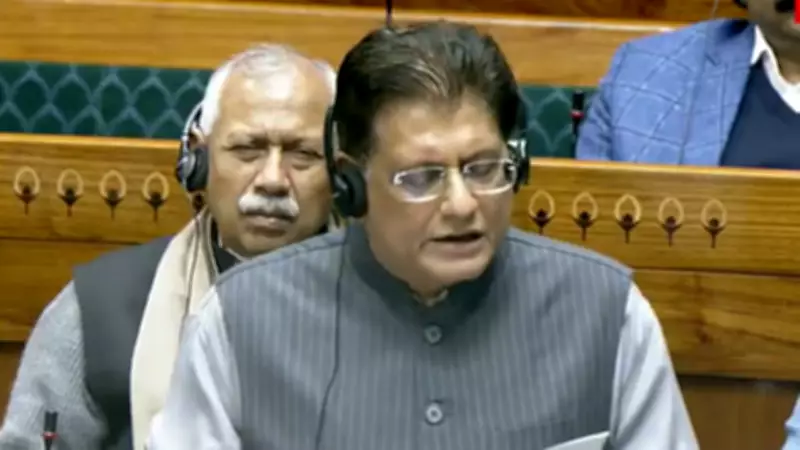
Commerce Minister Piyush Goyal Defends India-US Trade Agreement in Lok Sabha
Union Commerce and Industry Minister Piyush Goyal on Wednesday strongly defended the recently concluded India-US bilateral trade agreement during a session in the Lok Sabha. He emphasized that India had successfully safeguarded its sensitive sectors, particularly agriculture and dairy, following nearly a year of intensive negotiations between the two nations.
Protection of Critical Interests During Negotiations
"As the Members of the House are aware, since Prime Minister Narendra Modi's visit to the United States in February 2025, India and the US have been regularly engaged in discussions with the objective of concluding a balanced and mutually beneficial bilateral trade agreement," Goyal stated. He elaborated that negotiators from both countries conducted multiple rounds of discussions at various levels over the past twelve months.
The minister highlighted that during these negotiations, the Indian side successfully ensured the protection of its sensitive sectors, particularly agriculture and dairy. He noted that the United States also had areas it considered sensitive, making the negotiations a complex balancing act between two major economies.

Year-Long Talks Yield Finalized Key Sectors
Goyal explained that it was natural for both sides to protect their critical interests while seeking the best possible outcome. "After several rounds of deliberations spanning approximately one year, the negotiators from both sides have succeeded in finalizing several areas of the bilateral trade agreement," he informed the Lower House.
The minister outlined several benefits of the agreement for India:
- Promotion of flagship initiatives including Viksit Bharat, Atmanirbhar Bharat, Make in India, and Design in India for the world
- Enhanced export competitiveness for Indian exporters
- New opportunities for skilled Indian professionals in the US market
- Access for Indian micro, small and medium enterprises (MSMEs) to American markets
Tariff Reduction Lower Than Competitor Nations
Referring to the recent conversation between Prime Minister Modi and US President Donald Trump, Goyal revealed, "On 2nd February 2026, PM and US President Donald Trump held a telephonic conversation on several matters of bilateral and international importance. After this, President Trump announced a reduction in tariff to 18 per cent."
The minister emphasized a crucial point about this tariff reduction: "I would like to emphasize the fact that this tariff is lower than the US tariff on several competitor nations." He further added that energy security for Indians remains the top priority of the government.
Balanced Agreement Strengthening Bilateral Ties
Goyal maintained that the agreement successfully balanced the interests of both countries while protecting India's core sectors and strengthening bilateral trade relations. The announcement follows US President Donald Trump's declaration on his social media platform Truth Social that India and the US had "agreed to a trade deal" and that the US would reduce tariffs on Indian products from 25 percent to 18 percent.
Prime Minister Narendra Modi later acknowledged Trump's announcement in a post on X, stating, "Delighted that Made in India products will now have a reduced tariff of 18%. Big thanks to President Trump on behalf of the 1.4 billion people of India for this wonderful announcement. When two large economies and the world's largest democracies work together, it benefits our people and unlocks immense opportunities for mutually beneficial cooperation."
The comprehensive trade agreement represents a significant milestone in India-US economic relations, with both nations carefully navigating their respective sensitivities to create what officials describe as a mutually beneficial arrangement that respects each country's strategic priorities while opening new avenues for economic cooperation.