

Bengal Exporters Face Uncertainty with New US 10% Universal Tariff Announcement
Exporters across West Bengal's leading sectors are expressing deep concern and anxiety following the announcement of a 10% universal tariff by US President Donald Trump. This development comes in the wake of a US Supreme Court verdict that declared his previous global tariffs illegal, creating a volatile trade environment for Indian businesses.
Significant Export Decline and Market Diversification
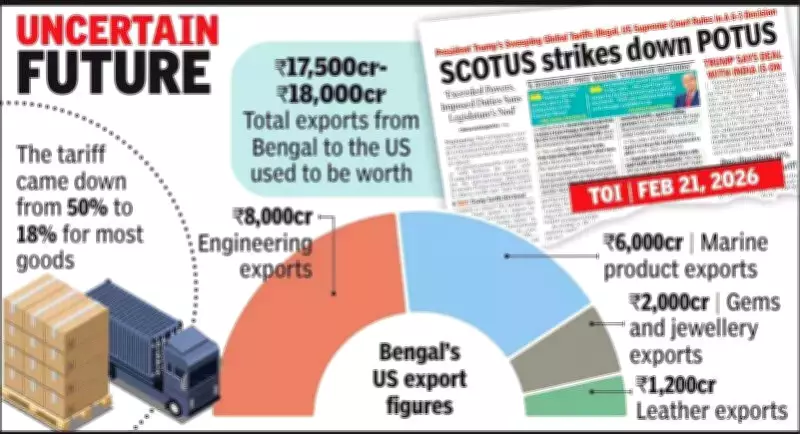
The Bengal export industry has already endured substantial losses, with a Rs 3,000 crore to Rs 3,500 crore decline in exports to the United States over the past five months. This downturn was triggered by a 50% US tariff imposed on various Indian products earlier this year. In response, exporters have been exploring new markets to mitigate the impact.
- The United Arab Emirates (UAE)
- China
- European Union countries
These alternative markets have managed to compensate for approximately 15% to 20% of the export deficit to the US. Despite this diversification effort, the total export value to the United States from Bengal remains substantial at around Rs 17,500 crore to Rs 18,000 crore, making the US market critically important for the region's economy.

Industry Leaders Express Cautious Optimism and Concerns
Sanjay Jain, Chairman of the ICC National Committee on Textiles, provided historical context about the evolving duty structure. "Before April 2025, different Indian products faced duties ranging from 2% to 10%," he explained. "Then came the 50% duty, followed by the announcement of an 18% duty. The new duty structure that has been announced should be lower if we add the basic customs duty for garments, but we do not know what will happen next week."
Arjun M Kulkarni, President of the Indian Leather Product Association, revealed that uncertainty persists even among US associates. "We have spoken to a few of our associates in the US, but nobody is sure whether the Trump administration will impose any new section or not," he stated. "If things stand where they are now, the duty on leather goods will be 18.5% (10% + 8.5% basic customs duty), which was 26.5%, but we have to see whether there will be any further decisions."
Sector-Specific Impacts and Future Outlook
Arun Garodia, Immediate Past President of the Engineering Export Promotion Council (EEPC), noted some temporary relief for engineering exporters. "As of now, it is good for engineering exporters as a 10% duty will be charged for the next five months," he observed. However, he cautioned that "one never knows whether the US administration will apply any new sections or not."
Garodia further explained that for engineering exports, the basic customs duty was 0% to 3% before March 2025. "As of now, 10% plus basic customs duty is less than the reciprocal duty of 18%, but we have to wait and watch," he added, emphasizing the need for continued monitoring of the situation.
In the gems and jewellery sector, Pankaj Parekh, Chairman (East) of the Gems and Jewellery Export Promotion Council, highlighted a temporary exemption. "Diamonds and jewellery, as of now, attract 0% duty, and it will be applicable up to February 24," he noted. "If any new sections come, it will be applicable after that."
Rajarshee Banerjee, a board member of the national managing committee of the Seafood Exporters' Association of India, echoed the prevailing sentiment of uncertainty. He emphasized that the situation remains "still not clear" for marine product exporters, reflecting the broader apprehension across Bengal's export sectors.
The collective anxiety among Bengal exporters stems from the unpredictable nature of US trade policy under the current administration. While some sectors may experience temporary relief compared to previous duty structures, the looming possibility of additional sections or policy changes keeps the industry in a state of cautious anticipation. Exporters are advised to maintain flexibility in their market strategies while closely monitoring developments in US trade regulations.






