

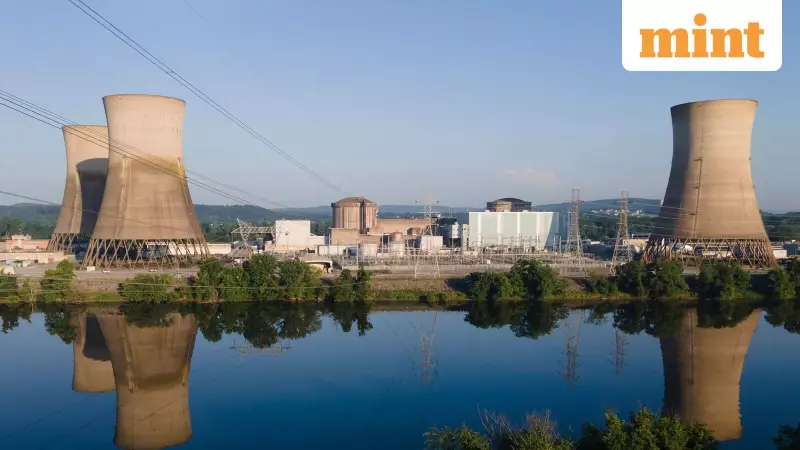
The Trump Administration has approved a significant $1 billion federal loan to Constellation Energy to restart the historic Three Mile Island nuclear power plant in Pennsylvania. This landmark decision marks a major shift in America's energy policy and represents one of the most substantial investments in nuclear power in recent decades.
The Nuclear Revival Deal
Energy Secretary Chris Wright announced the groundbreaking initiative on Tuesday, emphasizing that restarting the previously mothballed facility will help combat rising electricity prices across the United States. The administration has committed to bringing more nuclear generation online as part of a broader strategy to strengthen national energy security.
"We want to bring as much addition of reliable electricity onto the grid to stop these price rises," Wright stated during the announcement. He further highlighted that such strategic moves would significantly contribute to "reshoring manufacturing in our country," bringing industrial production back to American soil.

The deal specifically calls for Constellation Energy to revive the plant's undamaged reactor, which had been deemed too costly to operate and was consequently closed in 2019. This reactor had continued operations for decades after the famous 1979 partial core meltdown that affected the facility's other reactor.
Microsoft's AI Power Demands
Constellation Energy revealed last year its ambitious plan to restart the Three Mile Island site, which witnessed the country's worst nuclear power accident, to primarily generate electricity for technology giant Microsoft. The tech behemoth requires substantial additional power capacity to fuel its rapidly expanding artificial intelligence business operations.
Under a comprehensive 20-year power purchase agreement, all electricity generated by the revived nuclear plant will be sold exclusively to Microsoft. This arrangement addresses the technology industry's nearly insatiable demand for round-the-clock power supply essential for operating AI data centers, which consume enormous amounts of electricity continuously.
The timing aligns perfectly with Microsoft's aggressive expansion in artificial intelligence, requiring stable, carbon-free power sources that can operate 24/7 without interruption - something renewable energy sources alone cannot guarantee.
Broader Nuclear Energy Strategy
The Trump administration has emerged as a strong proponent of nuclear power, setting an ambitious target to quadruple U.S. nuclear generation capacity by 2050. This visionary plan involves both restarting existing reactors and developing 10 large-scale new nuclear facilities that would expand the nation's nuclear capacity from the current 100 gigawatts to an impressive 400 gigawatts.
This represents a dramatic acceleration in nuclear energy development, especially considering that the United States has added only three new large reactors since the 1990s. The most recent nuclear projects faced significant delays and substantial budget overruns, highlighting the challenges in nuclear infrastructure development.
Wright confirmed that Three Mile Island's revival will contribute approximately 800 megawatts of reliable power generation to the national grid. Constellation Energy has committed to investing about $1.6 billion to restart the plant, with operations expected to recommence in 2027.
The company has strategically rebranded the site as the Crane Clean Energy Center, distancing it from the historical incident while emphasizing its renewed purpose. Constellation officials noted that under the Trump administration's streamlined approach, it has become possible to "vastly expedite this restart without compromising quality or safety."
Wright also highlighted that the Nuclear Regulatory Commission has shifted its focus toward reducing bureaucracy while maintaining rigorous safety standards. "With the new generation of reactors that's even easier," he added, signaling a new era for nuclear power regulation in the United States.

The revival of Three Mile Island occurs against the backdrop of changing global energy dynamics. Following Russia's invasion of Ukraine and subsequent energy crises in Europe stemming from sanctions on Russian natural gas, perceptions about nuclear power have evolved significantly. Countries including France, Japan, and the United Kingdom are similarly looking to expand nuclear power within their national energy grids.





