

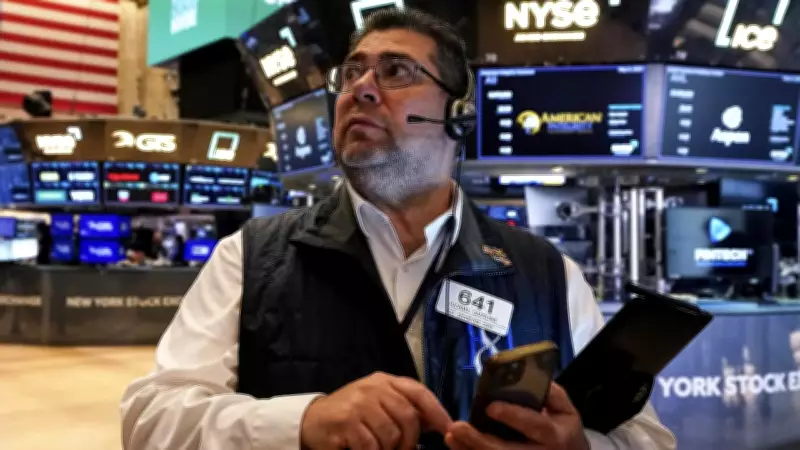
Wall Street Stages Modest Rebound Despite Widening Middle East Conflict
In a session marked by cautious optimism, Wall Street's primary indices managed to edge higher during choppy trading on Monday. This recovery followed the significant losses experienced in the previous session, even as geopolitical tensions in the Middle East continued to escalate, keeping investor sentiment restrained.
Key Index Movements and Sector Performance
According to Reuters data from early trading, the Dow Jones Industrial Average demonstrated resilience with a gain of 0.48 percent. Simultaneously, the S&P 500 index advanced by 0.32 percent, while the technology-heavy Nasdaq Composite recorded a more modest increase of 0.19 percent.
The rebound occurred against a complex geopolitical backdrop. US President Donald Trump indicated that Washington was engaged in serious discussions with what he described as a "more reasonable regime" to potentially end the ongoing conflict. However, he simultaneously reiterated stern warnings directed at Iran, demanding the reopening of the strategically vital Strait of Hormuz and threatening US strikes on Iranian oil and power infrastructure if compliance was not forthcoming.

Geopolitical tensions intensified further over the weekend with the entry of Yemen's Iran-backed Houthi militia into the regional conflict, adding another layer of uncertainty to an already volatile situation.
Energy and Financial Sectors Drive Market Advance
Energy stocks emerged as the clear leaders in Monday's trading session. The S&P 500 Energy Index surged by an impressive 1.5 percent, reflecting investor response to rising oil prices linked to the Middle East tensions. Individual energy giants showed strong performance, with Exxon Mobil shares climbing 3 percent and Chevron adding 1.5 percent to its valuation.
Sam Stovall, Chief Investment Strategist at CFRA Research, provided context to Reuters, noting, "The S&P 500 is still down less than 10 percent since the war began. In many ways, investors have been affected less by the implications of the Strait of Hormuz being closed than I would have thought." He further suggested that "Today's action is probably more of a technical bounce because many sectors and sub-industries are in oversold condition."
The financial sector also contributed significantly to the market's upward movement, gaining 0.8 percent. This advance followed the US Department of Labor's issuance of new guidelines that clarify how trustees can incorporate alternative assets—including private equity and cryptocurrencies—into 401(k) retirement plans. Major asset management firms benefited from this development, with Blackstone rising 1.7 percent, KKR gaining 1.4 percent, and Apollo Global Management increasing by 1 percent.
Broader Market Context and Economic Indicators
Overall market breadth showed positive momentum, with nine of the eleven major S&P 500 sectors trading in positive territory during the session. However, despite this uptick, major US indices including the Dow, Nasdaq, and Russell 2000 remain in correction territory since the conflict's inception.
In a significant strategic shift, Morgan Stanley downgraded its stance on global equities from "overweight" to "equal weight." The firm noted, however, that capital flows into US equities and bonds have strengthened, suggesting that the United States may be regaining its traditional appeal as a safe-haven destination for global investors.
Market participants are now keenly awaiting remarks from Federal Reserve Chair Jerome Powell and New York Fed President John Williams, scheduled for later in the day. Additionally, key labor market data this week, including the crucial March nonfarm payrolls report, will be closely monitored for signals about the health of the US economy.
Inflation Concerns and Individual Stock Movements
Rising oil prices, directly linked to the Middle East conflict, have reignited concerns about persistent inflation. According to data from CME Group's FedWatch Tool, market participants have now completely priced out any expectations for Federal Reserve interest rate cuts this year. This represents a dramatic shift from pre-conflict expectations, which had anticipated as many as two rate reductions in 2024.

Individual stock movements presented a mixed picture. Sysco Corporation experienced a dramatic plunge of 12 percent following its announcement of a massive $29 billion acquisition of Jetro Restaurant Depot, a deal that includes assumed debt. Conversely, metal stocks staged a strong rally as aluminum prices hovered near four-year highs. Alcoa surged by 12 percent, while Century Aluminum recorded an even more impressive gain of 13.6 percent.
Market technicians noted that advancing stocks significantly outpaced decliners, with ratios of 2.69-to-1 on the NYSE and 1.49-to-1 on the Nasdaq. The S&P 500 recorded 19 new 52-week highs against just 4 lows, while the Nasdaq saw 17 new highs contrasted with 121 new lows.
Investors should note that US markets will remain closed on Friday in observance of the Good Friday holiday, potentially adding to trading volatility earlier in the week as participants adjust their positions ahead of the extended break.





