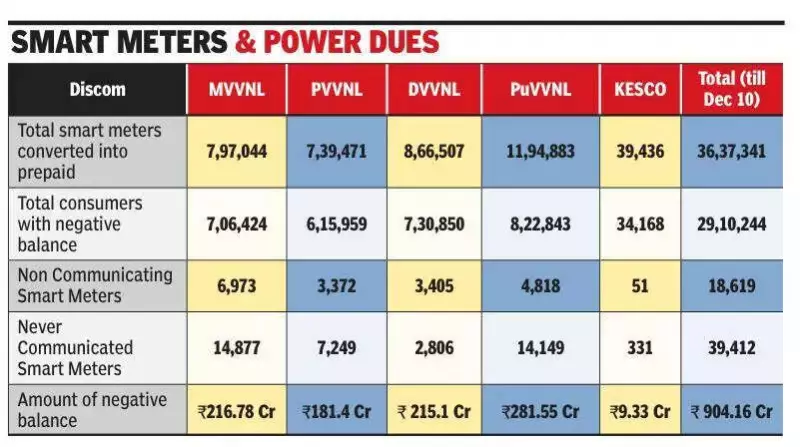
A flagship initiative aimed at revolutionizing power distribution in Uttar Pradesh has hit a major roadblock. A recent review by the Uttar Pradesh Power Corporation Ltd (UPPCL) has uncovered a staggering Rs 904.16 crore in unpaid electricity dues from consumers who were supposed to be on smart prepaid meters, a system designed precisely to prevent such defaults.
Mounting Dues and Widespread Defaults
The data, current as of December 10, paints a concerning picture. Out of the 54.35 lakh smart meters installed across the state, 36.37 lakh have been switched to prepaid mode. Shockingly, 29.10 lakh consumers are currently running on a negative balance, meaning they owe money for power already consumed.
The problem is widespread across all discoms. The Purvanchal discom leads with 8.22 lakh defaulting consumers owing Rs 281.55 crore. It is followed by Dakshinanchal with 7.3 lakh consumers (Rs 215.1 crore) and Madhyanchal with 7.06 lakh consumers (Rs 216.78 crore).

A deep dive into the payment patterns reveals more systemic issues. A massive 17.85 lakh consumers haven't paid their dues in the last three months. Furthermore, a startling 6.9 lakh consumers across UP have recharged their smart prepaid meter only once since its installation, indicating a possible rejection or misunderstanding of the new system.
Technical Glitches Compound Billing Confusion
The crisis is not solely due to consumer non-payment. Significant technical failures are exacerbating the situation. The UPPCL report flags 39,412 smart meters as 'non-communicating'—they fail to send real-time data to the central Meter Data Management System (MDMS). Another 18,619 meters have 'never communicated' since their installation under the RDSS scheme.
Errors in core billing systems have also emerged. An assistant engineer in Jhansi flagged incorrect data migration from the workforce management portal to the MDMS, including wrong multiplication factor values. This factor is crucial for converting raw meter readings into accurate consumption data, and errors here can lead to incorrect bills and revenue loss for discoms.
Official Response and Consumer Grievances
UPPCL Chairman Ashish Kumar Goel acknowledged the issue. He stated that while the majority of defaults are from consumers not recharging, no coercive action like disconnection is being taken immediately. He also admitted to network issues for meters installed in basements or shadow areas, for which manual billing is being arranged.
Regarding the faulty meters, Goel said payment would be withheld from the companies responsible for installation and maintenance until the issues are fixed. Meanwhile, consumer advocacy groups present a different side. Avadhesh Kumar Verma, chairman of the UP Rajya Vidyut Upbhokta Parishad, pointed out that social media is flooded with complaints about delayed billing and mounting dues. He emphasized the moral responsibility of discoms to resolve these issues and restore public trust.
The situation presents a paradox: a technology introduced to enhance billing efficiency and ensure regular collections is struggling with exactly the problems it was meant to solve. With crores in dues pending and thousands of meters malfunctioning, the path to a 'smart' power grid in Uttar Pradesh appears to need a urgent course correction.