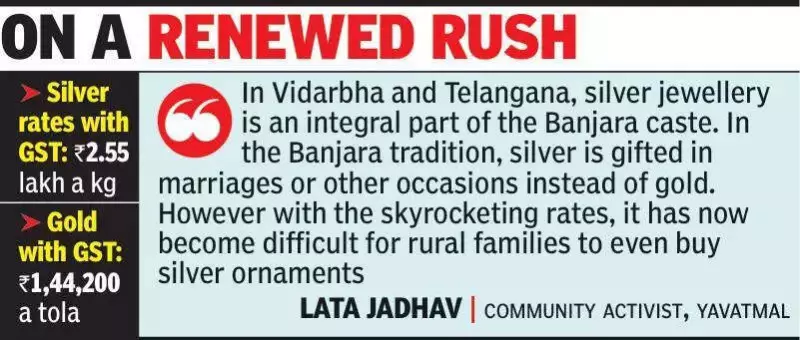
In an unprecedented weekend surge, silver prices in Nagpur shattered records, crossing the staggering mark of ₹2.5 lakh per kilogram on Saturday. This sharp ascent defied typical market behavior, occurring on a day when commodity exchanges are traditionally closed, sending shockwaves through the local bullion trade.
A Weekend of Unprecedented Volatility
The precious metal opened with a massive jump of ₹28,000 per kg compared to Friday's closing rate. While physical markets usually draw their rates from domestic commodity bourses like the Multi Commodity Exchange (MCX), leading to minimal weekend movement, this Saturday was a stark exception. The prices, after closing at ₹2.28 lakh a kg on Friday, soared to a high of ₹2.53 lakh per kg on Saturday morning before finally settling at ₹2.48 lakh a kg.
Gold was not left behind in this rally. According to data maintained by the Nagpur Sarafa Association, the yellow metal touched ₹1.4 lakh per tola (10 grams) on Saturday, marking a rise of ₹3,000 from the previous day.

Global Squeeze Halts Local Business
Traders attribute this dramatic rise to a confluence of global factors, with a primary driver being China's move to restrain exports, creating a tight squeeze in the international supply. This extreme volatility brought business in India to a standstill. Retailers, who typically source silver from bulk bullion traders via B2B apps, found all trading platforms blank on Saturday.
Bullion merchants stopped quoting any rates due to the unpredictable market. Rajesh Thakher of M/s Dipti Jewellers in Akola explained the dilemma: "It's difficult to offer any price in such a situation. Rates are not stable. By the time a bullion trader fixes a deal at certain rates, prices can further go up, leading to a loss. Under these circumstances, traders prefer not to offer any price at all."
Sourcing Rates from Global Markets
Rajesh Rokde, Chairman of the Gems and Jewellery (Domestic) Council, shed light on the shift in pricing mechanisms. "Normally the rates in Multi Commodity Exchange (MCX) in India are followed. However, of late, the prices are directly sourced from the global market due to the rapid increase in bullion rates," he said.
He added that due to differing global time zones, some market is always open. This time, the industry took cues from the London Bullion Market Association (LBMA), which was operating during the night in India, leading to the domestic price translating to ₹2.53 lakh a kg for silver.
The consequences of this price explosion are being felt deeply. Trade sources confirm that retail demand has been severely impacted. Pankaj Bakhai of M/s Anantrai and Sons in Itwari highlighted the broader effect: "Even the artisans who make silver articles have been hit hard due to the situation." While investors in physical silver or ETFs may be sitting on profits, the so-called 'poor man's gold' has become unaffordable for many, especially in rural segments of society.