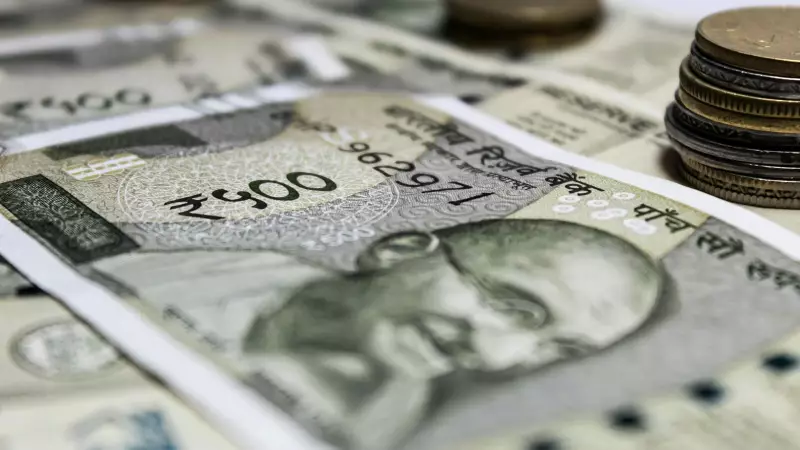
The Indian rupee continued its downward trajectory, hitting a fresh record low against the US dollar during early trading on Tuesday, December 16, 2025. The domestic currency depreciated by 9 paise to touch an unprecedented level of 90.87 against the greenback, extending losses from the previous session.
Key Factors Driving the Rupee's Decline
Forex traders attributed the rupee's weakness to two primary headwinds: sustained selling by Foreign Institutional Investors (FIIs) and lingering uncertainty surrounding the much-anticipated India-US trade agreement. FIIs sold equities worth Rs 1,468.32 crore on Monday, as per exchange data, maintaining the pressure on the rupee. The lack of a breakthrough in trade negotiations has created a cloud of uncertainty, dampening investor sentiment.
Anil Kumar Bhansali, Head of Treasury and Executive Director at Finrex Treasury Advisors LLP, noted, "The US-India trade deal still seems to be off by a distance... The uncertainty has clouded the recovery on the USD/INR pair as the rupee opened lower with dollar buying happening every day." He added that even a reduction in the trade deficit failed to support the rupee due to the continuous FII outflows.

Moderating Factors and Supporting Data
However, the rupee's fall was somewhat contained by supportive global factors. A weaker US dollar and declining global crude oil prices helped prevent steeper losses. The dollar index, which measures the greenback's strength against a basket of six currencies, was trading marginally lower at 98.27. Meanwhile, the global oil benchmark, Brent crude futures, were down 0.61% at USD 60.19 per barrel.
On the domestic data front, India's trade deficit narrowed to a five-month low of USD 24.53 billion in November. This improvement was driven by a strong 19.37% rebound in exports, which reached a six-month high of USD 38.13 billion, led by engineering and electronics goods. Concurrently, imports dipped by 1.88% to USD 62.66 billion, aided by lower shipments of gold, crude oil, coal, and coke.
Broader Economic and Market Context
The domestic equity markets mirrored the currency's weakness. In early trade, the benchmark Sensex declined by 363.92 points to 84,849.44, while the Nifty was down 106.65 points at 25,920.65.
Furthermore, wholesale inflation data released on Monday showed the Wholesale Price Index (WPI) remained in negative territory for the second consecutive month in November, printing at (-) 0.32 per cent. This was an improvement from the (-) 1.21 per cent recorded in October, though it indicated persistent disinflationary pressures at the wholesale level, with food articles like pulses and vegetables seeing a month-on-month price uptick.
At the interbank foreign exchange market, the rupee opened at its all-time low of 90.87 and traded in a narrow band between 90.77 and 90.87 in initial deals. This followed Monday's close, where the rupee had settled at a then-record low of 90.78, marking a 29-paise loss over its previous close.