

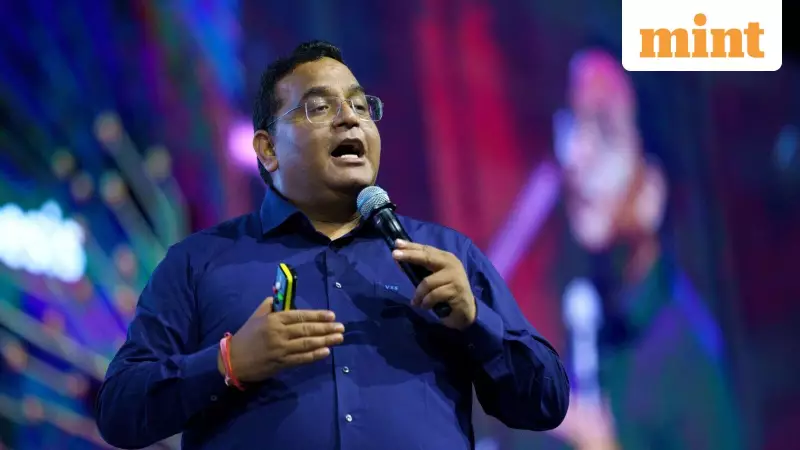
Indian fintech leader Paytm, operated by One97 Communications Ltd., is executing a significant business reset. After facing severe regulatory challenges and a steep decline in its share price, the company is now showcasing a promising turnaround driven by strategic stake consolidation and a sharp focus on artificial intelligence (AI).
Strategic Consolidation for a Cleaner Structure
In a key move to simplify its corporate framework, One97 Communications has acquired full ownership of three critical group entities. The company now holds a 100% stake in Foster Payment Networks, which manages core payment-processing infrastructure. It has also fully acquired Paytm Insuretech and its credit-distribution arm, Paytm Financial Services.
This consolidation aims to strengthen governance and bring all major payments and financial services businesses under direct control. The result is a unified ownership structure that promises better strategic alignment, smoother operations, and enhanced regulatory compliance. In a related step, the company transferred its offline merchant payments business to its wholly-owned subsidiary, Paytm Payments Services Ltd. (PPSL), to create a synergistic omnichannel platform.

Financial Recovery Gains Momentum
The structural changes are underpinned by a visible financial recovery. For the September quarter of FY26, Paytm reported a 24% year-on-year increase in operating revenue to ₹2,061 crore. The core payments business remained robust, with payment services revenue growing 25% to ₹1,223 crore and net payment revenue jumping 28% to ₹594 crore.
A major growth driver has been the financial services division, where revenue surged 63% year-on-year to ₹611 crore in Q2 FY26. This was supported by rising merchant loan disbursals and improved repeat borrower behaviour, with over 50% of merchant loans going to existing customers. The platform also saw its user base for financial services expand from 6.0 lakh to 6.5 lakh.
AI Transitions from Cost-Cutter to Revenue Driver
Central to Paytm's new growth strategy is artificial intelligence. The company is moving AI from a tool for cost optimisation to a core engine for revenue generation. It is developing AI-led agents designed to function as virtual CFOs or COOs for small businesses, with plans to monetise these through subscriptions.
This AI push, combined with a growing base of subscription merchants—now at 1.37 crore—is building operating leverage. The company turned EBITDA positive, reporting ₹142 crore with a 7% margin, a stark improvement from a ₹404 crore loss a year ago. Contribution profit rose 35% to ₹1,207 crore.
On the bottom line, One97 posted a record profit after tax (PAT) of ₹211 crore for the quarter, before accounting for a one-time impairment. This compares favorably to a loss of ₹415 crore in the prior-year period.
The Path Ahead: Growth and Valuation Scrutiny
While the operational and financial trajectory looks more predictable, challenges remain. Paytm's valuation continues to be a point of scrutiny. One97 Communications now trades at a price-to-sales multiple of 11.2x, nearly double its four-year median of 6.6x. The company is also evaluating international expansion, though a meaningful contribution from this front is not expected for another two to three years.
Founder and Chairman Vijay Shekhar Sharma's commitment to a stronger comeback appears to be materialising. With payments stabilising, financial services scaling rapidly, and AI opening new monetisation avenues, Paytm is scripting a notable comeback story in India's competitive fintech landscape.






