The Nifty 50 index has demonstrated remarkable resilience, closing November with gains for the third month in a row. This sustained upward movement has been fueled by a combination of encouraging domestic economic indicators and a strategic shift in global capital flows, helping Indian equities narrow their performance gap with other major Asian markets.
Domestic Strength Offsets Global Volatility
Despite a soft start to the month, the benchmark index gathered strong momentum from the second week of November and maintained it throughout. This rebound is particularly notable as it occurred against a backdrop of significant selling pressure in global markets. The artificial intelligence-led rally that generated massive wealth overseas has lost steam due to soaring valuations, prompting international investors to seek fresh opportunities.
Their attention has turned back to India, evidenced by consistent net buying by foreign portfolio investors (FPIs) in the latter half of November. A major milestone was achieved as the Nifty 50 set a fresh all-time high after a gap of 14 months. The rally received a powerful boost from India's impressive GDP growth of 8.2% for the July-September quarter. This propelled the index to touch another lifetime peak of 26,325 points in trade on December 1, pushing its yearly return to 11% and setting it on course for a potential tenth straight year of gains.

Market sentiment has been bolstered by a visible recovery in corporate earnings, which has alleviated some valuation worries. Recent policy announcements from both the Reserve Bank of India (RBI) and the central government have further strengthened the positive outlook. Analysts now expect the earnings rebound to continue over the next few quarters, a view that has turned global brokerage firms bullish on Indian equities.
Auto and NBFC Stocks Drive the Bull Run
Leadership within the Nifty 50 in 2025 has decisively shifted to the automobile and non-banking financial company (NBFC) sectors. Bajaj Finance leads the pack with a staggering 50% year-to-date surge to ₹1,021. Its sibling, Bajaj Finserv, has also jumped sharply by 32.3%.
In the auto space, Maruti Suzuki has zoomed 48.24% to ₹16,097, marking its biggest annual gain since 2017. The stock is poised for its fifth consecutive year of positive returns. Other auto majors have joined the party: Mahindra & Mahindra delivered a solid 24.5% return, while Eicher Motors surged 48% to ₹7,125, heading for a sixth straight year in the green.
Shriram Finance emerged as the third top performer among index constituents, with its stock gaining 47.40% to ₹851.60. Bharat Electronics continued its dream run, rising 47.2% after a 60% rally last year, marking its seventh consecutive year of positive returns.
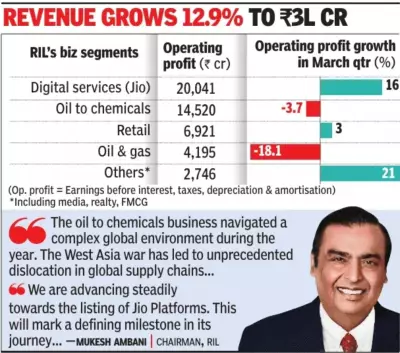
The rally has been broad-based. Index heavyweight Reliance Industries soared 29% to ₹1,566. Tata Consumer Products delivered a 27.3% return, while other Tata Group stocks like Tata Steel and Titan rose 22.15% and 20%, respectively. Banking stocks such as SBI, Kotak Mahindra Bank, and Axis Bank rallied between 20% and 22.4%.
Analysts See Earnings as Key to Future Gains
Financial services firm Equirus Securities, in a recent note, highlighted that Nifty 50 earnings growth is set to improve meaningfully in CY26 and CY27, with estimates of 17% and 14% respectively. The brokerage pointed out that with valuation upside limited due to elevated prices, future market returns will depend primarily on the delivery of these earnings.
It added that despite a steep 13% cut to consensus earnings per share (EPS) estimates for CY25, early signs point to the beginning of an earnings surprise cycle. This could trigger meaningful upward revisions in EPS, acting as a more credible catalyst for the market than liquidity flows alone.

However, the firm also sounded a note of caution. While large-cap valuations have eased from post-COVID peaks, they remain above historical averages. Small-cap valuations are seen as significantly stretched, with the small-cap to large-cap forward P/E ratio at around 1.25x versus a long-term average of 0.9x, making the segment vulnerable to corrections.
Echoing a valuation-focused view, InCred Equities noted that the Nifty's forward P/E near its 10-year average of 20x offers some comfort, especially as the EPS outlook has stabilized. It also observed that the correlation (beta) of Indian indices like Nifty 50 and Nifty 200 with the US S&P 500 has reduced sharply in recent years. This decoupling, according to the brokerage, should help cushion the domestic market from any potential global correction triggered by an unwinding of the AI bubble, allowing local factors to dominate near-term performance.