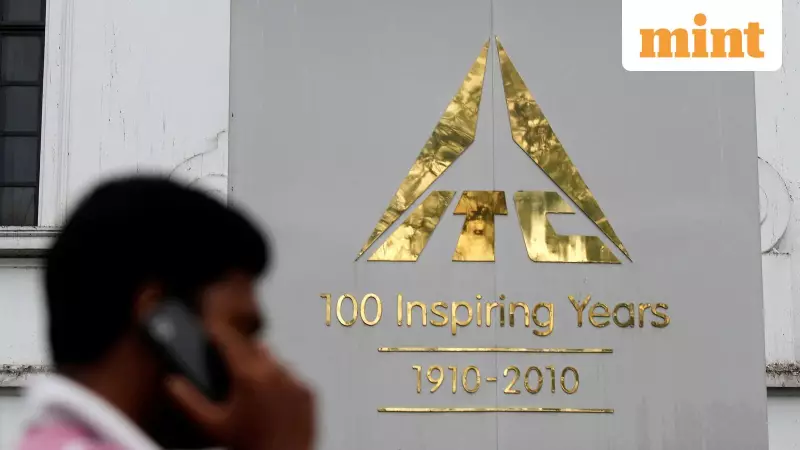
The new year brought no cheer for shareholders of ITC Ltd, as the company's stock witnessed a dramatic sell-off on Thursday, January 1. The shares plunged almost 10% to an intraday low of ₹362.70, marking their weakest level in nearly three years. This sharp decline was triggered by a government notification announcing a new excise duty on tobacco products, set to take effect from February 1.
Details of the Tax Hike and Market Reaction
According to a notification from the Finance Ministry issued on Wednesday evening, cigarettes will now attract an excise duty ranging from ₹2,050 to ₹8,500 per 1,000 sticks. This levy is in addition to the increased Goods and Services Tax (GST) rate of 40% that will also apply to cigarettes, tobacco, and similar products starting February 1. A Bloomberg report, citing analysts from Jefferies, indicated that these higher charges imply an overall tax increase of over 30%, assuming the National Calamity Contingent Duty continues.
The market reaction was severe and immediate. ITC's intraday fall to ₹362.70 was its lowest since January 30, 2023. Bloomberg reported that this constituted the worst single-day drop for the ITC stock since 2020, making it the biggest loser on the Sensex today. The sell-off was not limited to ITC; Godfrey Phillips India, the manufacturer of Marlboro and Four Square cigarettes, saw its shares tank by a staggering 19% in intraday trading.

Analyst Views: Price Hikes, Volume Risks, and Broader Concerns
Financial analysts have raised alarms about the potential negative impact on cigarette sales, as the new taxes will likely force manufacturers to increase prices significantly. Jefferies analysts, quoted by Bloomberg, stated, "While we are still unsure on the final outcome, if confirmed, this will be a clear negative as volumes will be impacted and concerns would also re-emerge on risk of losing some volumes to illicit industry." The brokerage estimates that ITC would need to raise cigarette prices by "at least 15%" to pass on the full impact to consumers.
Market experts are divided on the long-term implications. Harshal Dasani, Business Head at INVAsset PMS, views the correction as more of a sentiment-driven adjustment than a fundamental reset. He noted that while tax hikes cause near-term volatility, the industry has historically managed to pass on costs through calibrated price increases over time.
However, G Chokkalingam, Founder of Equionomics Research, expressed deeper concerns. He pointed to multiple overhangs on ITC's stock, including the likelihood of continued duty hikes as the government seeks revenue amid GST cuts on other consumer products. He also highlighted challenges in ITC's other businesses: "The paper segment is doing badly, the IT services segment has also not shown significant profit growth, and other FMCG growth also remains slow." He further warned of potential equity selling by its largest shareholder, British American Tobacco Plc. Given this backdrop, Chokkalingam believes that in the best-case scenario, ITC is just a HOLD after today's meltdown.
Investment Outlook and Data
For long-term investors, Dasani suggests such policy-led drawdowns can create buying opportunities in high-quality, cash-rich businesses like ITC, though near-term volatility may persist. According to data from Trendlyne, analyst sentiment on ITC remains largely positive, with 23 analysts recommending a 'Strong Buy' and 10 suggesting a 'Buy'. Only one analyst each has a 'Hold' and 'Sell' rating.
The stock's performance has been under pressure, with the ITC share price slumping 24% over the past year and 12% in the last six months. Today's crash adds to this downward trend, placing the focus squarely on how the company navigates the new tax regime and its effect on consumer demand in the coming quarters.