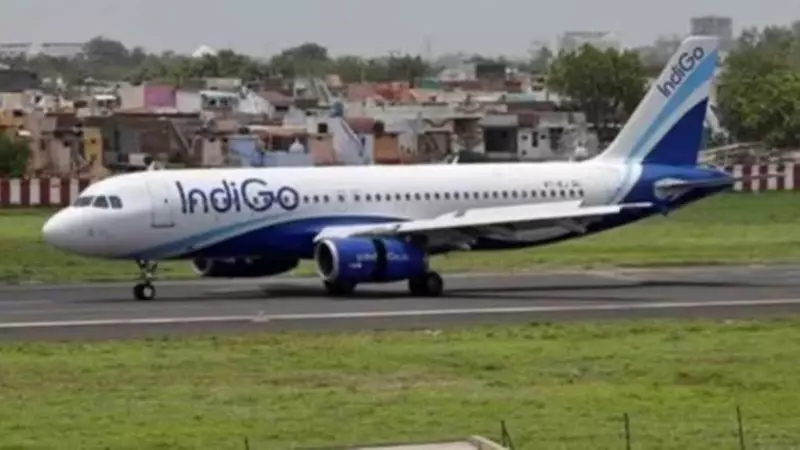
Shares of InterGlobe Aviation, the parent company of IndiGo airlines, opened in the red on Thursday, December 4, reflecting the severe operational turbulence gripping the country's largest carrier. The stock opened nearly 2% lower on the National Stock Exchange (NSE), underscoring investor concern as the airline battles widespread network disruptions, mass cancellations, and regulatory scrutiny.
Market Reaction to Operational Chaos
The IndiGo share price opened at Rs 5,499 on the BSE, marking a drop of Rs 93.50 from the previous day's close. Although the stock regained some momentum about 30 minutes after market opening, it remained in negative territory. At last check, it was trading down by 1.08% on the NSE. The market's focus is squarely on how the low-cost carrier navigates this crisis, which has led to chaos at major airports across India.
The immediate trigger for the sell-off was the airline's announcement of major disruptions. On Wednesday alone, IndiGo cancelled over 150 flights and experienced numerous delays, stranding hundreds of passengers. The airline has attributed the meltdown to a combination of factors, primarily crew shortages linked to new Flight Duty Time Limitation (FDTL) norms, along with technology glitches and airport congestion.

DGCA Probe and the Root Cause: FDTL Norms
The Directorate General of Civil Aviation (DGCA) has taken serious note of the situation. The regulator has launched a formal probe and has asked IndiGo to submit a detailed explanation for the large-scale cancellations and delays. Furthermore, the DGCA has demanded the airline's mitigation plan to restore normalcy.
Data provided to the DGCA reveals the scale of the problem. In November, IndiGo reported a staggering 1,232 flight cancellations. A deep dive into the causes shows that 755 cancellations were due to crew and FDTL-related issues. Other factors included airspace and airport constraints (258), air traffic control system failures (92), and miscellaneous reasons (127).
The revised FDTL norms, implemented in phases, are at the heart of the crew planning crisis. The second phase, effective from November 1, has been particularly challenging. These rules mandate a 48-hour weekly rest period for crew, extend the definition of night hours, and crucially, reduce permitted night landings from six to two. Airlines, including IndiGo and Air India, had opposed these norms, arguing they would require a significant increase in crew strength.
Performance Metrics Nosedive
The operational disruptions have severely impacted the airline's service quality. IndiGo's on-time performance (OTP) has plummeted. It fell sharply to 67.7% in November from 84.1% in October. The decline intensified at the start of this week, with OTP dropping to around 50% on Monday and a dismal approximately 35% on Tuesday.
In response, IndiGo has initiated what it calls "calibrated schedule adjustments," which involve pre-emptive cancellations and rescheduling. The airline stated that these measures would continue for the next 48 hours to stabilize operations. It is reinforcing crew planning, improving coordination with airports and ATC, and enhancing its disruption-management protocols as directed by the DGCA.
For passengers, the situation remains fluid. The airline has warned that further flight disruptions are likely on Thursday. Travelers are advised to check their flight status frequently before heading to the airport. As the DGCA investigation unfolds and IndiGo works to align its operations with the new crew rest rules, the financial markets will closely watch the carrier's ability to recover its famed operational efficiency.