

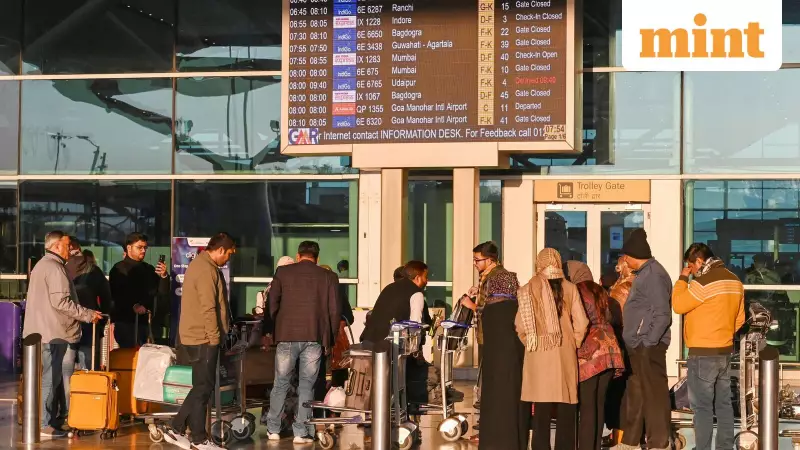
In a year marked by turbulence for aviation stocks, GMR Airports Infrastructure Ltd. has emerged as a clear winner. India's largest airport operator has seen its share price climb by an impressive 22% over the past six months of 2025. This performance starkly contrasts with the decline faced by its listed peers in the sector, which have shed between 16% and 54% of their value in the same period.
An Outlier in a Struggling Sector
The divergence in fortunes highlights a key trend: investors are favoring assets with predictable, annuity-like revenue streams over the more volatile airline business. While passenger traffic growth remains the core driver for aviation companies, the market is rewarding established airport infrastructure. India, the world's fifth-largest commercial aviation market according to the International Air Transport Association (IATA), continues to see robust growth. However, this has not translated into gains for airline stocks like InterGlobe Aviation (IndiGo), SpiceJet, and others.
Analysts point out that the appetite for airport assets is not limited to the listed space. Manan Doshi, co-founder of Unlisted Arena, noted that shares of Cochin International Airport have more than doubled in two years, rising from ₹210 to ₹455. Similarly, shares of Kannur International Airport have appreciated by 30%.

The Pillars of GMR's Strength
GMR's robust performance is anchored in several fundamental advantages. The company operates five airports in India, including the country's busiest, the Indira Gandhi International Airport in Delhi, as well as key hubs in Hyderabad and Goa. It also runs the Mactan-Cebu International Airport in the Philippines.
A critical factor is its long-term concession agreements, spanning 30 to 60 years, which provide exceptional visibility on sustainable cash flows, as highlighted by Ankita Shah, Vice President at Elara Capital. The recent rally, however, has been significantly fueled by a regulatory victory in Delhi.
Delhi Tariff Order: A Game Changer
The cornerstone of GMR's recent success is the new tariff order approved for Delhi International Airport for the five-year period from FY25 to FY29. Regulators approved a sharp hike in aeronautical tariffs, leading to a massive 147% jump in yield per passenger—from ₹145 in FY24 to about ₹360 in FY25. This hike allows the airport to recover past investments, including COVID-19-related losses, and reflects its expanded asset base.
"As a result, expect aero revenues to compound at a ~43% CAGR in FY25-28E, purely from tariff uplift," explained Shah. This regulatory clarity, often delayed in the past, has removed a major overhang and provided a solid foundation for future revenue growth.
The Next Growth Phase: Non-Aero and Consumer Shift
Looking ahead, analysts believe the next growth wave for GMR will be led by non-aeronautical and commercial property revenues. This shift is expected to transform the company from a utility play into a consumption-driven business. FY26 is projected to be a turning point, with profits turning positive, deleveraging beginning, and credit ratings likely to improve.
Saurabh Chawla, Executive Director of GMR Airports, emphasized this strategic pivot, stating the goal is to convert GMR Airports into a consumer business underpinned by utility-like stability. This vision is shared by other players like Adani Enterprises, which aims to increase the non-aero revenue share at its Mumbai airport to 75% from the current 61%.
Priyankar Biswas of JM Financial Institutional Securities pointed out that Indian metro airports like Delhi and Mumbai already have a higher share of non-aero revenue (from duty-free, retail, cargo, parking) compared to global hubs like Heathrow (22%) and Amsterdam (38%). However, there is still immense room for growth, especially in duty-free, where penetration at Indian metros is around 10%, lagging behind Dubai (15%) and Singapore (18%).
GMR has moved to capture more of this value, taking over duty-free operations at Delhi and Hyderabad airports in 2025, bringing key revenue streams in-house.

A Potential Risk on the Horizon
One factor that could alter the investment landscape is the potential listing of Adani Enterprises' airport business. Biswas highlighted that GMR currently benefits from being the only pure-play listed airport stock in India. If Adani lists its portfolio of eight airports, including Mumbai and the newly opened Navi Mumbai airport, it would provide investors with an alternative and could impact GMR's valuation premium. Reports suggest Adani is considering such a listing between 2027 and 2031.
Despite this, the immediate outlook for GMR remains strongly positive. Elara Capital initiated coverage on the stock with a 'Buy' rating and a target price of ₹123, citing that the growth story, driven by passenger traffic recovery and rising non-aero income, is not yet fully priced in. For now, GMR Airports continues to cruise at a high altitude while the rest of the aviation sector navigates through clouds.





