

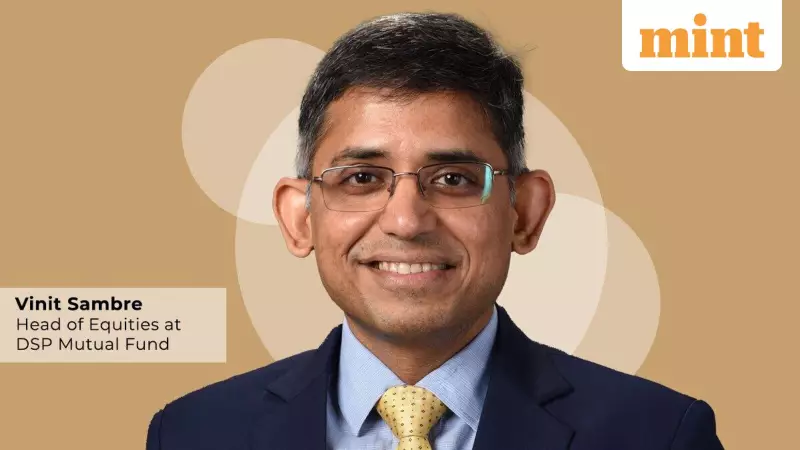
Vinit Sambre, who leads the equities division at DSP Mutual Fund, has expressed a positive outlook for the Indian stock market in 2026. He believes several catalysts are aligning to support a recovery in corporate earnings growth and overall market performance after a period of consolidation.
Analyzing the Challenges of 2025
Sambre assessed that the market in 2025 transitioned from strength to a phase of consolidation. A significant factor was the slowdown in corporate earnings. After four strong years of double-digit growth for the Nifty 50 from FY21 to FY24, earnings decelerated to low single digits through FY25 and the first half of FY26, with the full year expected to follow a similar trend.
This underperformance was due to a confluence of cyclical headwinds. Government spending moderated post-elections, while private sector capital expenditure did not rise sufficiently to fill the gap. Banking liquidity tightened near the start of 2025, and household consumption remained soft. External factors like uncertainty around US tariffs dampened foreign investor sentiment and hurt export-oriented sectors such as textiles, gems and jewellery, and parts of engineering.

Globally, market leadership narrowed to AI-linked technology giants, a space where India lacked comparable large beneficiaries. An extended monsoon further disrupted agriculture and consumer-linked sectors. "It was a confluence of cyclical factors that led to temporary underperformance versus global peers," Sambre explained.
The Road to Recovery in 2026
Sambre is more constructive about 2026, viewing it as a potential year of recovery. He pointed out that many previous headwinds are now being addressed by policy measures.
On the monetary front, the Reserve Bank of India (RBI) has injected liquidity through tools like open market operations (OMOs), dollar swaps, and cuts to the cash reserve ratio (CRR). Policy rates were reduced by 125 basis points through calendar year 2025, easing financial conditions and bringing surplus liquidity back into the banking system.
Fiscally, the government has raised tax-free income thresholds and reduced GST rates in several categories, putting more disposable income in the hands of consumers. "With both fiscal and monetary levers now active, the backdrop for growth looks much healthier," Sambre noted.
He also highlighted encouraging shifts, such as Indian IT companies making aggressive investments to build AI capabilities, which should create growing revenue pools over time. While challenges like stronger private capex, job creation, and clarity on US tariffs persist, Sambre believes they are evolving toward resolution. The combination of a low base, improving policy support, and better liquidity provides enough catalysts for an earnings recovery in the coming year.
Structural Growth Pillars Remain Firm
According to Sambre, India's structural growth story remains intact, though its composition is evolving. The economy is still consumption-driven, with a young working population (average age 27-28 years) supporting long-term demand. Consumption accounts for roughly 60-62% of GDP, with urbanisation and premiumisation as enduring themes.
While softness persists in rural demand, low-income consumption, FMCG, and building materials, new growth pockets are emerging rapidly. These include quick commerce, air travel, tourism, and experience-led spending.
Another major structural theme is the energy transition. India is decisively moving toward cleaner power, with 2025 being a strong year for solar capacity addition. Installed renewable capacity is now nearly at par with conventional power, a significant milestone. Furthermore, India's IT sector is investing to build a meaningful presence in the global AI ecosystem. "We continue to remain constructive on India’s long-term ability to create wealth for patient investors," Sambre concluded.

Earnings and Budget Expectations
For the third quarter (Q3), Sambre expects earnings momentum to stay muted. Demand tapered post the festive season, and the recovery seems pushed out. In banking, credit growth has seen modest improvement, but pressure on net interest margins (NIMs) is likely as lending rates adjust faster than deposit costs following RBI rate cuts. The IT sector is also expected to show a seasonally weak Q3 due to furloughs, with no major deviation from Q2 trends.
Looking ahead to Budget 2026, Sambre sees a crucial opportunity to catalyse investment and productivity. Key expectations include:
- Bigger incentives for manufacturing, especially in electronics manufacturing services and engineering, to unlock private-sector capex.
- Well-designed tax incentives to reward companies for hiring, training, and formalising workers to support job creation.
- Policy support for building a domestic AI ecosystem, including benefits for data centres and customs duty waivers on critical equipment.
- Continued focus on expanding renewable energy capacity to reduce energy risk and attract long-term capital.
- Embedding AI and emerging technologies across the education system to build the necessary talent pipeline.





