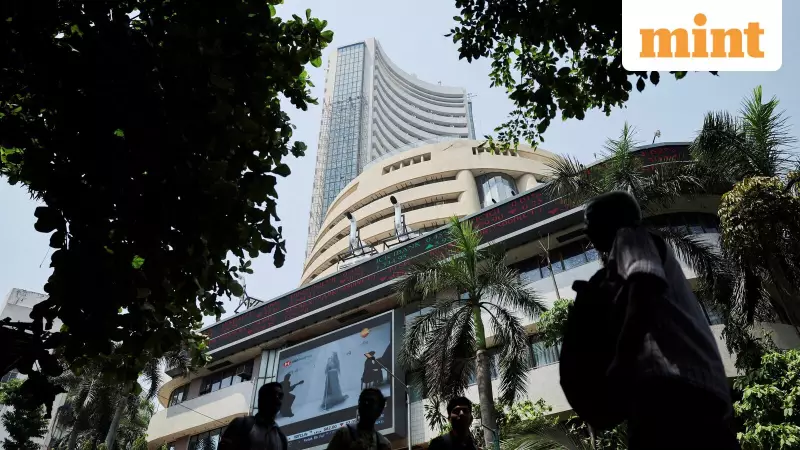
Indian equities are stepping into the new year after a cautious and range-bound 2025, with the benchmark Sensex clinging close to its historic peak. The market, which navigated fears of a downturn to end the year with an approximate 8% gain, now confronts a series of fundamental tests that will determine its trajectory in 2026. The interplay of corporate earnings, rich valuations, and the flow of money will be crucial, centered around five pressing demand-supply questions.
The AI Frenzy and Market Discipline
Every major bull run is fueled by a dominant narrative. For the current cycle, that catalyst is unequivocally Artificial Intelligence (AI). From advanced chipmakers to data center operators, companies building the AI superstructure have seen their valuations soar on expectations of widespread business adoption. However, history warns that when such lofty expectations falter, the subsequent market correction can be sharp. The interconnected nature of large AI deals means fragility in one segment could trigger a cascading effect across the chain.
Simultaneously, 2025 witnessed a notable shift towards more discerning valuations, particularly in the broader market. While the Sensex, trading at a price-to-earnings (PE) ratio of about 23.5, is merely 1% below its September 2024 high, a deeper look reveals caution. For the first time since 2020-21, less than half of all BSE-listed stocks posted gains in 2025-26. The BSE MidCap and SmallCap indices remain 6% and 11% below their respective peaks, indicating a flight to quality and a reduction in the froth that had built up in smaller companies.

The Divergence in Institutional Investment
A stark contrast has emerged between two key classes of institutional investors. Foreign Portfolio Investors (FPIs) were net sellers of Indian equities in 2025, continuing a trend that has seen them pull out a net ₹0.8 trillion over the past five years. In sharp contrast, domestic mutual funds have been relentless buyers, investing a net ₹13.7 trillion in equities during the same period. This divergence underscores a valuation sensitivity among global investors, while local funds are buoyed by sustained domestic inflows.
The bedrock of this domestic support is the unwavering faith of retail investors. The number of unique mutual fund investors swelled to about 58.4 million by November 2025, adding 3.8 million in just eight months. Systematic Investment Plan (SIP) inflows have skyrocketed, with monthly averages jumping from ₹10,381 crore in 2021-22 to ₹28,207 crore in 2025-26. However, signs of potential fatigue are emerging. The pace of new demat account openings has slowed to a monthly average of 1.7 million in 2025-26, the lowest since 2020-21. Furthermore, the share of inactive demat accounts has risen from 55% to 66%.
IPO Momentum and the Road Ahead
The vibrant primary market has been a hallmark of recent years, with 2025-26 on track to surpass the strong numbers of 2024-25. A steady stream of companies, including many from new-age sectors, have successfully launched initial public offerings (IPOs), banking on robust market sentiment. However, this segment is particularly sensitive to shifts in retail appetite. Any material slowdown in the continuous flows from retail investors—both direct and via mutual funds—could alter demand-supply dynamics and cool the IPO fervor.
As 2026 unfolds, the direction of Indian stocks will hinge on the answers to these interconnected questions. Can the AI theme deliver on its promise without a painful correction? Will foreign capital find Indian valuations palatable again? Can retail investor enthusiasm be sustained amidst signs of slowing engagement? The market's resilience will be tested by the delicate balance between business fundamentals, investor sentiment, and global macroeconomic cues.