

Mumbai's Slum Redevelopment: SRA Launches 18 Major Projects Under New Scheme
The Slum Rehabilitation Authority (SRA) is embarking on a transformative urban renewal initiative in Mumbai, with plans to launch 18 comprehensive redevelopment projects under the state government's recently introduced slum cluster redevelopment scheme. This ambitious program represents a significant step toward addressing the city's housing challenges through integrated and sustainable urban planning.
Andheri West: The Flagship Project
The most prominent project involves a 100-acre plot in Andheri West around Gilbert Hill, which currently houses approximately 14,000 hutments and several residential buildings. The SRA has already floated tenders for this substantial redevelopment, marking the beginning of what promises to be one of Mumbai's largest urban renewal efforts in recent years.
Expansive Project Locations Across Mumbai
The redevelopment initiative extends far beyond Andheri West, with identified sites spanning multiple key areas of the city:

- Mankhurd
- Govandi
- Sion
- Wadala
- Vikhroli Park Site
- Goregaon West
- Kandivli West
- Borivli East
Tenders for these additional projects will be floated once plot demarcations are finalized, ensuring systematic implementation across Mumbai's diverse neighborhoods.
Scheme Parameters and Eligibility Criteria
The state government's slum cluster redevelopment scheme establishes clear parameters for project selection:
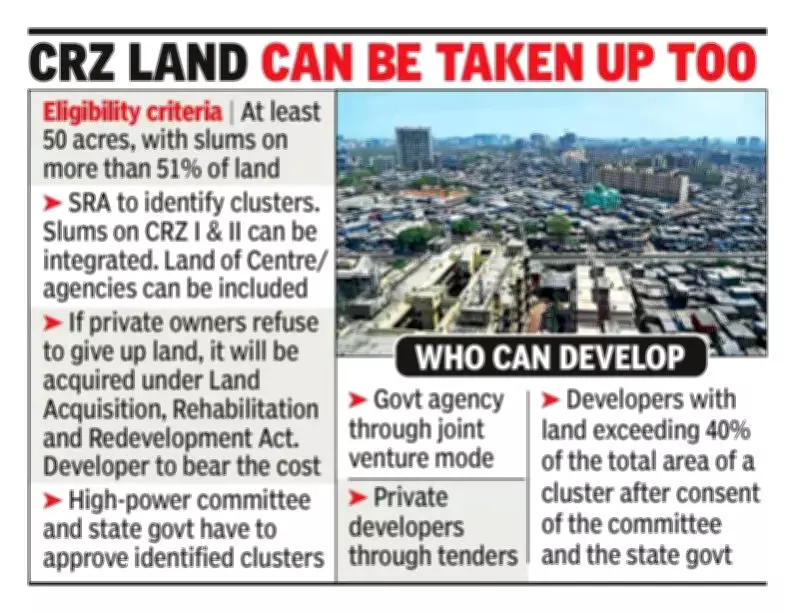
- Clusters must cover at least 50 acres where over 51% of the area is occupied by slums
- Even slums located within coastal regulation zones I and II can be integrated into the redevelopment plans
- The scheme allows for comprehensive redevelopment that includes not just slums but also non-slum structures, old and dilapidated buildings, tenant-occupied buildings, vacant land unsuitable for construction, and certain private buildings
Implementation Framework and Agency Roles
SRA CEO Mahindra Kalyankar emphasized that "redevelopment will be done in an integrated and sustainable manner in terms of urban planning so that all civic facilities can be developed in a modern and scientific manner and the quality of life is improved." According to the scheme provisions, the SRA will serve as the nodal agency overseeing all aspects of implementation.
The official outlined a structured approval process:
- Slum clusters identified by SRA must be approved by a high-power committee led by the additional chief secretary for housing
- Final approval rests with the state government
- Implementation can proceed through three possible routes:
- A government agency via joint venture mode
- A private developer selected through tender process
- If a developer already controls over 40% of the cluster area, implementation through that developer with prior state government approval based on committee recommendation
Land Acquisition and Compensation Mechanisms
The scheme includes provisions for various land ownership scenarios:
For central government lands, inclusion in projects requires consent from the respective central authorities or undertakings. For private landowners, once approvals are granted, they will receive developed plots with equivalent floor space index valued at 50% of the total land value based on town planning scheme assessments.
Should private landowners reject the proposal, the land will be acquired under the Land Acquisition, Rehabilitation and Redevelopment Act, 2013, with acquisition costs borne by the project promoter or developer implementing the redevelopment.
This comprehensive approach aims to balance development needs with property rights while creating modern, sustainable communities across Mumbai's diverse urban landscape.






