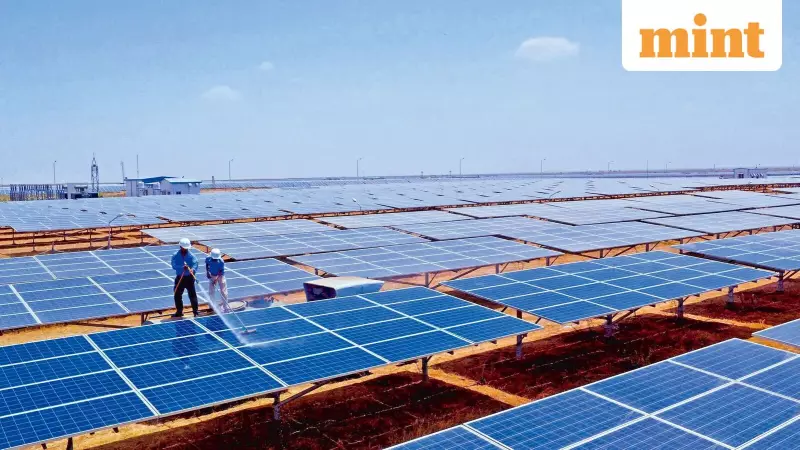
India's ambitious solar energy push in Rajasthan has hit a significant roadblock, with major power producers being forced to dial down generation due to a severely congested transmission grid. This bottleneck highlights a critical mismatch between the frenetic pace of renewable capacity addition and the slower development of evacuation infrastructure.
Major Developers Forced to Curtail Peak Production
In a move that underscores a growing crisis, the Northern Region Load Despatch Centre (NRLDC) stepped in on 14 November, directing curbs on power evacuation from solar plants in Rajasthan. The action was taken citing concerns over grid security and "evacuation constraints." This directive has impacted leading energy giants including Adani Group, NTPC Green, KKR-backed Serentica, EQT-backed Zelestra, and JSW Group.
The scale of the curtailment is substantial. In the second half of November alone, these companies had to reduce peak-hour production by a cumulative 5 gigawatts (GW). According to sources, the curtailment has been as high as 50-55% during peak solar hours at some pooling stations. Rajasthan, which boasts India's highest solar irradiation and maximum sunny days, has a total renewable energy capacity exceeding 40GW. However, at five key pooling stations with a capacity of 23GW, only 18.35GW is currently available for evacuation, creating a severe bottleneck.

Financial Losses and Structural Challenges
The forced reduction in output is translating into direct financial losses for project developers. An executive from a solar power project explained the math: if a plant planned to supply 20 million units at a tariff of ₹3 per unit, a curtailment to 15 million units results in a direct revenue loss of ₹15 million. One developer reported being adversely impacted by an average of 42% curtailment monthly since the start of the financial year, incurring losses of over ₹20 crore.
Rahul Mishra of BluPine Energy pinpointed the core issue: "Rajasthan’s challenge today is that of evacuation. Capacity is built, plants are operational, but the grid cannot absorb and transmit the power because key high-voltage corridors are delayed by 15-24 months." He warned that elevated curtailment levels are likely to persist for the next one to two years until new infrastructure is commissioned.
The problem is not confined to Rajasthan. Data from the Grid Controller of India for 1 December showed widespread curtailment: 4.78GW (20%) in the northern region, 7.63GW (68%) in the southern region, and 2.79GW (30%) in the western region.
Transmission Lag and the Road Ahead
The root cause lies in the lagging capacity addition in the transmission space, plagued by issues like land acquisition and securing the 'Right of Way' (RoW). In FY25, only 8,830 circuit kilometres (ckm) of transmission lines were added, a sharp 38% decline from the 14,203 ckm added in FY24. India's National Electricity Plan estimates a need for an additional 191,000 ckm of transmission lines by 2031-32 to support renewable growth.
There is some hope on the horizon. The recent commissioning of the 765 kV Khetri–Narela transmission line connecting Delhi, NCR, and Rajasthan is expected to ease the situation. The upcoming Bhadla to Sikar 765 kV line should provide further relief. Former Union energy secretary Bhupinder Singh Bhalla acknowledged the issue but termed it a short-term phenomenon, expressing confidence that long-term investment plans would remain unaffected.
However, the congestion is exacerbating other challenges in the renewable sector, including delayed Power Purchase Agreements (PPAs) for about 43GW of already-awarded capacity. Some developers are exploring Battery Energy Storage Systems (BESS) to time-shift output, though this adds cost and only partially addresses the structural congestion.

This setback poses a risk to India's ambitious target of adding 50GW of renewable capacity annually to reach 500GW by 2030. It underscores the urgent need for synchronized planning where transmission infrastructure development keeps pace with generation capacity addition to fully harness the nation's solar potential.