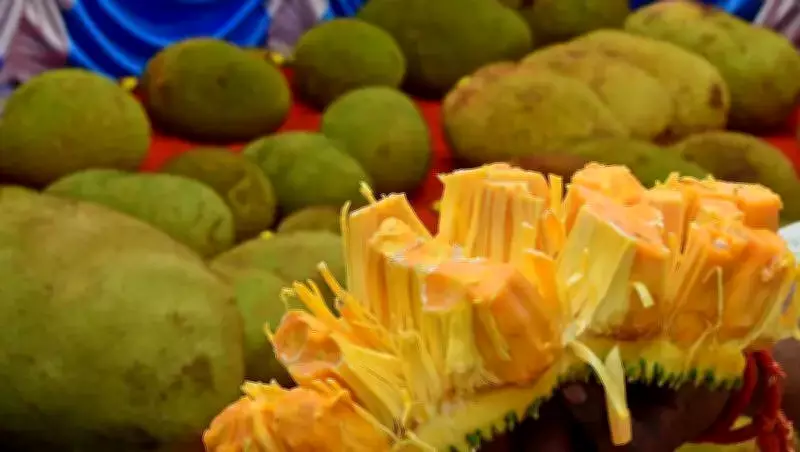
Jackfruit's Meteoric Rise in Karnataka: A Price Transformation
Bengaluru: Once scorned as a "poor man's fruit," jackfruit is experiencing a remarkable resurgence, with prices skyrocketing across Karnataka this summer. This shift is driven by growing consumer awareness, the popularity of innovative value-added products, and the introduction of multiple premium varieties, transforming the fruit from a backyard staple into a sought-after urban commodity.
Urban Demand Fuels Price Hike
The demand for jackfruit has surged so significantly that traders in Bengaluru markets have abandoned selling whole fruits in favor of pricing by the kilogram. A single fruit that previously sold for Rs 100-200 just a few years ago now commands Rs 40-80 per kg, depending on the color and quality of the bulbs. This adjustment pushes the cost of an average 4-5kg jackfruit to Rs 400-500, while larger fruits weighing 10-12kg, especially popular varieties, are sold at Rs 600-700, according to market traders.
Expert Insights on the Transformation
Prof K Narayana Gowda, former vice-chancellor of the University of Agricultural Sciences (UAS) and a key figure in establishing the Tubugere Jackfruit Growers Association near Doddaballapur, attributes this price surge to a decade-long campaign raising public awareness. "All these years, especially in urban markets, jackfruit was a big turn-off due to the complex process of cutting and extraction of bulbs," Gowda explained. "However, ever since the horticulture department popularised the sale of ready-to-eat bulbs through their jackfruit mela, people are increasingly buying bulbs. The fact that this is a diabetic-friendly fruit with a low glycaemic index (30-60) has added to the demand."

Dr G Karunakaran, a senior scientist at the Indian Institute of Horticulture Research (IIHR) in Hesaraghatta, who has documented numerous jackfruit varieties in southern Karnataka, noted, "It has moved from being an underutilised backyard fruit to a commercially viable crop."
Value Addition and Premium Varieties
Value addition has played a crucial role in boosting prices. A prominent jackfruit farmer from Tumakuru elaborated, "In the southern parts of Karnataka, people consume the fruit fresh. But, in coastal areas, it is processed into chips, flour, sweets, ice creams, pappad, and various cuisines. This has helped expand its demand and market reach beyond fresh consumption."
Experts credit this collective transformation largely to the popularity of the Siddu jackfruit variety, identified and promoted by IIHR scientists. "The Siddu jack, hailed for its coppery-red flakes, high nutritional value, and superior taste, fuelled the demand and gained strong commercial traction among farmers and buyers alike," explained a senior horticulture department official. "Subsequently, several varieties such as Lalbagh Madhura, Shankara, Rudrakshi, Swarna, Toobugere, and all-season jackfruit varieties have gained a foothold. Farmers cultivating premium jackfruit types are now earning significantly higher returns, with some individual trees generating substantial income."
Production and Infrastructure Developments
In Karnataka, jackfruit is cultivated on 726 hectares, yielding 29,576 tonnes annually, according to horticulture department data. To address the fruit's highly perishable nature, the government has established 236 cold storage units with a collective capacity of 8.4 tonnes. Currently, work is progressing on seven additional cold storage units with a capacity of 24,000 tonnes. Once completed, these facilities will provide ample storage for jackfruit, supporting its market growth.
A senior official clarified that the rising prices are also influenced by increasing demand and dwindling tree cover, highlighting the fruit's evolving economic significance in the region.