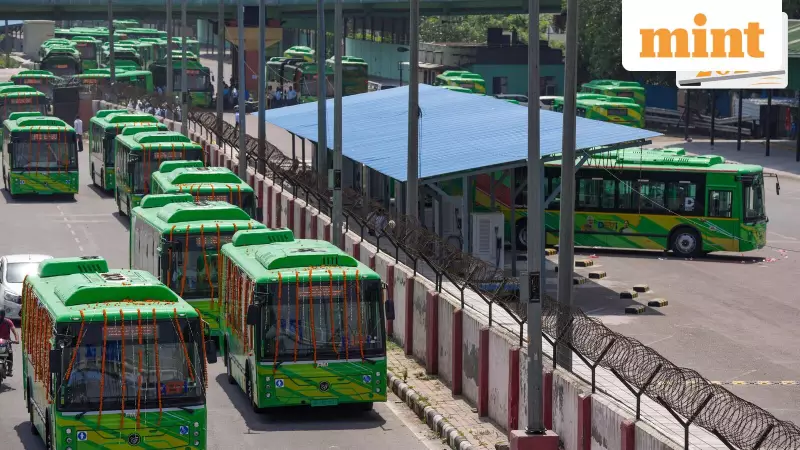
As 2025 draws to a close, the Indian government is setting a clear roadmap for its green mobility ambitions in the coming year. The focus is decisively shifting from personal electric vehicles to the mass transport and freight sectors, with electric buses and trucks taking center stage under the flagship ₹10,900-crore PM E-Drive scheme in 2026.
Why the Strategic Shift to Heavy Vehicles?
This strategic pivot comes as incentives for electric two- and three-wheelers under the same scheme are set to lapse in March 2026. A senior government official directly aware of the development confirmed that e-trucks and e-buses will be the administration's priority moving forward.
The rationale is rooted in environmental impact and national targets. Large diesel-powered buses and trucks are disproportionate emitters of greenhouse gases and harmful particulate matter, significantly worsening urban air quality. "Diesel is notorious for emitting more air pollutants (particulate matter, sulphur oxides, nitrous oxides, etc) than petrol or even CNG," explained Shyamasis Das, a fellow at the Centre for Social and Economic Progress (CSEP).

This focus is critical for India to meet its ambitious goal of achieving 30% electric vehicle penetration by 2030. "India’s ability to achieve 30% vehicle electrification by 2030 will hinge on one defining variable: whether the commercial segment scales fast enough to pull the rest of the ecosystem with it," said Kunal Mundra, founder of EV financier Astranova Mobility.
The Current Landscape and Challenges
Despite overall EV adoption rising to over 2 million units in 2025 (up from 1.9 million in 2024), the share of electric heavy vehicles remains minuscule. In FY25, only about 4,000 electric buses were sold compared to roughly 63,000 diesel ones. Sales of medium and heavy electric trucks incentivised under PM E-Drive stood at just 496 units as of 10 December 2025, against more than 291,000 diesel counterparts.
The primary hurdle is cost. An electric truck or bus costs about 2.5 times more than a comparable internal combustion engine (ICE) vehicle, making subsidies vital. The PM E-Drive scheme allocates ₹4,391 crore (40% of its outlay) for e-buses, aiming to deploy 14,028 new units through state transport undertakings.
Recent tenders show promise. Last week, new-age manufacturers like PMI Electro Mobility, Eka Mobility, and Olectra Greentech won nearly 80% of India's largest tender for 10,900 e-buses destined for cities including Bengaluru, Hyderabad, Delhi, Surat, and Ahmedabad.
Supply Chain and Incentive Disbursal Hurdles
The path forward is not without obstacles. The tendering process for the massive 10,900-bus order faced delays due to manufacturer concerns over contract conditions and inadequate state-level infrastructure. Furthermore, disbursal of incentives has been patchy. While funds have flowed for two- and three-wheelers, no incentives have yet been released for e-trucks and e-buses under PM E-Drive.
Localization remains a key theme and a challenge across all EV incentive schemes. The disruption caused by China's export controls on rare earth magnets in April 2025 highlighted the urgent need for supply chain self-sufficiency. "Indian OEMs are gradually reducing dependencies on Chinese suppliers... But managing cost is still a major concern," noted Shantanu Das of Sasken Technologies.
Manufacturers are responding. PMI Electro Mobility stated its 2026 focus is on "increasing localisation of high-value components" and "expanding our domestic value-addition footprint" to build resilience and cost-competitiveness.
The Road Ahead: Financing, Charging, and Policy
Financing is emerging as a critical enabler. India's commercial EV financing market is projected to expand to nearly $20 billion by 2030, from $2.37 billion in 2025. Experts call for partnerships between large lenders and specialized EV financiers to combine scale with technical underwriting depth.

Charging infrastructure is growing, with about 29,000 public EV charging stations operational as of August 2025. Battery swapping, particularly for heavy vehicles, is also gaining traction. Energy In Motion, which set up Haryana's first battery-swapping station for heavy commercial vehicles in October 2025, expects 400-600 heavy-duty vehicles under such contracts by March 2026.
Looking ahead, policy think tank NITI Aayog has recommended a stricter approach, suggesting not just incentives for EVs but also higher registration fees, tougher emission standards, and increased taxes on ICE vehicles to accelerate the transition. As 2026 approaches, India's electric mobility journey is entering a decisive phase where scaling commercial vehicles will define its success.