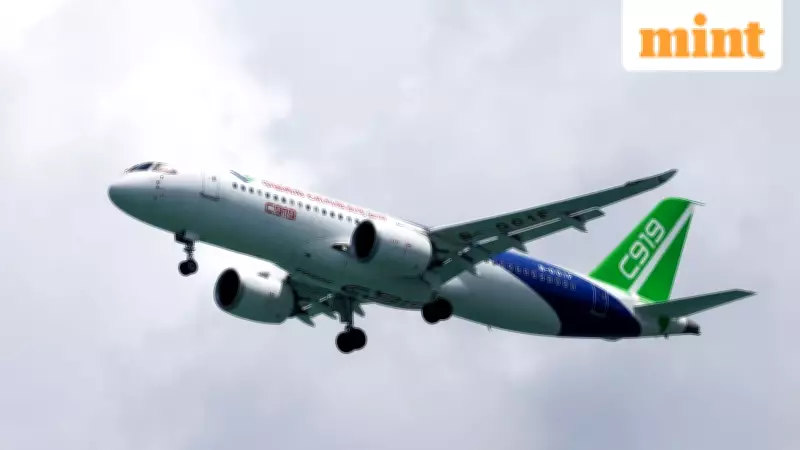
China's COMAC Intensifies Global Aviation Market Push, Aims to Rival Boeing and Airbus
China's state-backed aircraft manufacturer, COMAC (Commercial Aircraft Corporation of China), is rapidly accelerating its efforts to penetrate the global aviation market, positioning itself as a formidable long-term competitor to industry giants Boeing and Airbus. This strategic move comes as the company leverages its recent advancements and showcases its capabilities at international events like the Singapore Airshow.
COMAC's Milestone Achievements and International Debut
Since its C919 passenger jet made its inaugural flight outside China to Singapore nearly two years ago, COMAC has achieved significant progress. The Singapore Airshow, which commenced on Tuesday, serves as a pivotal platform for the Chinese planemaker to highlight its latest commercial jets and aviation technology. Exhibition halls feature detailed scale models, interactive mock cockpits, and immersive displays, underscoring COMAC's commitment to innovation and global outreach.
The C919 jet, specifically designed to compete with the Boeing 737 MAX and Airbus A320neo, is now targeting markets beyond China. In its own statements, COMAC is "setting sights on the Southeast Asian aviation market," a region recognized as the world's fastest-growing aviation hub. This expansion is timely, as airlines across the Asia-Pacific grapple with delivery delays and strained supply chains from both Boeing and Airbus, exacerbated by engine shortages and broader logistical bottlenecks.

Market Dynamics and the Need for Alternatives
The current aviation landscape is marked by uncertainty, with tariffs and trade tensions adding complexity to manufacturing and procurement strategies. This environment creates a unique opportunity for COMAC to present itself as a viable alternative. The company's fleet includes two key jets: the C919 and the ARJ21, recently rebranded as the C909.
- C919: This aircraft seats between 158 and 192 passengers, with a range of 4,075 to 5,555 kilometers. It boasts an advanced cockpit design, low noise levels, and cabin systems engineered to enhance passenger comfort.
- C909: Designed for versatility, it accommodates 78 to 97 passengers and operates efficiently on short, narrow runways. It excels in challenging conditions such as high temperatures, high altitudes, and crosswinds, with a range of 2,225 to 3,700 kilometers.
To date, COMAC has delivered over 200 aircraft, which are operational on approximately 800 routes and have transported more than 36 million passengers. Notably, countries like Laos, Indonesia, and Vietnam currently operate a quarter of these planes, with recent orders from Brunei's GallopAir and Cambodia planning to purchase nearly 20 aircraft.
Competitive Analysis: C919 vs. Airbus A320neo
While the Chinese government promotes the C919 as the future of aviation, the market it seeks to enter is highly competitive. In the short-to-medium-haul segment, the Airbus A320neo is a top performer. A comparison reveals:
- Dimensions: The C919 measures 38.9 meters in length and 11.95 meters in height, compared to the A320neo's 37.57 meters and 11.76 meters, respectively.
- Capacity: The C919 seats 158 to 192 passengers, while the A320neo accommodates 150 to 180.
- Range: A critical difference lies in range; the A320neo can fly over 2,000 kilometers farther than the standard C919, with even the extended-range version of COMAC's design unable to match its European counterpart.
Future Prospects and Certification Challenges
Beyond its Asia-Pacific expansion, COMAC is actively pursuing European certification for its C919. Regulators are conducting test flights, but the process is expected to be lengthy, with potential certification dates projected for 2028 or 2031. Currently, the company is not seeking certification from United States regulators, focusing instead on strengthening its position in other key markets.

As COMAC awaits European approval, it is ramping up production of the C919 jets. China's three largest airlines have each ordered 100 aircraft, and the company plans to deliver at least 28 planes this year, up from 15 in 2025. This production surge underscores COMAC's ambition to solidify its role as a major player in the global aviation industry, challenging the duopoly of Boeing and Airbus in the years to come.