

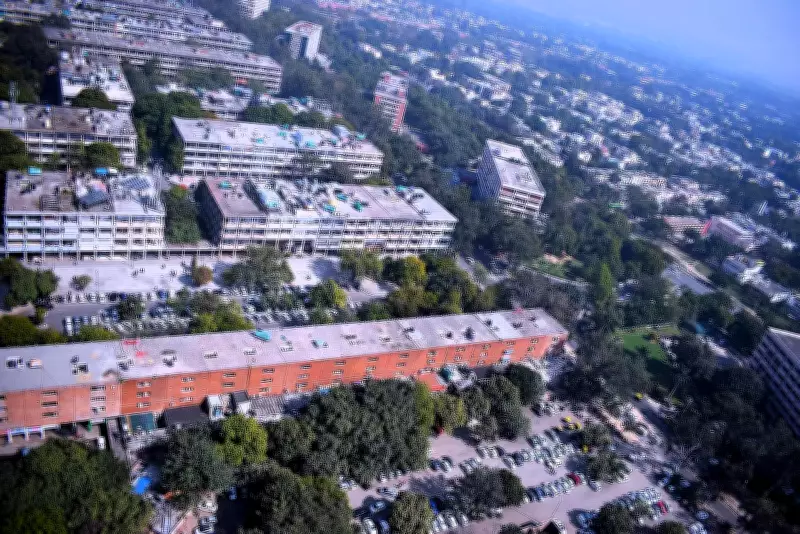
In a decisive move to safeguard the industrial character of Chandigarh, the city administration has announced that business-to-consumer (B2C) activities will not be permitted in Industrial Areas Phases I and II under the proposed amendments to the Chandigarh Master Plan 2031. This decision aligns with the recommendations of an expert committee chaired by the deputy commissioner and estate officer of the Union Territory, which was formed on the directions of the UT administrator to examine priority areas under the Deregulation agenda.
Maximizing Land Utilization with B2B Focus
The committee’s recommendations aim to optimize land use by allowing additional industrial and service sector activities in these zones, but strictly limited to business-to-business (B2B) operations. Direct customer-facing businesses will remain prohibited, ensuring that the industrial zones retain their original purpose. The committee’s report highlights that Chandigarh’s dedicated Industrial Areas (Phases I, II, and III) cover only 1,410 acres, approximately 4.8% of the city’s total area. This is at the lower end of international benchmarks, where global cities typically allocate 5% to 15% of urban land for industrial purposes. The committee noted that an ideal range of 7% to 8% is required for balanced urban development.
Addressing Erosion of Industrial Character
While Industrial Areas Phase I and II are fully developed with complete trunk infrastructure, the Conversion Policy of 2005 has led to a gradual shift of some plots toward commercial use, eroding their original industrial character. To counter this trend, the committee has recommended expanding permissible activities in these phases, including IT/ITES, warehousing, testing labs, and certain backend services, all while enforcing a strict ban on B2C operations. This approach is intended to preserve the industrial identity of these zones while adapting to modern economic needs.

Mixed Land Use for Industrial Area Phase III
In contrast, the committee has proposed a significant shift for Industrial Area Phase III. Out of the 153-acre zone, 60 acres currently earmarked for warehousing and related uses will be developed as a Mixed Land Use Area, incorporating residential, commercial, institutional, cultural, and recreational components. This move aligns with the Centre’s Deregulation 1.0 reforms while preserving the overall industrial identity of the city. The committee emphasized that Chandigarh’s neighbourhood planning concept already provides ample commercial spaces in every sector, making dedicated industrial zones essential for maintaining economic balance.
Permitted Activities Under Existing Policy
Chandigarh notified its Industrial Policy 2015 and subsequently issued an amendment in 2019. As per Chapter 5 of the policy, activities relating to IT/electronics/software/hardware, ITES units, and technology and research units were allowed. The 2019 amendment further permitted the following activities:
- Booster stations with respect to IT/ITES
- Warehousing facilities for general items, industrial goods, white goods, and medical/surgical goods
- All types of authorized service centres related to industry, strictly for B2B operations
- Engineering/industrial/structural testing labs
- Audio-visual recording studios for social media (for photo labs/film labs only)
- Documentation centres for industrial designing and printing
- CAD/CAM design workshops (for pattern-like drawing for industries only, Photoshop)
- No security management services (for backend services and equipment store only)
- Display by manufacturers of furniture, electrical goods, auto parts, welding equipment, and apparels as demonstration from the front portion of the building
- Base kitchen for restaurants and outdoor caterers, without opening a dine-in/takeaway/online restaurant, subject to pollution control and environmental norms
Overall, no activity involving direct service to customers is allowed as per the Chandigarh Industrial Policy 2015, Amendment 2019, and Chandigarh Master Plan 2031. This strict regulation ensures that the industrial areas remain focused on production and B2B services, supporting the city’s economic balance without compromising its planned urban structure.






